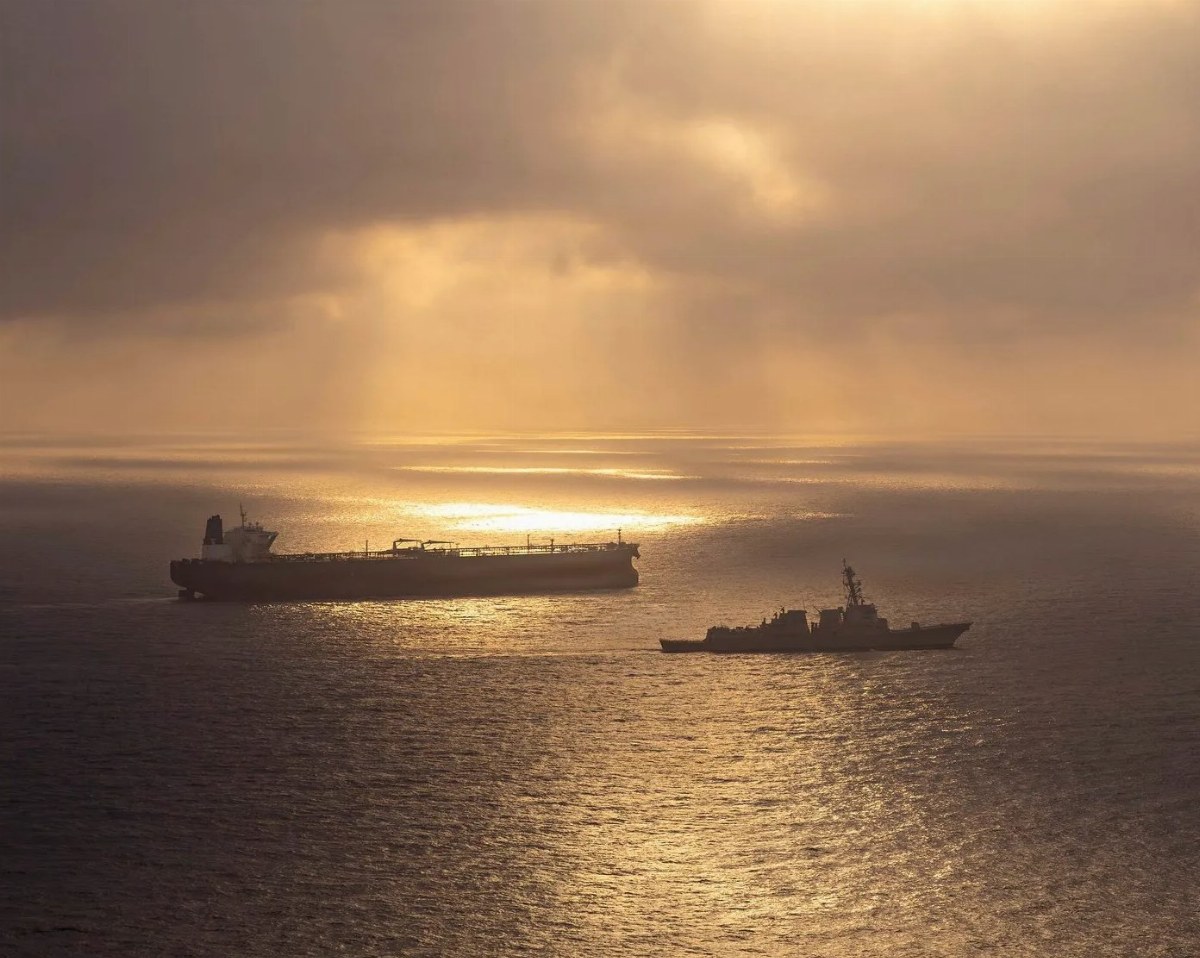
Shipping companies are increasingly avoiding the U.S.-monitored transit route through the Strait of Hormuz, following a series of Iranian attacks that have raised safety concerns, according to seven sources in maritime security and transportation provided to Reuters.
For decades, vessels have safely navigated in and out of the Persian Gulf using a set of designated lanes established by the UN maritime agency in 1968, known as the “Traffic Separation Scheme.” However, since the onset of the war between the U.S. and Iran on February 28, Iranian forces have mined areas in this zone, forcing ships to utilize two improvised routes located near either the Iranian or Omani coast.
Support for Gulf Energy Exports
In June, it was reported that the U.S. military aided ships in traversing the strait as part of operations involving secret transfers of oil from vessel to vessel to maintain the flow of energy exports from the Gulf. The U.S. military utilized aerial and underwater drones, as well as helicopters, to guide tankers.
This U.S.-supported initiative enabled the export of tens of millions of barrels of oil, helping to mitigate the impact on energy prices during the largest supply disruption in the history of oil and gas.
Nonetheless, carriers now deem the route on the Omani side of the strait increasingly perilous after a wave of attacks on vessels.
On Tuesday, the Iranian Revolutionary Guard Corps (IRGC) claimed responsibility for attacks on two supertankers in the United Arab Emirates.
Since July 7, at least five vessels have been attacked, including three supertankers, an LNG carrier, and a cargo ship, in Omani territorial waters that fell under the U.S. protection program, as analyzed through incidents reported by the UN maritime agency.
It remains unclear if all vessels were navigating under the American protection program, sources cited by the international news agency stated.
“The U.S. does not seem to have control over the situation,” said a maritime sector source who added that their firm decided against navigating through the strait due to crew safety concerns and deteriorating security conditions. “The fact that Iran continues to target vessels on the Omani route indicates that the solution proposed by the Trump administration to keep maritime traffic flowing is unlikely to succeed,” said Torbjorn Solvedt, a senior Middle East analyst at risk intelligence firm Verisk Maplecroft.
Olivia Wales, spokesperson for the White House, stated that the Strait of Hormuz remains open despite recent attacks on commercial vessels. “The Strait of Hormuz is open, and oil is flowing. Iran is committing acts of international terrorism by firing on peaceful commercial ships and targeting innocent civilians, and the United States is responding firmly,” Wales remarked.
Escalation Amid U.S. Naval Blockade Reimposition
A U.S. defense official, who spoke on condition of anonymity, reported that over 100 vessels coordinated directly with the U.S. military to transit the strait in the past week, while more than 300 have passed through the region overall, indicating that U.S.-led efforts are bearing fruit, even if transit volumes remain below pre-war levels.
Tehran threatened on Wednesday to further block regional energy exports after the U.S. reinstated a naval blockade on Iranian ports, with both parties launching new attacks in the struggle for control of the strategic strait.
Tehran hinted at potentially calling on its Houthi allies in Yemen to block the Bab el-Mandeb strait leading to the Red Sea, opening a new front against Washington and jeopardizing two of the world’s most vital maritime arteries.
Nine LNG tankers operated by Greek companies that navigated the Persian Gulf via the Strait of Hormuz last week were stranded within the strait due to security issues, another maritime source reported.
Additionally, two oil tankers were attacked since July 7 in open waters outside the Strait of Hormuz.
Strait Open, Claims Trump
On Tuesday, U.S. President Donald Trump stated in a post on Truth Social that the Strait of Hormuz “is open to ALL vessels except Iranian ones.”
On the same day, the U.S. reinstated a blockade on maritime transport linked to Iran.
Last week, the U.S.-led Maritime Information Sharing Center raised the risk level for vessels in the strait from “substantial” to “severe,” just below the highest level of “critical.” This increase in risk level followed attacks on three tankers.
In a note issued by the U.S. Navy after launching the coordinated U.S. plan last month, companies were informed that efforts would be made to alert ship crews, “but real-time communication of threats to ships may not be possible.”
The U.S. military has not provided sufficient clarifications regarding the risks facing vessels navigating the Omani route, five of the sources cited by Reuters stated.
“They have stated that the Strait of Hormuz ‘is not closed’ and remains available for use,” said a maritime security source. “This makes operators nervous and uncertain. While everyone must make their own risk assessments, it is clear that it is not safe, so why say it is open?”
The Greek maritime security company Diaplous stated on Tuesday that the threat level remains high and advised shipping companies to suspend voyages until Saturday. Another Greek company in the same sector, MARISKS, also commented on Tuesday, stating: “At this moment, there is no guarantee that transit through the Strait of Hormuz can be conducted with an acceptable level of safety.”