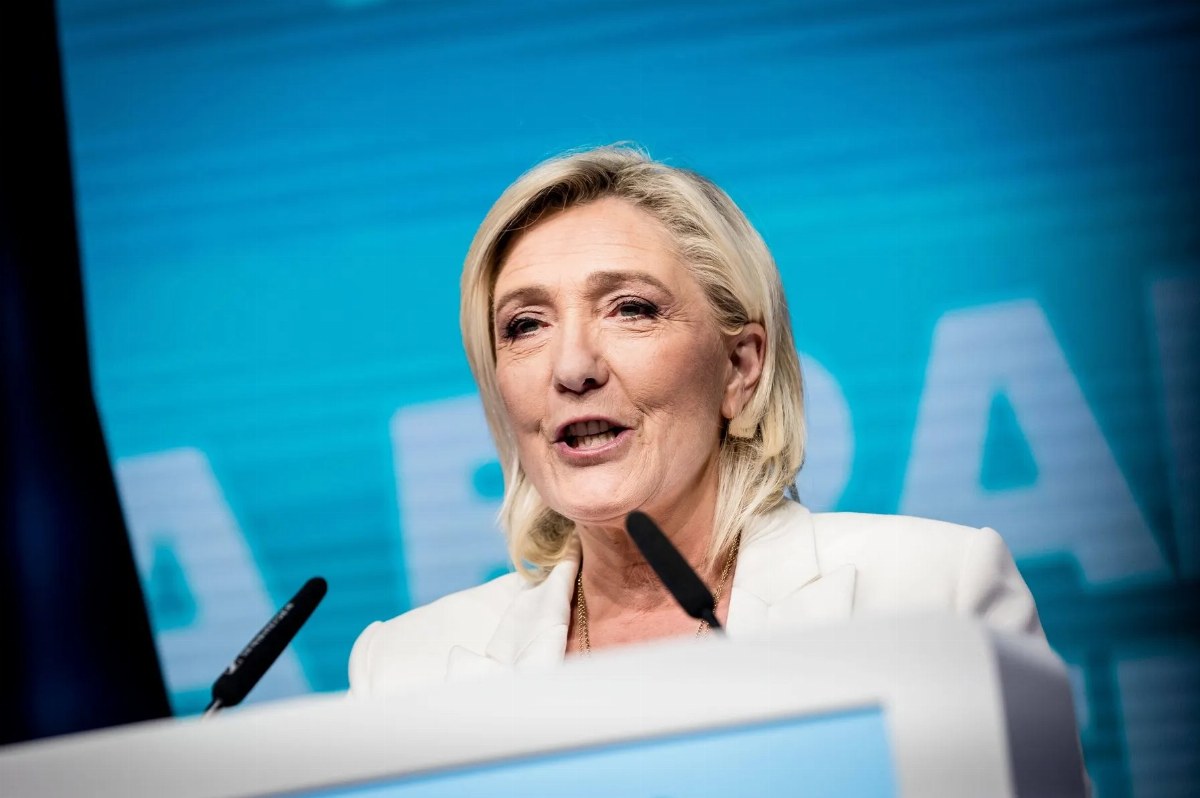
Marine Le Pen, leader of the National Rally (RN) party, was sentenced on Tuesday to three years in prison, two of which are suspended under electronic surveillance. Additionally, she received a 45-month prohibition from holding public office, with 30 of those months suspended, due to an embezzlement case involving European Parliament funds, reported by Reuters and AFP. The court’s decision theoretically opens the door for her to run in the 2027 presidential elections, which had previously seemed impossible.
On the same day, the French court ruled to reduce the period during which Le Pen cannot hold public office, thus allowing her a potential candidacy for the 2027 presidential elections.
However, the court also mandated that Le Pen must serve a three-year prison sentence, during which she must wear an electronic ankle bracelet for one year. This condition poses significant challenges for her presidential campaign, both politically and logistically.
Complications arise further if Le Pen opts not to run; the party has indicated it would support Jordan Bardella, Le Pen’s younger protégé, as a potential candidate, which might lead to tensions within the party.
Background of the Case and Le Pen’s Conviction
The ruling concerns an old case regarding the misappropriation of European Parliament funds, which can still be appealed by both Le Pen and the prosecution at the highest court in France.
In the initial ruling in March 2025, judges found that Le Pen knowingly operated a scheme where party employees in Paris posed as EU parliamentary assistants in Brussels and Strasbourg to be paid from EU funds. At that time, the party was facing chronic funding shortages.
Will Le Pen Campaign with an Ankle Bracelet?
A critical aspect of the ruling is that the ban on holding public office, initially set for five years, was declared effective immediately and was not suspended during the appeal. This has drawn Le Pen’s criticism, who claims it is a politically motivated sentence.
In recent days, Le Pen anticipated a possible reduction in the ban but also suggested that running for president while under electronic monitoring would be impossible. “A candidate needs total freedom of movement,” she stated before the Tuesday ruling. “Can you imagine having to ask for permission every time you want to attend a meeting or go to the market?”
Le Pen refrained from making statements after the trial but is expected to give a televised interview on Tuesday evening, potentially revealing her political future.
Le Pen and Bardella
The initial ruling has propelled 30-year-old Jordan Bardella, Le Pen’s protégé and the RN’s “future,” into the position of a potential presidential candidate, with polls suggesting he might win the office.
Bardella’s rapid rise in party leadership and now as a prospective candidate has fueled internal tensions regarding the RN’s direction, particularly concerning economic policy, according to party sources.
Having recently recruited a personal advisor from a libertarian billionaire-controlled investment fund, Bardella supports a more market-oriented policy than Le Pen. He has also expressed his own views on pension reform, raising questions among party members about how much he may diverge from the platform Le Pen has championed until now.
Polls Indicate Bardella Ahead of Le Pen
Polls forecast that both Le Pen and Bardella would easily win the first round of the 2027 elections, qualifying for the second round.
An Ifop-Fiducial poll conducted for LCI and Le Figaro indicated that Bardella exceeds Le Pen with up to 37% of voter intentions compared to her 32%. “This differentiation between the two represents a true turning point,” noted Frederic Dabi from IFOP on LCI, adding that Bardella enjoys greater popularity among private sector employees, entrepreneurs, and voters aged between 50 and 64.
The polls also suggest Bardella would more easily win a second round against a leftist candidate than against a centrist rival.
EU Assistants Who Never Stepped Foot in Parliament
The case that complicated the lives of France’s far-right involves accusations against Le Pen, the RN, and several party politicians for siphoning over €3 million from European Parliament funds to pay party staff in France who never worked in Brussels or Strasbourg.
The defendants claimed the money was used legitimately, arguing that the prosecutors defined the role of a parliamentary assistant too restrictively.
The European Parliament estimated the damages in Le Pen’s case at €3.5 million, according to the institution’s lawyer, Patrick Maisonneuve. The RN has already reimbursed €1 million, which they insist is not an admission of guilt.
Members of the European Parliament are allocated funds to cover expenses, including those of their assistants, but must not use them for cross-party activities.
RN officials contended that the issue stems from a different understanding of the assistant’s role compared to the European Parliament. However, prosecutors argued that the reality was more complex, stating that assistants were actually working exclusively for the party outside Parliament.
Moreover, prosecutors claimed that many of these assistants were unable to describe their daily activities, and some had never even met their supposed MEP boss or set foot in the parliament building.
A bodyguard, a secretary, Le Pen’s chief of staff, and a graphic designer were among those employed under false pretenses.
Several witnesses testified regarding a 2014 meeting where a clear structure for creating “fake jobs” was discussed.