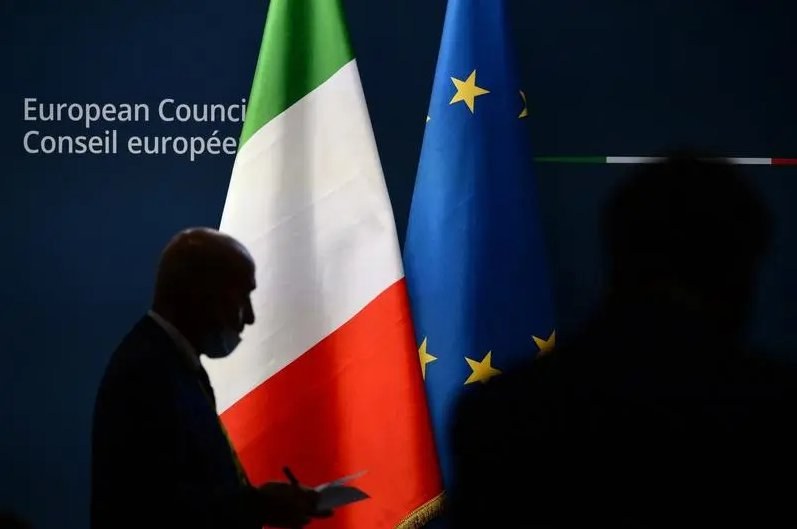
Starting July 1, Ireland is set to assume the presidency of the Council of the European Union, prompting questions among lawmakers and security experts about whether one of the EU’s weakest military powers can effectively protect European summits and critical infrastructure from drone attacks and cyber threats, according to reports.
A visit from Ukrainian President Volodymyr Zelensky to Dublin last December highlighted these challenges. During that trip, unidentified drones were spotted near the flight path of Zelensky’s aircraft, despite the presence of an Irish naval vessel assigned to secure the area.
This incident “demonstrated that high-level political visits expose Ireland’s vulnerabilities,” remarked Barry Andrews, a member of the European Parliament from the Renew Europe group and author of a key report on Ireland’s defense. “With the presidency, you become a target,” he warned.
Over its six-month mandate, Ireland will coordinate political negotiations among EU countries, overseeing major summits, including the meeting of the European Political Community, and 22 informal ministerial meetings. Dublin must ensure the safety of visiting leaders, delegations, and vulnerable infrastructure.
This presents significant demands on a country that has relied on geographical isolation and military neutrality for decades as the cornerstones of its security policy. Ireland’s defense spending is the lowest in the EU—just €1.35 billion, or 0.2% of GDP in 2025, compared to the EU average of 2.1% of GDP.
The Irish presidency comes at a time when European governments are increasingly alarmed by cyberattacks, disinformation, and sabotage linked to Russia’s war against Ukraine. Security experts warn that the EU presidency could make Ireland a target for those looking to undermine both Dublin and the European Union.
No country in Europe is exempt from Russia’s list of targets, cautioned Kaja Kallas, head of EU diplomacy, during her visit to Dublin on June 9.
Vulnerabilities of a Nation Lacking Air Forces
Lawmakers have long warned about Ireland’s vulnerabilities, but the country has now reached a “turning point,” noted Irish Senator Gerard Craughwell, an independent who has served in both the British and Irish armies. He stated that successive governments have neglected national defense and the protection of submarine data cables, despite three-quarters of such cables in the Northern Hemisphere passing near or through Irish territorial waters.
The Irish navy operates eight ships and aims to have four available for operations on a rotational basis. It lacks fighter jets and only last year awarded a contract for its first military-grade radar.
Nonetheless, Dublin insists it is ready for its presidency.
It allocated €1.5 billion for defense in its current budget, launched its first maritime security strategy, and announced a five-year plan to spend €1.7 billion on improving military equipment, capabilities, and facilities, aiming to deter drones and potential Russian sabotage of submarine cables.
Additionally, it updated a security agreement with the United Kingdom that includes cooperation on drone countermeasures and maritime security.
We are implementing elements of that UK agreement to ensure that if British forces are required to utilize drone countering technology during Ireland’s EU presidency, that capability will be available, stated Defense Minister Helen McEntee in late May in Brussels.
Contradictory Priorities
In its political agenda for the presidency, published on June 16, Dublin states it will promote various defense initiatives, including the European Security Strategy and the EU’s Common Security and Defense Policy.
The document also notes that supporting Ukraine will be a “defining priority for the presidency.”
We will strive to ensure Ukraine has what it needs to defend itself against Russian aggression and will support Ukraine in strengthening its capabilities, coordinating with the EU and working with partners, the document states.
However, unlike most EU nations, Ireland has limited its support to Kyiv to non-lethal military assistance and humanitarian aid.
Defense will be one of our main priorities, said Thomas Byrne, Minister of State for European Affairs and Defense. He indicated that Ireland must lead EU defense negotiations as an “impartial mediator,” representing the collective interests of member states, most of which are NATO members, rather than as a neutral country.
When asked whether Ireland’s neutrality poses a challenge to EU objectives in Ukraine, EU’s chief diplomat Kaja Kallas said in a televised interview in Dublin on June 9: “Militarily neutral, yes, but not indifferent to what is happening.”
In a press statement the same day, Defense Minister Helen McEntee reiterated, “Ireland recognizes the importance of enhancing our own security and defense capabilities while significantly contributing to the collective security of our European partners.”
The Cyber Challenge
The challenge is also digital. Ireland hosts operations for several major U.S. tech companies, including Meta. However, the country does not have an autonomous signals intelligence service—a national security agency responsible for intercepting and analyzing foreign electronic communications, as noted by Edward Burke, an assistant professor of war history at University College Dublin.
While the country has a National Cyber Security Centre, the army and police maintain their own cyber and intelligence capabilities. However, Burke argues that these institutions do not constitute a fully developed signals intelligence service comparable to those found elsewhere in Europe, such as the UK’s GCHQ.
Richard Browne, director of the National Cyber Security Centre, recently warned that cyberattacks during Ireland’s presidency are likely to focus on damaging the reputation of both the EU and the host country.
We rely entirely on this notion of neutrality, said Craughwell. We claim to be neutral, and therefore cannot rely on support from our NATO neighbors. But in practice, we do this all the time, he emphasized.