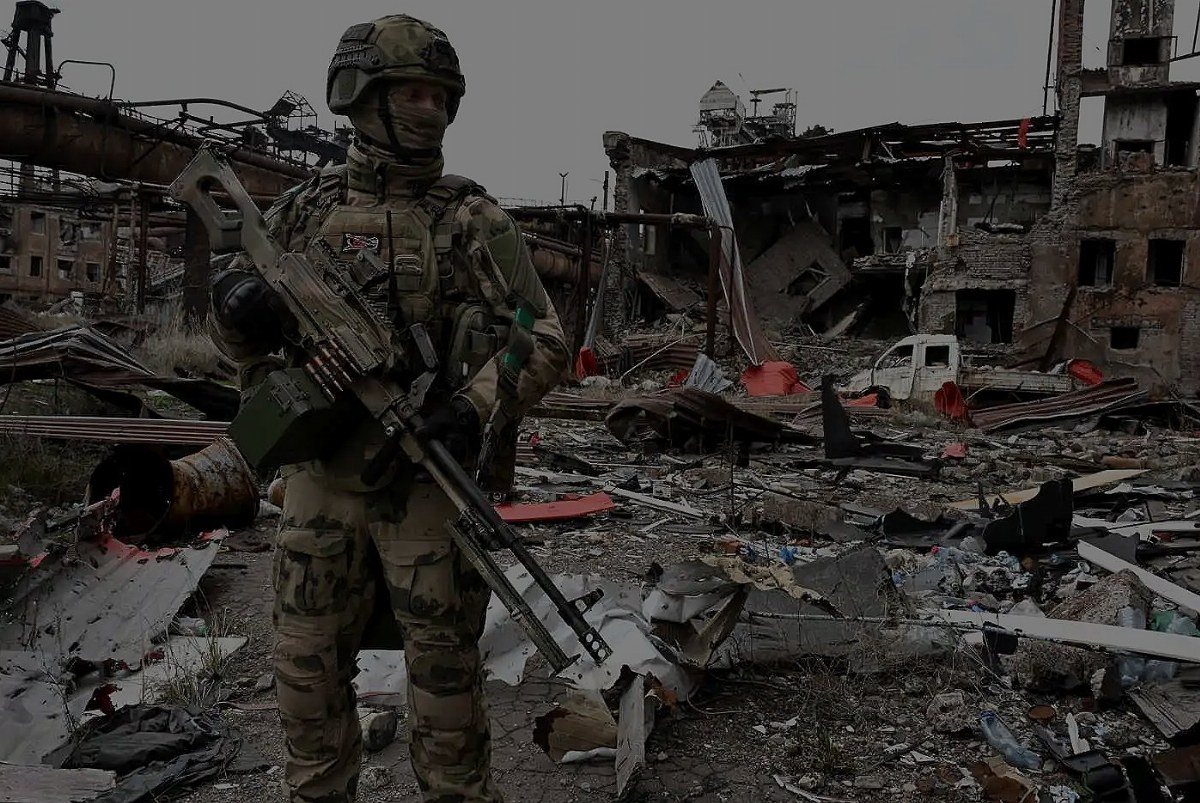
Colonel Arsen Dmitrik, the chief of staff of the Azov First Corps, stated, “When the time comes, we must be ready. I believe we will reclaim it. It’s just a matter of time,” in an interview with Reuters. Four years after the Azov Regiment of Ukraine surrendered the last stronghold of the devastated city of Mariupol to Russian forces, the rebuilt unit is focused on punishing Moscow.
The defeat in May 2022, which resulted in the deaths or capture of hundreds of fighters, transformed the Azov Regiment into a symbol of resistance in Ukraine and paved the way for its resurgence as a larger and stronger force. The unit is now redirecting its attention to its hometown by the Sea of Azov.
Drones Strike Key Port
Last week, drones belonging to the Azov First Corps targeted the strategic port of Mariupol, executing an operation that targeted electrical substations, repair facilities, and a sanctioned vessel, leading to a power outage, according to the Ukrainian military.
This attack is part of a broader campaign by Ukraine to target Russian military logistics deep behind the front lines, aiming to deplete Moscow’s war machine and alter the war’s dynamics in favor of Kyiv. Colonel Dmitrik mentioned that dozens of similar operations are planned.
He acknowledged that driving Russian forces out of Mariupol, located 120 kilometers behind enemy lines, is a “long-term fight.” “Even if it takes 20 years, we will spend 20 years planning, waiting, and preparing,” he asserted.
Months of Attacks
The strike on the port was conducted with the assistance of Ukrainian drone forces and the SBU security service, occurring just a few kilometers from the plant where Azov fighters and other troops surrendered after a three-month siege. This attack followed months of operations targeting critical supply routes in Russian-occupied areas of eastern Donetsk, including Mariupol, as part of a systematic effort to disrupt Russian supply lines to the front.
Images shared by the army corps showcase their operations: in a video from April 16, drones are seen hovering over vast fields and long highways around Donetsk before striking military vehicles.
Azov Patrols Its Hometown
Another post from May 8 features drone footage of central Mariupol and the heavily damaged Azovstal steel plant, where Ukrainian forces mounted their last stand in 2022. The post reads, “Azov is already patrolling its hometown, Mariupol. From the sky, for now.” Today, the city, which had a pre-war population of over 400,000, hosts new infrastructure projects as part of Russia’s efforts to consolidate control over occupied southern Ukraine, according to a Reuters investigation earlier this year.
In January, Ukraine’s foreign intelligence service reported that Russia is expanding the maritime port of Mariupol, making it a key node for its economy while prioritizing prestige construction projects at the expense of ordinary residents.
Goals of Ukraine’s Campaign
As part of Ukraine’s medium-range strike campaign, the primary objective of the Azov Corps is to block Russian shipments—particularly fuel—coming from Russia through key nodes such as Mariupol and Donetsk, an officer responsible for drone operations stated. The constant movement of supply trucks on vast, open roads makes them difficult to defend, he noted: “There is no way to hide a tanker truck carrying fuel… It is simply impossible.”
The targeted routes include the M14 highway connecting Mariupol to the Russian city of Rostov to the east, the H20 road heading north from Mariupol towards Donetsk, and a bypass road around Donetsk.
Ukrainian forces are also intensifying attacks on logistical infrastructure along the Russian-occupied “land bridge” connecting Russia to Crimea, resulting in a fuel crisis in the peninsula.
Isolating Crimea
In an interview with Reuters last week, the chief commander of Ukrainian drone forces, Robert Brovdi, committed to “isolating Crimea in the near future” by ramping up attacks on the key P-280 highway. Azov’s attacks are described as “more cumulative than decisive” by Franz-Stefan Gady, an expert at the Center for a New American Security in Vienna, as they force the Russian army to spread its vehicles over longer detours and rely on more nighttime movements.
Over time, he added, this “diminishes the pace of offensives that Russia can generate” on the battlefield. Russian forces are on the verge of capturing the city of Kostiantinivka, the southern anchor point of the so-called “fortress belt” in the Donetsk region.
Russian drones are also striking Ukrainian logistics heavily on the battlefield. However, Russia’s overall advance has considerably slowed in recent months, with Ukrainian forces regaining ground in certain areas of the front.
Rob Lee, a senior researcher at the Foreign Policy Research Institute in the U.S., indicated that Ukraine’s medium-range attacks could “test the conditions” necessary for Ukraine—and eventually Azov—to shift to an offensive stance.
“This is one of the big stories of this year: how will Russia cope with Ukraine’s medium-range attack campaign?” he said.
Azov Uses Enhanced American Drone
One of Azov’s primary weapons is the Hornet drone, enhanced with AI, produced by the American defense technology firm Perennial Autonomy, led by former Google CEO Eric Schmidt. Ukrainian operators have modified it by installing Starlink internet terminals to extend its initial range of 100 km, showcasing the unit’s technical expertise.
“Azov has been responsible for much of the improvements made to the Hornet model,” he noted.
Release of Last Fighters
By launching waves of drones along the routes leading to and from Mariupol, the army corps aims for a key objective, according to Chief of Staff Dmitrik: hastening the moment that would bring an end to hostilities, which he hopes would lead to the release of over 700 of its fighters from Russian prisons. Kyiv has made the “all for all” prisoner exchange a central component of any peace agreement. Frequent rallies under the slogan “Free Azov” take place in Kyiv and other major cities, reflecting the unit’s status in Ukrainian society.
The commander of the army corps, Denis Prokopenko, stated last month on X that the release of his comrades was “my personal priority and a matter of honor.”
Nationalism in Azov
Accused in Russia of Nazism and terrorism and viewed warily in other parts of the world due to its origins as a nationalist militia and links to the far-right, today’s Azov, as reported by Reuters, is far from the improvised volunteer battalion that liberated Mariupol from pro-Russian separatists in 2014 or the fragmented regiment of 2022. Officially part of the National Guard, it is now considered a top-tier fighting force and one of Ukraine’s “most advanced formations,” especially in drone warfare, according to defense analyst Olena Kryzhanivska from the Canadian Global Affairs Institute.
Last year, the unit expanded, becoming a corps that includes six brigades, a drone regiment, and a special purpose unit, now numbering tens of thousands of soldiers, according to its own statements.