
Article by Maria Olteanu – Published on Sunday, 14 June 2026, 07:56 / Updated on Sunday, 14 June 2026 07:56
Journalists who tried to interact in Spanish, the second most spoken language in the United States, before the match between Brazil and Morocco, were warned by FIFA, which has a clear position and does not accept dialogues to be conducted in this language.
The press conference ahead of Brazil's 1-1 draw with Morocco in New Jersey sparked an unexpected controversy on social media that only came to light after the Group C game ended.
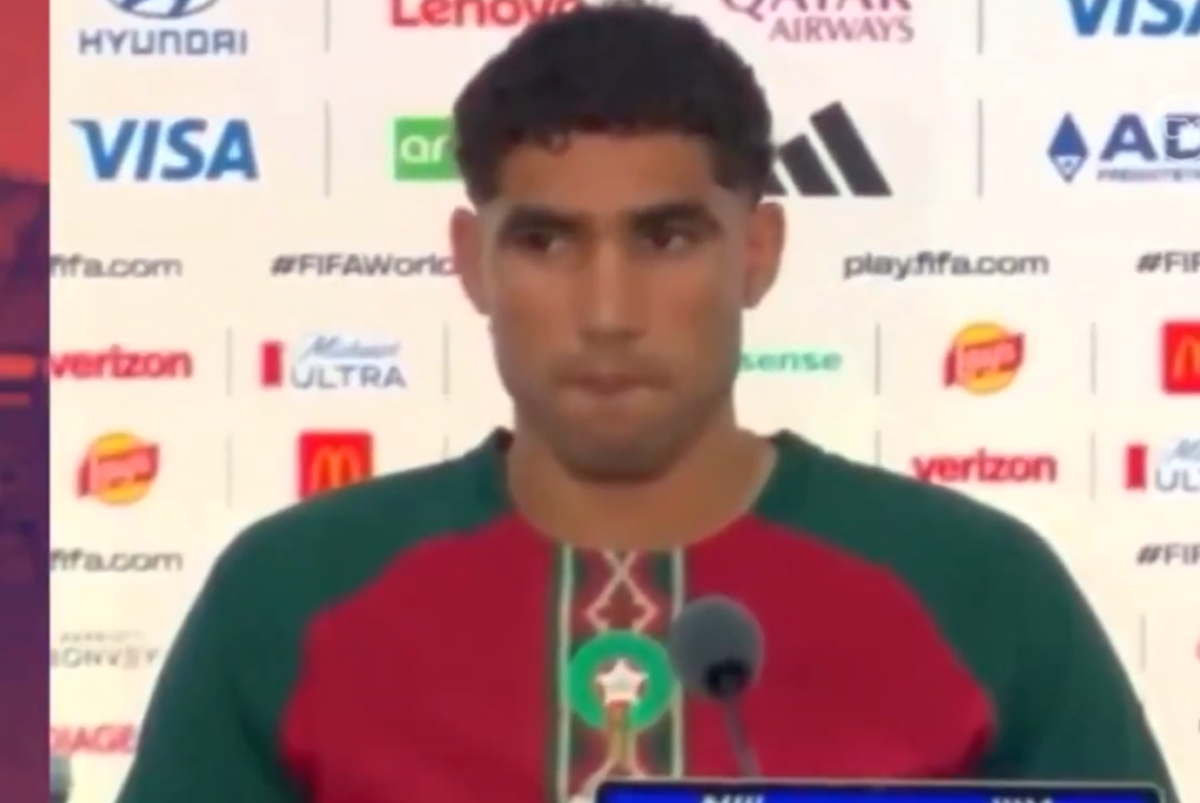
Under the viral slogan “FIFA does not allow questions in Spanish in the United States”, a video went viral in which a Mexican journalist was warned by a FIFA moderator about an alleged ban: he could not ask questions in Spanish, the language of one of the three host countries, Mexico, and the second most spoken in the US, to Spain-born Moroccan defender Achraf Hakimi.
FIFA does not want to hear Spanish at World Cup conferences
When TV Azteca Deportes journalist Rodrigo Ornelas took the microphone to address Hakimi in Spanish, the FIFA moderator cut off the question, which was meant to be just a greeting to the country's fans ahead of the match against Brazil, and offered a double clarification, according to elpais.com.
🇺🇸🇲🇽 | FIFA forbids journalists to ask in Spanish to players from Brazil and Morocco despite being the second most spoken mother tongue in the world over English.
La FIFA authorized to ask questions in French, Arabic, Portuguese and English, something that involved a… pic.twitter.com/67K1XRTTcA
— ʜᴇʀQʟᴇs (@herqles_es) June 14, 2026
On one hand, the media official reminded the Paris Saint-Germain star that he could only respond “in the language they mentioned.” Although not specified, it is assumed that Hakimi was referring to Arabic, the official language of Morocco, and French, a language widely spoken in Morocco due to its colonial past and which Hakimi has mastered while playing in France. On the other hand, the moderator also explained to Ornelas that questions in Spanish are not allowed.
At all press conferences, FIFA allows questions to be asked in English and in the languages of the two opposing teams. Moreover, each federation sends a list of the languages it deems necessary, hence the translator's remark to Hakimi that Spanish had not been requested.
At the pre-Brazil-Morocco conference, there were translators in the press room at MetLife for English, Portuguese, Italian, at the request of Brazil, for Carlo Ancelotti, Arabic and French, that's five languages, but not Spanish.
-
FIFA argues that it cannot ensure translators are available for, say, a Chinese, Japanese or Egyptian journalist, or any other country, to ask questions in their native language. This provision ignores the fact that Mexico is one of the organizing countries and that, according to data from specialized websites, 57 million people speak Spanish in the United States;
Hakimi tried to save the situation but was not allowed
Morocco captain Hakimi, who was born and raised in Madrid, tried to resolve the situation using his perfect Spanish, but the FIFA official explained the reason for the ban: “We can't do that because of the translations,” he said, referring to the fact that they didn't have a Spanish interpreter, not so Hakimi could understand the question, but so someone could translate the Mexican journalist's question and then the Moroccan's eventual answer for the rest of the reporters and viewers.
Graciously, the polyglot Hakimi said he could also answer in English, but FIFA's translator reminded him of the first point: they didn't have the staff to translate the question from Spanish to English. “If we start with this…” he retorted, suggesting that if he made an exception, the other journalists would continue in their native languages.
Finally, with the agreement of Hakimi, who relayed “I understand, I understand”, referring to Spanish, the journalist who started the situation asked him the question in Castilian, and Hakimi asked the moderator in which language he should answer. When answered “English”, the Moroccan complied and spoke in English: “I love your country, I've been there before”, adding other references about the Brazil match.
Vinicius, also caught in the middle not allowed to speak Spanish
The Brazil-Morocco match press conference had another similar moment, but it didn't go viral. A Spanish journalist, DAZN's Sergio Quirante, started to ask Brazilian Vinicius a question in English, but the Real Madrid striker, confused by the language used, interrupted him and asked him to speak to him in Spanish.
Journalist Pilar Suárez, a contributor to the Marca newspaper, was the one who reported the controversy on the X social network (formerly Twitter). The reporter, who was covering the sports event, denounced the fact that the organizers of the tournament forbade asking questions in Spanish to Vinícius, who is Brazilian, and Hakimi, who is Moroccan but has played in Spanish football and has lived in Spain for some time. “Honestly, it's surreal,” the journalist wrote on the social network, attaching a video from the conference, which sparked outrage among readers.
In the video, an audio message can be heard warning the journalists. “Questions in English only, please,” says a female voice echoing through the hall. “Any question in Spanish will be cut off,” she warns. The outrage of users on social networks was not long in coming.
“Vinícius speaks Spanish, Hakimi speaks Spanish. We are in the United States, where there are millions of Spanish speakers. And you can't ask questions in Spanish? Absurd,” one user criticized. “What a shame,” wrote another.
Another journalist present at the event, Paco Villalba, also denounced the situation. “Surreal press conference I just attended with Hakimi and Vinícius in DC. First they tell us that Spanish questions are not allowed. Then that only two questions will be allowed each…and to make it complete, ONLY ONE QUESTION PER PLAYER!!,” he posted, irritated, on the X network. “I don't understand anything. Honestly,” he concluded.
-
The situation is all the more surprising since Spanish is the second most spoken language in the United States, with 60 million Spanish speakers. The US is actually the second most Spanish-speaking nation in the world, after Mexico. In Washington DC, the capital where the ban took place, 11% of the population is Hispanic, most of whom speak Spanish.


