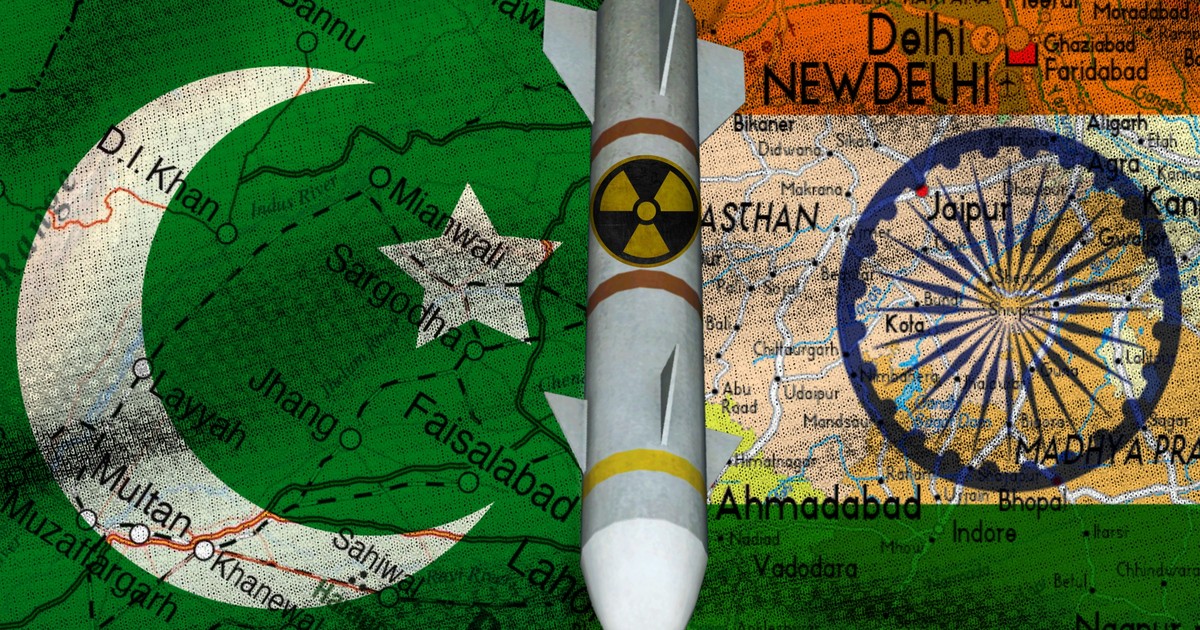
The nuclear race in Asia is gaining momentum. India and China are increasing their arsenals

What exactly does the term “deployed” mean? In practice, the point is that warheads are no longer kept in warehouses separately from missiles or ships, as was the case before. Instead, they were most likely mounted on carriers and placed on standby, most likely aboard Arihant-class nuclear submarines.
India has two such ships in service since 2024: INS Arighat and INS Aridhaman, which patrol the oceans with ballistic missiles capable of carrying nuclear warheads. Thanks to this, India gains the so-called second-strike capability, i.e. the ability to retaliate even after the enemy destroys their land or air forces. This is a classic element of modern nuclear deterrence, which is intended to deter a potential aggressor from any thoughts of attack.
30 new warheads in a year
The total Indian arsenal increased to 190 warheads during the year, 10 more than in 2025. Of these, 12 are already in operational condition and the remaining 178 are still in storage. SIPRI emphasizes that India continues to modernize its weapons delivery systems, including long-range missiles. It is no longer an arsenal directed solely against Pakistan. Delhi is increasingly focusing on weapons capable of reaching any point in the territory of China, the largest and most dynamically developing rival in the region.
- Read also: SIPRI Director: Arms control has failed. The expansion of nuclear weapons in the world is now unlimited [WYWIAD]
According to SIPRI estimates from early 2026, China currently has approximately 620 nuclear warheads. This is the fastest growing number of all nuclear states. In just one year, the arsenal increased by 20 warheads. From this pool, 34 warheads are already operationally deployed, i.e. ready for immediate use on intercontinental missiles, submarines or strategic bombers.
Beijing is modernizing not only the number but also the quality of its systems. It introduces new global-range DF-41 ballistic missiles, JL-3 submarine-launched missiles and the H-20 stealth bomber. As a result, China's arsenal is becoming more flexible and capable of striking not only the United States, but also targets across Asia.
Pakistan maintains its nuclear arsenal at a stable level of 170 warheads and, unlike India and China, does not deploy them operationally in peacetime.
The Asian nuclear race
The history of the nuclear race in South and East Asia dates back to the 1960s and is inextricably linked to border conflicts and competition for regional domination. China was the first in the region to embark on the nuclear path. Their first nuclear test took place in 1964 at the Lop Nor test site in Xinjiang province. The decision to build nuclear weapons was made immediately after the humiliating defeat in the war with India in 1962.
Over the following decades, China adhered to the doctrine of “minimal deterrence” – that is, having a small but credible number of warheads, just enough to inflict unacceptable losses on the aggressor. Only since around 2010, in the face of growing tensions with the United States and India, has Beijing entered a phase of dynamic modernization, building new silos, submarines and strategic bombers.
- Read also: Poland is arming itself massively. The question about nuclear weapons arises by itself [OPINIA]
India went down its own nuclear path a little later. In 1974, they conducted the first test, codenamed “Smiling Buddha”, officially called a “peaceful nuclear explosion”. The real breakthrough came only in May 1998, when India performed a series of five nuclear tests as part of Operation Shakti in the Thar Desert in Rajasthan. These tests were a direct response to both China's nuclear capabilities and the growing threat from Pakistan.
Pakistan, as the youngest member of the “nuclear club”, joined it in response to Indian tests in 1998. Already in 1972, immediately after the war with India that led to the secession of Bangladesh, Prime Minister Zulfiqar Ali Bhutto ordered scientists to launch a secret nuclear program. At that time, Islamabad benefited from technical assistance and materials from China and from illegal technology transfer by Pakistani scientist Abdul Qadeer Khan.
In May 1998, just two weeks after India's tests, Pakistan conducted its own tests, becoming the seventh nuclear-weapon state in the world.
Since 1998, the entire region has been living in the shadow of the so-called strategic chain. Pakistan is developing its arsenal mainly to counter India's conventional superiority. India, in turn, is modernizing its potential primarily as a response to China's growing capabilities. Beijing is looking at India, but also at the United States and Russia. This mutual influence creates a domino effect in which any strengthening of one country forces a response from the others. As a result, South and East Asia has become the most dynamic area of nuclear development in the world, although none of these countries is openly pursuing an arms race.
Border conflicts
The most important reason for the dynamic development of nuclear arsenals in South and East Asia is the decades-long territorial conflict between India and China and India and Pakistan. India has been facing the challenge of the so-called “two fronts”. At the same time, they must take into account the threat from Pakistan in the west and China in the north and east.
- Read also: Record spending on nuclear weapons. “A new arms race is coming”
Border disputes regularly erupt into clashes, and Chinese military bases are often beyond the range of older Indian missiles. That is why Delhi is investing in long-range systems that can reach any target within China. The deployment of the first 12 operational warheads on submarines is a response to this sense of threat. India wants to make sure that even in the event of a surprise attack, it will be able to deliver a crushing retaliatory blow.
Chinese military expansion acts as a catalyst for the entire process. Beijing has been building one of the fastest-growing arsenals in the world for several years, not only to compete with the United States, but also to consolidate its dominance in Asia and potentially get its hands on Taiwan.
India is fighting for prestige
Prestige and political motives cannot be ignored either. India has been striving for years to be recognized as a global power on par with China. A permanent seat on the UN Security Council or membership in the group of nuclear technology suppliers (NSG) are goals for which nuclear weapons are an important argument.
Model of the Indian lunar lander Chandrayaan 3
|
NiAk Stock / Shutterstock
Finally, technological and economic factors matter. India allocates about $2.5 billion to its nuclear program. per year – more than Pakistan, but much less than China. Thanks to its own developments in missiles and submarines, costs are falling and capabilities are increasing. This led, among others, to launch into space one of the cheapest rockets capable of reaching the Moon, such as Chandrayaan-3.