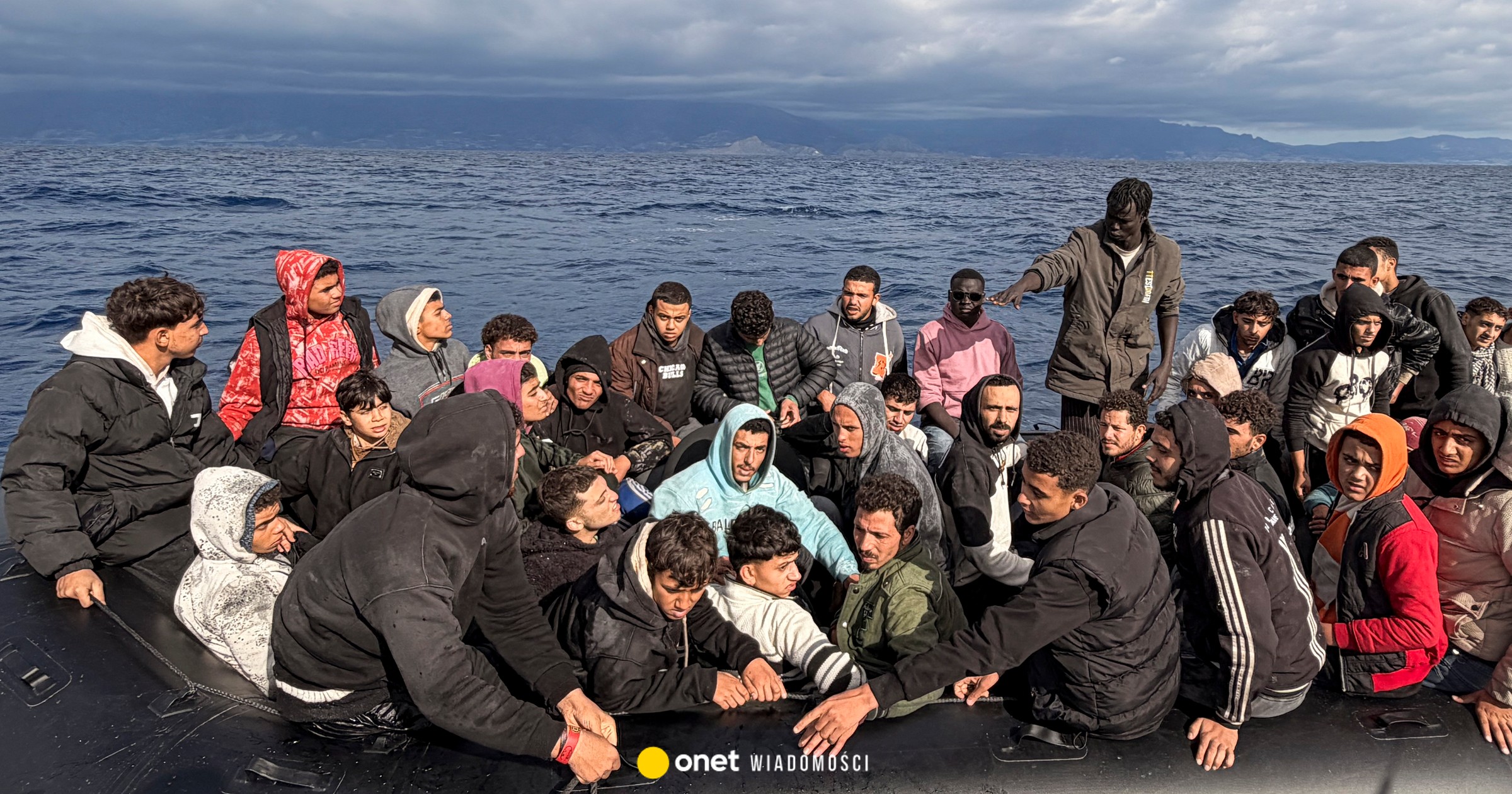
The Hellenic Coast Guard sounded the alarm several times this week. South of Crete and on the island of Gavdos off its coast, officers detained a total of approximately 550 migrants, some of whom were in immediate danger at sea.
During the largest operation on Tuesday, the services rescued 192 people from an overloaded fishing boat, including 42 minors. The rescued said they had left Libya. They were to pay the smugglers approximately PLN 3,000 for the crossing. hole. (according to the current exchange rate: PLN 11,000).
Okay. The 300-kilometer route to Crete becomes an increasingly large migration hotspot in the Mediterranean Sea. The European Border and Coast Guard Agency Frontex also raises the alarm.
“On the Libya-Crete route, the number of crossings has tripled in 2025. It can be expected that this corridor will continue to be under enormous pressure,” we read in an internal risk analysis obtained by Welt am Sonntag.
In a strategic report covering the years 2026 and 2027, Frontex analyzes where new migration tensions are emerging, which routes are shifting and where the threat from smuggling networks, weapons and drug smuggling is growing.
“Hybrid Weapon”
The warnings extend far beyond Greece. Frontex recommends that the European Union conclude an agreement with Libya and introduce more effective deterrent measures. The agency assumes that migration is becoming more frequent political tool — so far mainly in the hands of Russia and Belarus, but in the future it may also be used by North African countries and Libya.
According to Frontex's findings, migrants with financial assistance from Moscow and Belarus are deliberately directed from the eastern borders of the EU to Libya, from there to enter Europe as “hybrid weapons”. “It is unlikely that people would do this purely on their own initiative, much less that they would be able to cover such costs themselves,” Lars Gerdes, deputy executive director of Frontex, said recently.
Fears of a new wave of migration are also growing in Athens. Just a few days ago, Greek Minister of Migration Thanos Plevris stated that in Libya itself, people are currently waiting for a chance to get to Europe. over 500 thousand people.
This is a worrying moment for Greece: the new European asylum law, GEAS, comes into force only from Friday. It aims to improve procedures at the EU's external borders and strengthen cooperation with third countries. According to the Greek authorities, talks on similar agreements are already underway with two African countries.
The article continues below the video
Dispute over deportations
From Frontex's perspective, the central Mediterranean remains the most sensitive migration route in Europe. The agency locates further risk zones in the West African Sahel corridor and in the Horn of Africa region. In countries such as Eritrea, Ethiopia and Somalia, the capacity to accept refugees is practically exhausted in many places.
Frontex is particularly critical of the EU return policy. It runs throughout the analysis gap between return decisions and the actual number of deportations. Although in 2025, EU countries spent approx. 490 thousand decision to return – by 5%. more than a year earlier – approximately 151,000 were actually sent back. people.
The new asylum reform gives hope to border officers in this respect. Thanks to new border procedures, faster decisions and tighter return rules, the number of actual deportations is expected to increase significantly in the coming years.
Frontex expects “gradual” improvement – although it stresses that it won't happen overnight. Clear effects of the reform should be visible by the end of 2026 at the earliest.
Gray zone
In addition to migration routes, Frontex pays attention to the developing gray zone at the EU borders. The agency is watching with concern as smuggling networks become more and more bold they use new technologies and open new transport channels. More and more cocaine is entering Europe aboard semi-submersible boats, which operate just below the water's surface, making them much more difficult to detect by radar and coastal patrols. Investigators also notice another trend: drones are increasingly transporting drugs across the border with Morocco. Frontex describes both phenomena as “dynamically growing trends”.
European security services pay particular attention to the situation in Ukraine. Since the beginning of the Russian invasion, the trade in weapons, ammunition and explosives in this country has increased significantly. Officers warn against serious threats after a possible ceasefire.
— The risk of weapons transfer to Europe will increase dramatically in the event of a ceasefire or demobilization, border guards warn. Then huge supplies of weapons would go to people who urgently need money after years of war. According to investigators, this combination may fuel the illegal arms trade.
The development of the situation in Turkey is also worrying for Frontex: the agency is observing the growing popularity of stun guns converted into live weapons.
I’m Ashley Davis as an editor, I’m committed to upholding the highest standards of integrity and accuracy in every piece we publish. My work is driven by curiosity, a passion for truth, and a belief that journalism plays a crucial role in shaping public discourse. I strive to tell stories that not only inform but also inspire action and conversation.