
INTERVIEW. What effects can the powerful meteorological phenomenon “which will pour gas over the fire of a warming world” have in Romania?

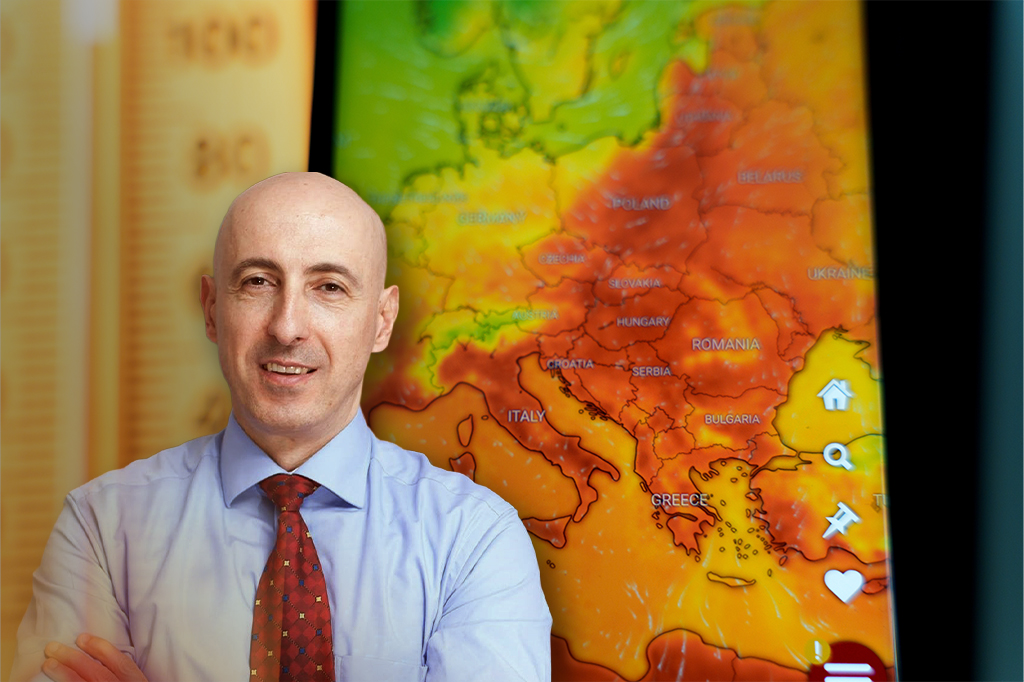
Several organizations have warned that the El Nino climate phenomenon will come in the second part of 2026 with unprecedented force and will make the effects of global warming even harder to bear. HotNews spoke with university professor Mihai Dima to find out what this means for Romania.
- Mihai Dima is a professor at the Faculty of Physics of the University of Bucharest and has experience in climate change and its physical mechanisms. He is one of the authors who signed articles in the State of the Climate in Romania report, coordinated by InfoClima.ro.
The natural weather phenomenon El Nino has an 80% chance of forming before September and a 90% chance before November, the World Meteorological Organization announced.
In short, El Nino is a phenomenon characterized by an overheating of the Pacific Ocean near the Equator. However, its effects are felt globally. Temperatures are rising and certain precipitation patterns are worsening.
The last El Nino climate event was in 2023-24, but the one soon to begin will bring many extremes, organizations such as the UN and WMO (World Meteorological Organization) have warned.
“The conditions associated with the El Niño phenomenon will pour gas on the fire of a warming world (…) The effects will be even stronger, will be felt over even greater distances and will cross borders with devastating speed,” said António Guterres, the UN Secretary General, quoted by The Guardian.
HotNew spoke with Mihai Dima, university professor and expert in extreme phenomena, to find out what meteorological risks are looming over Romania.
“It will be an event with a very, very large amplitude”
HotNews: In recent days, both the UN and other organizations have warned that a large-scale so-called “super El Nino” is coming. Is Romania in any way influenced by this phenomenon?
Michael Dima: The very vocal warnings come from the fact that forecasts indicate that this will be a very, very large amplitude event. This is where the concerns come from. In which areas will the impact be greater? It is not primarily Europe, but we are talking about the areas of the tropical Pacific, Australia, South-West Asia and especially South America with the West coast. That's where the special influence begins.
– How is Romania doing in this whole landscape?
– If we talk about Romania, it is a long way to us… The influence from the Pacific must cross the Atlantic to reach the European area. This happens in a limited way through various waves in the atmosphere, but overall the direct net effect on Europe is not large.
Europe is among the areas least affected by this phenomenon. However, it can be affected, indirectly, so to speak, when this phenomenon is in the El Nino phase. Then heat is released from the ocean into the atmosphere and that contributes to the increase in global average temperature. That heat spreads through the atmosphere all over the globe – in principle – and can also affect Romania.
– When should this Super El Nino start and when would it peak?
– Now it is in formation, it could reach its maximum phase in the summer and it could last for several months.

When it can have effects in Romania
– And then we could say that there will be a warmer summer in Romania also because of this phenomenon or would it be exaggerated to say that? Or, for example, could a warmer winter also follow due to El Nino?
– I would say this: that we can have this summer, and maybe also in the fall, a warming contribution from this phenomenon as well. We can also have a contribution from it, indirectly, by increasing the global average temperature. But not a direct effect. For example, we could not say that it is getting warmer in Bucharest because of the phenomenon.
– And in 2027 could El Nino have an influence?
– This phenomenon is repeated at time intervals of the order of years, it can be two years, it can be seven years. Basically, the positive phase lasts for several months, maybe 3, 5, 7 or even 9 months. The phenomenon essentially results from the interactions between the atmosphere and the ocean in the tropical Pacific.
HotNews.ro conducted the interview at the end of a conference organized by InfoClima.ro which announced the launch of an advisory council on climate issues. Mihai Dima is one of the experts in this council.
What is El Nino and since when has it been in the sights of scientists
El Nino is a dreaded phenomenon, but it also fascinates climatologists, because this natural disturbance causes large variations in the climate system on a seasonal and annual scale. El Nino and La Nina have been nicknamed the “terrible children of the climate.”
In the last 175 years there have been six phenomena characterized as “Super El Nino”, in the years:
- 1877-78
- 1888-89
- 1972-73
- 1982-83
- 1997-98
- 2015-16
The most serious is considered the phenomenon of 1877, and some studies say that it played a role in the death of millions of people almost 150 years ago (mostly due to starvation).
When El Nino occurs, the trade winds decrease in intensity, sometimes they end up reversing, as a result warmer and warmer waters appear, which heat up even more, because the winds don't really blow anymore. As the waters warm more and more, an additional source of heat appears.
In Peru, the rains brought by the worst “editions” of El Nino led to severe landslides, and in 1972-73, the ocean temperature rose so much that people could no longer fish. During another violent El Nino in 1997-98, total damage in Peru exceeded $3.5 billion (buildings, farmland, infrastructure).
The name “El Niño” comes from the Spanish language and means “The Child” or “The Boy”, referring to the Baby Jesus (Jesus Christ). The term was first used by fishermen in South America to describe an unusual increase in the temperature of the waters of the Pacific Ocean near the coast of Peru and Ecuador, which usually occurs during the Christmas holiday season, and was given this name because of its occurrence around this time.
The phenomenon “entered” the scientific field in 1891, thanks to a young geographical society in Lima (Peru). Its geographers associated the torrential rains that fell that year on the desert region in the north of the country with the presence, along the coasts, of abnormally warm waters.
How meteorologists describe the phenomena of El Nino and La Nina
In the volume “Climate changes – from physical bases to risks and adaptation”, a book signed by 16 ANM researchers, El Nino is described as follows:
“This oceanic event is associated with a global-scale fluctuation of surface pressure in the tropics and subtropics called the Southern Oscillation. This atmosphere-ocean coupling phenomenon, with time scales of 2 to 7 years, is known as the El Niño-Southern Oscillation (ENSO).
It is often measured by the difference between surface pressure anomalies in the islands of Darwin and Tahiti and sea water temperature in the central and eastern regions of the Pacific Ocean.
During an ENSO event, the trade winds decrease in intensity, altering the ocean currents so that the sea water temperature increases, which amplifies the decrease in the intensity of the trade winds.
This phenomenon has an important impact on wind characteristics, sea water temperature and precipitation in the tropical Pacific and has climatic effects throughout the Pacific region as well as in other parts of the world. The cold phase of ENSO is called La Niña.
The opposite phenomenon, called La Niña, is characterized by cooler water temperatures in the Pacific Ocean and can have different climate effects than El Niño.”


