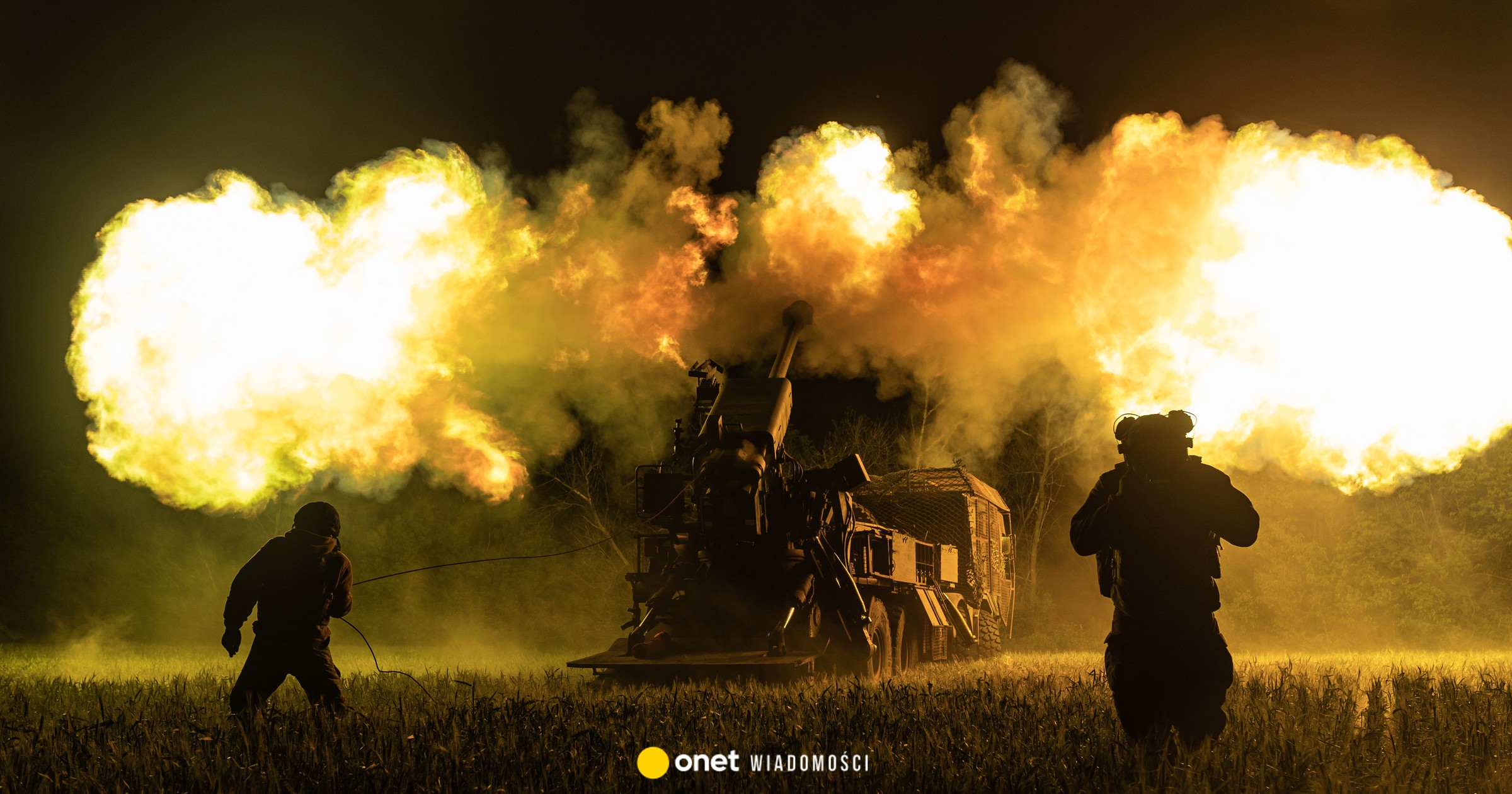
The war that Vladimir Putin started in Ukraine is often compared to World War I – mainly due to the trench fighting and the positional nature of the clashes, in which the fighting sides, despite suffering heavy losses, are practically unable to change the front line for a long time. Now, however, there is a new important reason for comparison – Putin's lightning-fast “special military operation” has been going on longer than the war that broke out over a hundred years ago.
Thursday, June 11, is the 1,569th day of the war in Ukraine. Putin's blitzkrieg, which was guided by the thesis “Kiev in three days”, as a result – as “The New York Times” notes – It surpassed World War I in terms of duration. After the Ukrainian Armed Forces pushed Russian troops out of the Kharkiv Oblast and parts of the Kherson Oblast in the fall of 2022, the conflict turned into a war of attrition.
— I thought that maybe in two or three years politicians would reach some consensus, a Ukrainian soldier nicknamed “France”, who previously served in the French Foreign Legion, told The New York Times. However, this did not happen.
Long wars develop according to their own logic and they are much more difficult to end than short conflicts — notes German historian Joern Leonhard, professor at the University of Freiburg. Huge losses and colossal expenditure of resources make any compromises difficult: the more victims, the more difficult it is for the parties to make concessions that seem to devalue these victims.
In the eyes of society, such concessions may be seen as a betrayal of the fallen, notes Leonhard. He adds that this was one of the obstacles to a quicker end to World War I and now this situation may repeat itself – it may be a block to the end of the fighting for both Ukraine and Russia.
Noticeable analogies
During World War I, between nine and 11 million people died over more than four years. In Ukraine, the Russian army lost up to half a million dead, said Ann Kist-Butler, director of the Government Communications Center, one of the British intelligence services, at the end of May. Ukraine keeps its losses secret, but they may amount to hundreds of thousands of people.
Leonhard also draws attention to another aspect – before possible negotiations, the parties try to show that they are able to continue the fight. The end of World War I was no less bloody than its beginning. The historian considers such a scenario likely also in the current conflict.
The article continues below the video
Long wars also give rise to new technologies and forms of warfare. If submarines, chemical weapons, tanks and planes appeared or began to play an important role during World War I, today it is drones and robotic systems. On the one hand, drones have created a “zone of destruction” approximately 20 km wide along the front line, where it is virtually impossible to survive.
On the other hand, they enable long-range strikes: Russia is bombing Ukrainian cities and power plants, and the Ukrainian Armed Forces are destroying the supply routes of the Russian army, cutting a land bridge to the annexed Crimea, and blowing up Russian refineries, ports and military facilities at a distance of up to 2,000 km from their borders.
Psychological limit
Michel Goya, a French military historian and retired colonel, also draws attention to the historical analogy. — The war in Ukraine resembles the war in the early 20th century in many respects, he notes. — When the front freezes, you feel like you've gone back to the times of World War I, he adds.
In both wars, it was the intensity of military operations that forced armies to entrench their positions. “You dig in to protect yourself,” Goya says. A hundred years ago, power was mainly provided by artillery, now it is provided by drones.
As a result of the use of drones, the mortality rate has now reached levels comparable to those during World War I, Admiral Pierre Vandier, NATO's Supreme Allied Commander for Transformation (SACT), noted in the spring after his visit to Ukraine.
The war unleashed by Putin has also crossed another historical boundary that is important to him — as of January 12, 2026, it has lasted longer than the Great Patriotic War, which lasted 1,418 days.
I’m Ashley Davis as an editor, I’m committed to upholding the highest standards of integrity and accuracy in every piece we publish. My work is driven by curiosity, a passion for truth, and a belief that journalism plays a crucial role in shaping public discourse. I strive to tell stories that not only inform but also inspire action and conversation.