The discovery that dispels the legend of the living water fountain in the Corvinor Castle. What did the workers bring out from 30 meters deep

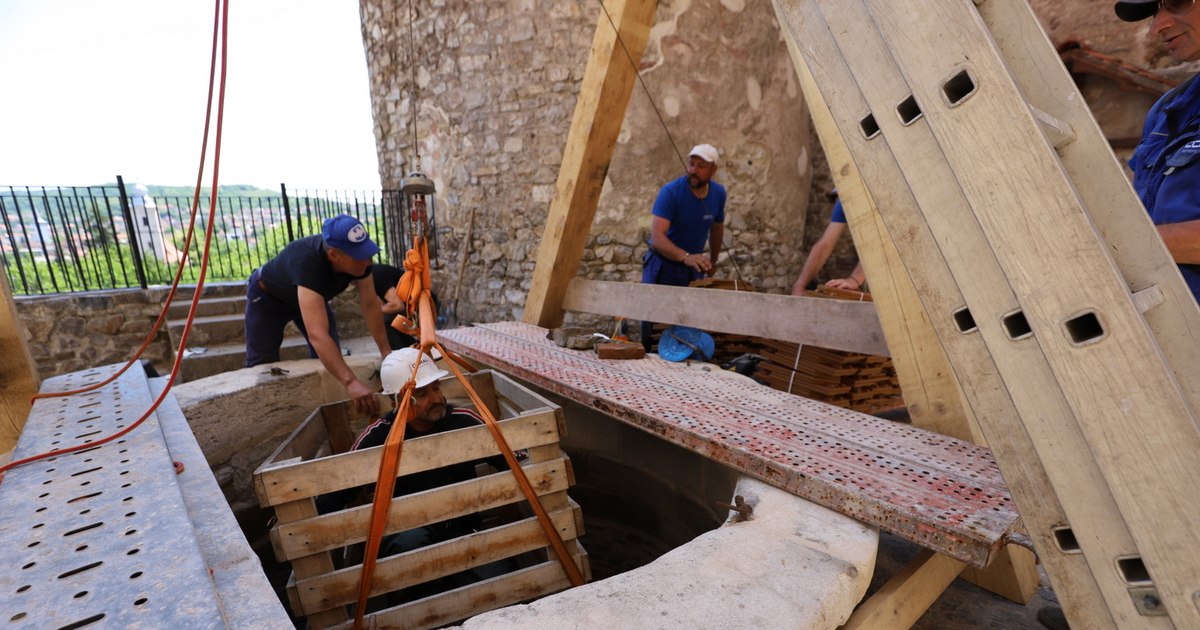
Six centuries old, the “living fountain” in the Corvini Castle recalls one of the most chilling legends in the history of the monument. These days it is being rehabilitated, the countless coins and objects thrown into it are removed, and some myths surrounding it are dispelled.
Restoration work at the medieval fountain. Photo: Daniel Guță. TRUTH
Restoration work has begun on the medieval fountain in the courtyard of the Corvini Castle, from the time of the Huniads, the 15th century, dug in the rock by three Turkish prisoners, according to legend. In the 17th century, when the Castle of the Corvins was in the possession of several families of princes from Transylvania, the well in its yard was called the “living well”, according to Janos Bajoni's inventory.
Bags of money pulled from the bottom of the well
Over time, it lost its utility as a source of water supply, but became more and more famous thanks to its legends and the many coins that were thrown here by visitors. These days, the medieval fountain is being restored and cleaned, as part of the Corvinor Castle restoration project, financed with European funds.
“At the moment, the restoration work is focused on completing the roofs, the facing of the new gate tower, the fresco on the Mace Tower and cleaning the castle fountain. It is unclogged, after quite a large amount of gravel and many coins have been thrown here over time”, archaeologist Sorin Tincu, director of the Corvinil Castle Museum, stated for Adevărul.
The work started a few days ago is on the upper layer at the bottom of the well, with a depth of almost 30 meters, so most of the coins taken out of it are current.
“First of all, we are talking about quite a large amount of coins of 50 money and subdivisions. But another aspect is interesting for us, which will be studied later: the provenance of these coins. We will also be extremely interested in the age of the coins, because in this way we will be able to establish a starting point for this custom of throwing coins into the castle well, as an accompaniment to a wish.” explained the specialist.
Image 1/15:
Corvinor Castle from Hunedoara Photo Daniel Guță THE TRUTH (107) jpg
After the well will be cleaned, the interesting coins and some objects discovered in its waters will be shown in an exhibition in its vicinity. The workers have so far found money coming from many countries in Europe, but also outside it. Metallurgical parts from Hunedoara's factories, cameras, cards, sunglasses and other things dropped by tourists also arrived in the well.
The fountain gave birth to many theories, starting from the 19th century: some researchers from the past compared it to a water cistern, extended with a gallery that led to the Zlasti river, while other authors recalled the legend of the secret tunnel that, starting from the fountain, would have connected the Corvinor Castle to the Deva Citadel, located about 10 kilometers in a straight line.
The well was not a cistern, as was believed in the past
A geologist claimed that the well was dug at the intersection of two faults, and at their junction there is a fissure from which the water in the water table originates. Research has revealed interesting details about the construction and the fact that it was not a cistern, but a well with a spring and drinking water, clogged due to clogging and things thrown into the well.
What is hidden behind the Corvinor Castle. The discoveries that bring to light a world three millennia old
“We are not talking about a cistern meant to store the water, but at the bottom of the well is a fairly strong spring. On the other hand, the well, beforehand, underwent a series of restoration and consolidation works, because, up to about four meters, we are talking about a brick wall. And from four meters down, it goes into the native rock, in the dolomite, up to 28 meters, which is the final depth, as was established in the 19th century when this well was first cleaned”said archaeologist Sorin Tincu.
The fountain of the Corvinir Castle dates back to the 15th century, the era in which Ioan de Hunedoara built the medieval fortress. Its legend, based on a medieval inscription that can still be seen today on a wall near the fountain, says that the well was dug by three Turkish prisoners, brought to the castle by Iancu de Hunedoara. The great commander of the army would have promised the prisoners that if they found water in the rock on which the castle was built, they would be freed.
After 15 years, the Turks found water, almost 30 meters deep, but in the meantime, the voivode of Transylvania died, and his wife, Elisabeta Szilagyi, no longer respected his promise, the prisoners being killed, in the end. In another version of the legend, Iancu de Hunedoara would have restored their freedom.
A message written in Arabic characters would have given birth to the legend. It is said that the slaves, dissatisfied with the way they were treated by the Huniaz family, chiseled the words at the bottom of the well “You have water, but no heart”. The Arabic inscription can currently be seen on one of the buttresses of the chapel above the fountain. Historian Mihail Guboglu translated it as follows: “The one who wrote it is Hassan, a prisoner of the beasts, in the fortress near the church.”
The legend of the Turkish prisoners, popular for over a century
The legend of the well dug into the rock on which the medieval castle was built became very popular in the 1980s, with the publication of the volume “Historical stories for children, schoolchildren, hawks of the homeland and pioneers”, signed by Dumitru Almaș, in 1982. It recalled the promise made, out of pity, by the wife of Iancu de Hunedoara to the Turks, in exchange for digging the well.
“When the prisoners showed up with the first glass of water from that well, Iancu Corvin also happened to be in the castle. He liked the water very much: cold, crystal clear. Remembering the promise, the voivode's wife prayed: “Let's forgive them, your majesty, they gave us water in the castle”. But Iancu did not relent… “Your wife, voivode, gave us “promised freedom if we dig a well in the castle,” said another of the Turkish prisoners. “Yes,” answered the lady. heart””the narrator noted.
The story of the fountain also circulated in the interwar period, being often reproduced in reports dedicated to the Corvinor Castle.
“That in the Middle Ages, without machines, workers made supernatural physical efforts is a known fact. The legend that was born around the well is very significant. There was a lack of water in the castle. Tired of the difficult supply of little, brought on the backs of donkeys, the senior Ioan wanted at any cost to have a well. This seemed an impossibility, because all attempts to probe the rocky soil failed. During that time, three young Turks were suffering in the prison cell. In exchange for their freedom, the Turks dug water for fifteen years and one day, at a depth of 25 meters, the water sprang up from the granite rock. After his freedom was restored, the slave said to the senior: “Great, sir you have, but you don't have a heart…”. Looking into it, you get dizzy. There is a Turkish inscription engraved on a corner stone, perhaps a quote from the Koran. Stankovich, in the report “Corvinii and the Castle of Hunedoara”published in January 1935.
Wolves are circling a town in western Romania. “Dracula's pet. He was looking for his master”
The legend of the secret tunnel, fake
A story about the well is told by the old employees of the Corvinor Castle, from the 1990s, who claim that, at that time, there was no water at the bottom of it, but it was full of coins.
A local man tried to descend into the well with the help of a rope, but the hemp rope broke, and the man collapsed and died, reported a former employee of the Castle of the Corvins. Another legend that circulates about the Castle of the Corvins, but less plausible, is that of an underground tunnel that connects it to the Deva Fortress. However, this tunnel was never discovered.
According to historians, the Corvinor Castle fountain had a strategic role in the composition of the edifice. Thanks to her, the castle had become an impregnable fortress, because its defenders could withstand the siege, having water.
“Even though the city was surrounded as in a pincer by the enemy, its inhabitants did not suffer from lack of water, because he could not stop the well or divert the water.” recounted Joseph Adalbert Krickel, a Viennese engineer who visited Hunedoara in 1828.