The day Transylvania was swallowed up by the Kingdom of Hungary. The forced denationalization measures to which the Romanians were subjected

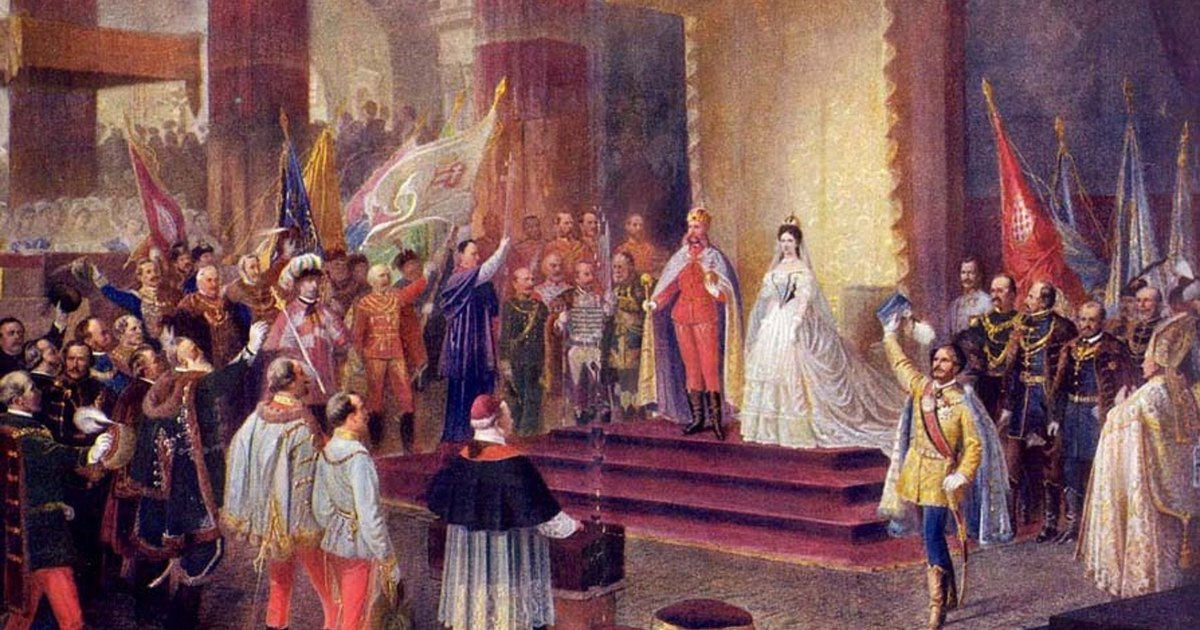
“The year 1867 marked the end of Transylvania's autonomy and its de facto annexation to the Kingdom of Hungary, a turning point with severe effects for the Romanian majority. The new political reality inaugurated a series of coercive legislative and administrative measures, aimed at accelerating the national uprooting of the Romanian community.
Coronation of the Emperor of Austria PHOTO wikipedia
The year 1867 was inauspicious for Transylvanian Romanians. It is the year in which, for the first time in its history, Transylvania lost its autonomy and was effectively included in the Kingdom of Hungary. This political and administrative decision belonged to the Austrian emperor Franz Joseph I, as a result of the 1867 compromise that led to Austro-Hungarian dualism. For the Habsburg Empire, this compromise meant saving its existence. For Romanians, dualism and the loss of Transylvanian autonomy meant a real misfortune. The Hungarian authorities tried at all costs the ethnic and cultural uprooting of the Romanians.
A giant with feet of clay sought salvation
The Habsburg Empire dominated European history for several centuries. With the emergence of the Enlightenment and the new currents of thought, as well as the democratic revolutions, this multinational empire, which stretched from the heart of Central Europe to the Carpathians, including Romanian territories such as Transylvania, Banat and Bucovina, began to shake more and more. The 19th century was an era of absolute contrasts for the Habsburg Empire. On the one hand, it was a period of glittering cultural elegance, with Vienna becoming the world capital of music and waltzes. On the other hand, the empire was riven by huge political tensions, being nicknamed at the time “the prison of the peoples” because of the way it tried to keep dozens of different ethnicities under control.
From a military point of view, the empire no longer corresponded to the new realities. Napoleon effectively crushed the imperial armies. After the defeat of Napoleon and the Congress of Vienna in 1815, the Habsburg Empire looked set to experience a new period of prosperity, especially since Chancellor Klemens von Metternich ruled the empire with an iron fist. His motto was stability at any cost. He introduced severe censorship and the secret police were everywhere. Metternich feared that the ideas of the French Revolution (liberty, equality, nationalism) would not take root. Although Vienna and Bohemia (modern-day Czechia) were beginning to build factories and the first railroads, most of the empire remained deeply agrarian and conservative.
Metternich's efforts were in vain. The new ideologies and, above all, the revolutionary year 1848, also called the “Spring of the Peoples”, seriously shook the empire. The revolutions included Vienna, Prague, Budapest and Transylvania. The Italians, Hungarians, Czechs, Romanians and Germans demanded rights, a constitution and national recognition at once. The old Habsburg emperor, Ferdinand I, sick and upset by what was happening, could no longer cope. Vienna was occupied by revolutionaries. So, on December 2, 1848, he abdicated the throne to his only 18-year-old grandson, Franz Joseph I. The transfer of power took place in the small town of Olmütz in Moravia, where the imperial court was sheltering from the revolutionaries.
Much younger and more energetic, Emperor Franz Joseph quickly quelled revolts in Austria, Italy, Poland, and Bohemia. In the case of the Hungarians and the Romanians, he asks for the help of the Russians and crushes the revolution of Lajos Kossuth. Neither the youth nor the energy of the new emperor could improve the situation of an anachronistic empire. It was a medieval political construct that stubbornly struggled to survive in an era of industrialization and was rapidly moving towards modernization. The Habsburg Empire suffered, in the middle of the 19th century, several severe military defeats. The Austrians were defeated by Piedmont, but mostly by the Prussians. The war with Prussia in 1866 completely crippled the Habsburg Empire, bringing it to the brink of collapse.
A Political Compromise: The Birth of Austria-Hungary
After defeats by Italy and Prussia, Franz Joseph had to make a major concession to the most powerful and rebellious minority: the Hungarians. In short, the Austro-Hungarian Empire would merge administratively and politically with the Kingdom of Hungary. The Habsburg emperor was also becoming king of Hungary. The Hungarians had the most to gain, who saw the re-establishment of the Kingdom of Hungary, collapsed after Suleiman the Magnificent's victory at Mohács in 1526. This union was called the Ausgleich and provided for the two states to be constituted as separate political entities, with their own constitution, parliament, administration and police institutions. The only common institutions were the ministries dealing with foreign policy, finance (economy) and the army, as well as the emperor. The expenses were common and borne largely by Austria. Basically, the Hungarian government gained equal rights with the one in Vienna.
The Transylvanian prince who wanted to be king of Dacia. Who was the flamboyant Gabor Bethlen
In addition, with the coronation of Emperor Franz Joseph as King of Hungary, it was decided that Transylvania would become part of Hungary. Basically, it has lost its autonomy. Ever since the Hungarian conquest in the 10th century, Transylvania has always had autonomy. It was first a vassal voivodeship of the Kingdom of Hungary, then an independent vassal Principality of the Ottoman Empire and, finally, an autonomous principality within the Habsburg Empire. Basically, Austria-Hungary was divided into two administrative entities. On the one hand, Cisleithania (ruled from Vienna), which included Austria, the Czech Republic, Slovenia, Galicia and Bucovina. And on the other side, Transleithania (ruled by the Hungarians), which included Hungary, Slovakia, Croatia and Transylvania.
The concerted operation to denationalize the Romanians
For the Romanians in Transylvania, this compromise was a heavy blow. The autonomy of Transylvania was abolished, being annexed directly to Hungary, which led to harsh policies of forced Hungarianization. In contrast, Romanians from Bucovina (under Vienna's administration) enjoyed much greater cultural tolerance. The consequences were multiple. The administration and the school were gradually Hungarianized, and the Romanians, the majority in many areas, did not have a representation proportional to their number. The entire territory of Transylvania was reorganized into counties according to the Hungarian model, and local institutions were subordinated to Budapest, Hungarian legislation becoming dominant. The Romanian language had limited access in the administration.
Perhaps the most important impact was in education, where it manifested itself most meaningfully. “The conclusion of the Austro-Hungarian dualist compromise also inaugurated a difficult period for the Romanian schools in Transylvania, the Hungarian governments trying, one by one, the spiritual uprooting of the Romanians. Dualism also brought with it the immediate reorganization, on new bases, of the primary education, according to the interests of the dualist state. The educational process was given a lot of attention, being seen as the best means of Hungarianization, this plan being put into effect especially since 1879. The school became a favorite target of the Hungarian governments, no longer seen as having the role of only forming loyal citizens, in the general European trend, but also good Hungarians”stated Constantin Băjenaru in “School legislation during the period of Austro-Hungarian dualism (1867-1918)”.
Actually, through successive laws, it got to the point where teachers or teachers who did not speak Hungarian well enough were fired. In addition, some schools teach 3-4 hours of Hungarian per week, in the case of schools with only one class. No diploma was issued anymore if the graduates could not read and write in Hungarian. “For the training of teachers, measures were taken so that in the pedagogical training institutes the Hungarian language is taught in such a way and in a certain number of hours, that each teacher acquires it in writing and speaking in order to be able to teach it in turn with the expected results. Those who within four years from the promulgation of the law did not acquire it properly were dismissed from the department, and after June 30, 1882 it was no longer possible to obtain a teacher's diploma or to be appointed as a teacher unless he proved that he had mastered the Hungarian language. The curricula were modified according to the new requirements – in schools with one teacher, the Hungarian language had to be allocated 3 and a half hours per week, in those with two, six hours per week, and in the case of schools with more, 14 hours teachers. Thus, no diploma could be issued to graduates who had not rigorously mastered the official language”stated Constantin Băjenaru in the same work.
Who has Romania secretly allied with to protect its borders. The story of a treaty that would have changed the destiny of our country
The reaction of the Transylvanian Romanians to the Hungarianization policies after 1867 was a constant one, and the main pillars were culture and the church. A Transylvanian political and cultural elite was highlighted, which would also influence the political classes of the Old Kingdom. The Romanian elites began to send protests and memos directly to the emperor in Vienna. They demanded freedom of language and religion, proportional political representation and preservation of local autonomy.
Ignored by the Hungarian authorities, to whom they were directed from Vienna, the Transylvanian patriots drew up the Memorandum of 1892. Through this document, they demanded respect for the national rights of the Romanians, an end to forced Hungarianization policies and a real political representation. And this time the document was sent directly to Vienna. However, the leaders were tried in Cluj in 1894 and convicted, but this Memorandum became a symbol of the Romanian resistance.