Article by George Nistor – Published Monday, May 25, 2026, 1:39 p.m. / Updated Monday, May 25, 2026, 1:39 p.m.
FCSB qualified for the play-off final for the Conference League after a 4-3 chaotic with FC Botoșani. The match at the Steaua Stadium showed, almost simultaneously, what the red-blues can produce offensively, at the end of a season of constant deterioration, but especially the frailties that Marius Baciu's team hides when they lose control of the game.
Transitions carried at speed, wide spaces between the lines and the constant feeling that any recovery can immediately become a big opportunity at one of the goals. For the neutral viewer, an excellent show. For FCSB, however, a game that leaves behind more question marks than certainties before the decisive duel with Dinamo.
In the first game with the new coach on the bench, FCSB tried a change of tone and energy. It was clearly seen the desire to remove the formation from the rigidity of the last months, to make it play more directly, more vertically, more aggressively without the ball and more willing to run.
Sebastian Mailat (14', 77') and Mykola Kovtalyuk (90+4) scored for the Moldovans, while the hosts' goals were scored by Joao Paulo (20'), Joyskim Dawa (53'), Florin Tănase (69'), from the penalty, and Octavian Popescu in extra time (107'), after a formidable individual action.
-
“It's all about tactics” is a GSP project that aims to analyze how coaches choose to approach key matches tactically. To determine the most important data, we use the Wyscout platform, which provides parameters and relevant information collected by 250 experts from all over the world.
FCSB without a real striker is a permanently exposed team
This time, Stoian had the task of constantly pressing, and the whole team tried to play more simply and more alertly, at the same time, without too many sterile passes. The problem is that this desired transformation comes at a time when FCSB no longer has the structure of a team capable of supporting, without huge risks, such an aggressive system as the 4-3-3 brought by Mirel Rădoi.
The first and perhaps most important warning signal comes from the very center of the game system. In theory, the 4-3-3 offers more control of possession, more width and more advanced pressing possibilities. A “6” in front of the defense and two full backs constantly going up between the lines should allow for territorial dominance of the opponent. In practice, the FCSB appeared, at this point, too fragile to function as such.
41of touches in which FCSB had. FC Botoşani – 26
Under Elias Charalambous, in the old 4-2-3-1, the lack of pace and creativity had become evident towards the end, but the defense benefited from a minimal safety net through the existence of the two central midfielders. At times the team became slow or predictable, but the spaces in front of the centre-backs were better protected. Now, Joao Paulo was the man used in front of the defence, but the Portuguese had more responsibilities. He came to the build a lot, looked for the ball, went up to speed up attacks, thus missing his positional instincts to recover and provide defensive balance.
In fact, one of the defining images of the match appears from the first minutes, when Joao Paulo descends a lot to participate in the build-up, then tries to recover ground and appear in the attack as well, remaining permanently in an intermediate zone, neither close enough to the central defenders to protect them, nor high enough to constantly fix the opponent.
Joao Paulo constantly went down to enter combinations with defenders Crețu, Dawa, Mihai Popescu. Photo generated in the Wyscout platform
The consequences were seen immediately. At Mailat's goal, one of the key phases of the game, FC Botoșani exploits exactly the space between the FCSB lines. Mitrov quickly develops the phase, sends the long pass, Radunovic loses ground, and Mailat, one of the players with the best start in the Superliga, receives exactly the ideal context for his profile, open ground and space to attack from the front. Decisive was not the duel lost in the attack, but how the phase unfolded afterwards. The center of the field is too easily crossed, with the defense remaining isolated, with no real protection in front of it.
The same vulnerability continues throughout the match. Behind the top of Stoian, Olaru, Tănase and Cisotti appear, one after the other, but almost no one secures the area in front of the central defenders. Hence the constant feeling that FCSB can score on almost any counter recovery. Bucharest dominates the territory, pushes the game, creates opportunities, but at the first lost ball everything is deconstructed.
18versus 16 was the ratio of crosses. FCSB on the other hand failed to cover the central area of the pitch
Too many attack men does not automatically mean offensive control
The second big red flag is that FCSB sometimes confuses the accumulation of offensive players with true offensive control of the game. The team had a lot of offensive talent on the field at the same time, with Olaru, Tănase, Cisotti, Stoian and Miculescu involved in the attack, plus the ascents of Crețu and Radunovic. Theoretically, enough to suffocate the opponent. In reality, many of the hosts' attacks had very little collective depth, even if FCSB got around the box often and produced a high volume of chances.
The actions of the red-blues came, for the most part, from moments of forcing, from fixed phases or from individual explosions, not from a fluent and well-laid collective game. The team accelerates brutally at certain intervals, creates panic and creates chances, but then loses structure and leaves huge colors behind.
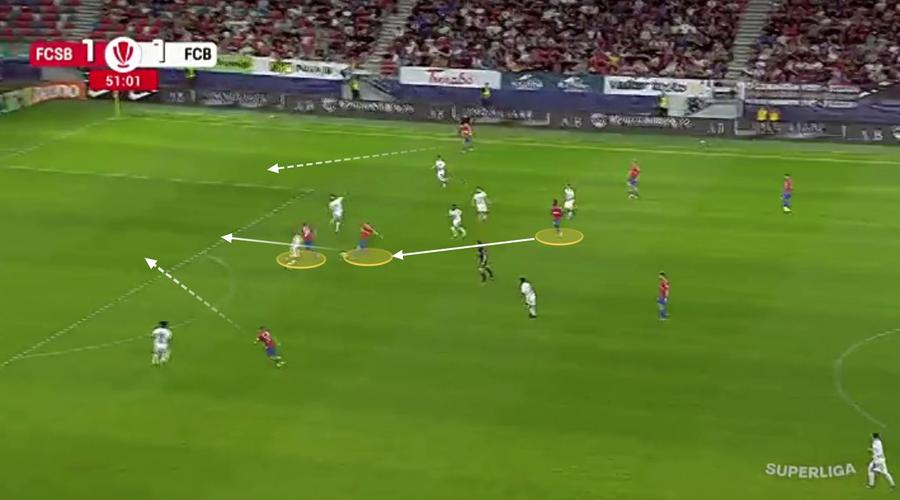
Behind the tip, Cisotti, served with a filter pass by Olaru. The Italian misses one on one with Anestis. Photo generated in the Wyscout platform
Joao Paulo is perhaps the perfect symbol of this paradox. The Portuguese can produce spectacular football around the opposition box, too the goal built on the route Olaru – Tănase shows exactly what FCSB can generate when they combine quickly between the linesbut the same offensive freedom constantly takes him out of the positions where he should provide defensive balance.
In parallel, FC Botoșani proposed a much simpler game. Croitoru accepted to suffer without the ball, but he prepared very well the transition exit. Quick recovery, immediate vertical pass and direct attack.
And exactly here another problem arises for FCSB, the team no longer controls the negative transition, the returns are late. Everything becomes an attempt to survive a rhythm that no longer recognizes.
65%FCSB had successful passes in the last third, compared to 55%, as recorded by the Moldovans
The new aggressiveness produces energy, but breaks the team
The third big red flag comes from the very good things the new staff has tried to bring. Marius Baciu tried to quickly mobilize the team in the few training sessions available, to increase its aggressiveness and availability to effort, and FCSB showed, on certain intervals, more alive than at the end of Charalambous' mandate.
FCSB had more entries into the final third, more touches in the box and an almost constant offensive presence, but such a game needs very small distances between the lines.
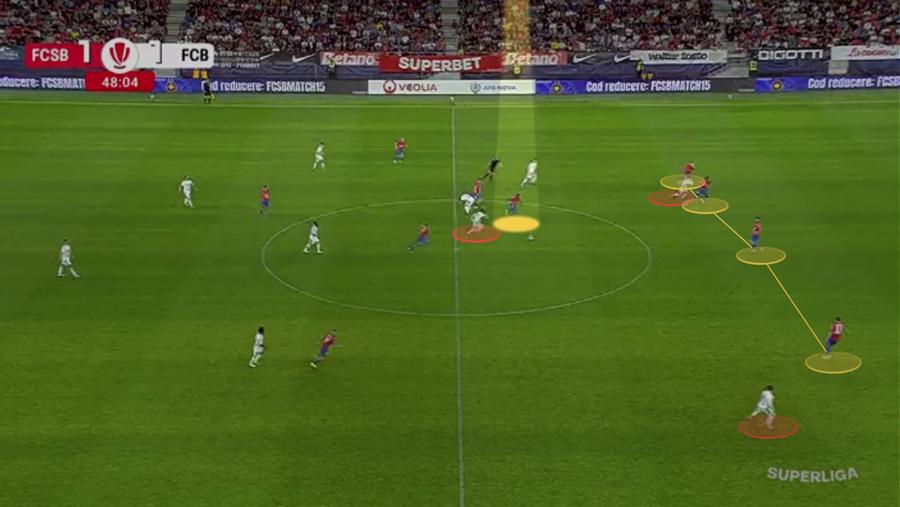
Joao Paulo loses possession, Enriko Papa intercepts. Fortunately for FCSB, Dawa blocks Mailat and Botosaniul does not develop the attack. Photo generated in the Wyscout platform
Aggressive pressing only works when the team stays short and when there is a defensive midfielder capable of extinguishing opposing transitions. FCSB does not yet have that number 6 profile to redress the imbalances generated by the constant promotions of midfielders and full-backs.
The fragility is also triggered at the fixed phases. At 3-3 in overtime, Dawa completely misses the trajectory of the ball and stays under the ball, and Kovtalyuk takes advantage.
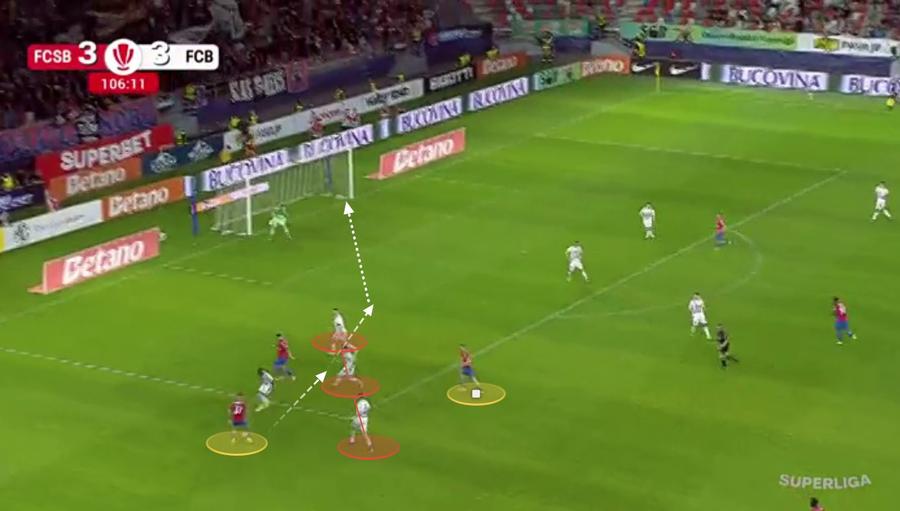
FCSB is dependent on individual actions. Tavi Popescu passes through the opposing defense and scores with a placed shot. Photo generated in the Wyscout platform
In conclusion, what remains after this 4-3 is not only the qualification, but also the image of a team trying to play the football of a healthy formation, although its body still works like an injured one. The 4-3-3 system can become part of the team's identity, but over time. Currently, FCSB does not yet seem ready to bear all the risks that this settlement entails.
It doesn't have an authentic stopper, it doesn't compact defensively, and in front of a team like Dinamo, much more organized without the ball and more tactically disciplined than FC Botoșani, these problems can become fatal.
I think I reacted well. I didn't like the central area. We asked to play with Joao in front of the central defenders not to have any emotions, but there we had the biggest emotions. We had some errors, at 3-1 it is not allowed to make these mistakes. And at 0-0, Joao could be much more careful. It happens, we asked to go up with the full-backs up. We tried to create numerical superiority, I don't know how successful we were. I didn't work as much as I told.
– Marius Baciu, FCSB coach
FCSB – FC Botoşani match figures
|
Parameter |
FCSB |
FC Botosani |
|
Possession |
54% |
46% |
|
Empty situation |
8 |
2 |
|
Accuracy of passes |
76% (111/146) |
77% (92/120) |
|
Square shots |
3 |
0 |
|
corners |
4 |
0 |
|
Balls recovered |
78 |
78 |
I started the second half weak, conceded a goal, came back, after which, at halftime, three players asked me to change. Exactly where Diaw came out, that's where the goal was scored. We came back, then a goal came after a really nice move from Tavi, and things got easier for them. I tormented them, but I lost. In the last matches we gave them three goals each. We just have to come back better. We cannot but recognize the merits of FCSB, but I think we have risen to their level.
– Marius Croitoru, FC Botoșani coach