Chinese supercomputers have been a regular on the Top500 list, a list of the world's most powerful computers, for years, and have topped the list many times – for the first time in 2010 thanks to the largest deployment of Nvidia chips at the time. In 2016, for the first time, this list included more machines launched in the Middle Kingdom than in the United States. Then came 2019 and American sanctions. China then largely stopped submitting its new machines to this list and since then we rarely get detailed information about them. Unless they are intended to send a specific message.
The National Supercomputing Center in Shenzhen broke the silence and released the general specifications and internal test results of its new machine, a supercomputer called LineShine. According to the data presented, the system could rank among the most powerful computers in the world. However, what attracts attention above all is the fact that it is meant to be built with components sourced from the domestic chip supply chain and infrastructure.
Japanese-style supercomputer
How did this happen? As they say, necessity is the mother of invention. China doesn't have access to the latest accelerators, so created a supercomputer somewhat reminiscent of the Japanese Fugakuwhich was the world's fastest supercomputer in 2020-2021.
Instead of Nvidia or AMD chips, the system is based on a huge number of more classic processors called LX2 based on the ARMv9 architecture – according to available technical descriptions, over 40,000. CPU and approximately 2.45 million cores, connected by a fast network and supported by HBM memory. Who designed and manufactured these chips? We don't know this for 100%, but it would be strange if it wasn't a Huawei project, at least to some extent. There is also no public confirmation of who exactly makes the LX2 processors – although SMIC remains a natural candidate.
SMIC is the most advanced Chinese manufacturer of semiconductor logic, capable of producing chips using a 7-5 nm technological process.
|
Nikkei Asia
This solution is inherently less energy efficient and to use its full potential requires very good programmers and a very effective network infrastructure, but China has no problem with electricity, talents and networks, so at least in theory it can compensate for its weaknesses. On the other hand, it is a very universal solution, so it can handle various types of calculations – from those related to AI (although on a much smaller scale than the huge computing clusters of hyperscalers) to advanced simulations.
Theoretical performance between the world's 1st and 3rd supercomputer
Estimates based on the parameters of LX2 processors indicate that the theoretical maximum system performance in scientific calculations using double-precision floating-point numbers is less than 2.5 exaFLOPS, which is several percent less than the American El Capitan, which was at the top of the last edition of the Top500 list.
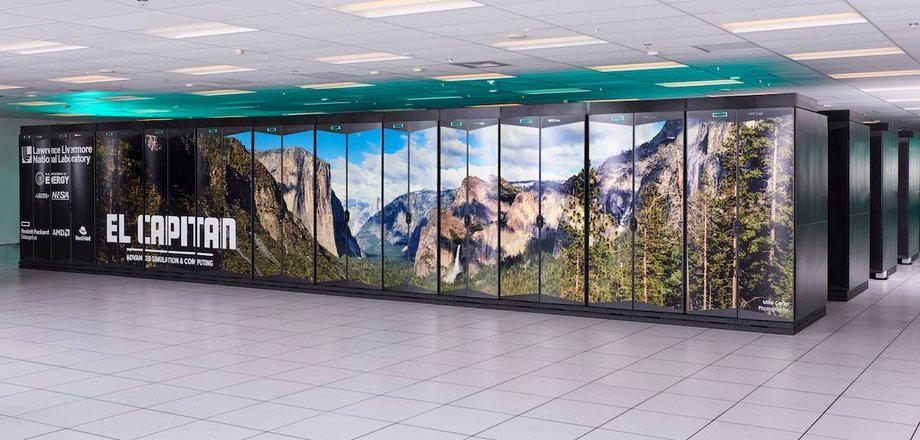
The American El Capitan currently holds the highest position in the supercomputer ranking. The new Chinese machine should, in theory, be able to challenge it.
Theory and practice are, of course, two completely different things and the National Supercomputing Center does not provide the results of the tests carried out for the purposes of the mentioned ranking. However, June is fast approaching, and with it a new edition of the supercomputer toplist. I wonder if it will bring with it the first new machine from China in several years or even more detailed data on structures such as LineShine.
What counts is what's inside, i.e. the Chinese quartet in action
The chip history of LineShine does not end with processors, because the remaining silicon elements of this machine are also to be included in the domestic supply chain. CXMT is most likely responsible for the production of RAMthe only Chinese manufacturer of DDR5 and HBM memory used by this supercomputer. Whereas the supplier of the memory used to store data is most likely YMTCone of the technological market leaders. Both companies are currently preparing for an IPO and in the current market conditions, they could quickly become one of the most valuable Chinese companies.
This quartet of processor, memory and logic manufacturers – Huawei, YMTC, CXMT and SMIC – puts China in a rather unique position. In practice today, this country belongs to a very small group of countries capable of building an almost complete technology stack for supercomputers (almost, because the supply chain of materials and machines necessary for chip production is very complex).
The United States is, of course, in the strongest position. Japan and Korea are relatively close, but both countries lack their own equivalent of Huawei or Broadcom, while Japan – despite strong competences in processor design and semiconductor materials – currently has no domestic production of logic circuits using the latest technological processes (although this will soon change when Rapidus starts mass production of chips), and the DRAM factories located in this country belong to the American Micron.
Doubts remain, but the message is clear
It must be taken into account that all information related to the LineShine supercomputer would benefit from independent verification. We still don't know its results in standard benchmarks or full specifications, and some of the data is based on industry declarations and analyses.
It should also be remembered that the role of the most advanced computing systems has changed in recent years. Classic supercomputers are still of great importance in science and industry, but at the same time the importance of gigantic AI clusters built by American hyperscalers is growing, which often exceed traditional supercomputer systems in terms of total computing power.
However, this does not change the fact that LineShine exists, it is an interesting construction and the moment of showing it to the world is not entirely coincidental.