Rising housing prices, limited availability of premises and the increasing share of investors in the market cause this the topic of cadastral tax returns to public debate with new force. Although the government assures that it is not working on introducing such a levythe discussion was reignited by a bill submitted to the Sejm by Left MPs. It assumes abandoning the current model of property taxation based on area and replacing it a tax charged on the value of an apartment or house. For some, it would be a way to limit housing speculation and the mass purchase of investment premises, for others – the beginning of another financial burden for property owners. The latest research shows that Poles are strongly divided on this issue, but at the same time they increasingly notice the problem of inequality in the housing market.
Rankomat.pl research shows that only 20 percent Poles support the introduction of a cadastral tax, while 45 percent is against it. Importantly, as much as 35 percent respondents have no opinion. This shows that for many people the term “cadaster” itself remains unclear, and the attitude towards the proposed changes depends primarily on the details.
Cadastral tax
|
rankomat.pl
Cadastral tax
|
rankomat.pl
Read also: Investing in Georgia. What rates of return can you count on? Promises versus real profits
— Most Poles approach the proposal to introduce a cadastral tax with caution. However, there is nothing unusual about this. After all, it is an additional tax, and everyone would prefer to have as much money in their pocket as possible – comments Jarosław Sadowski, director of the Analysis Department at Rankomat.pl.
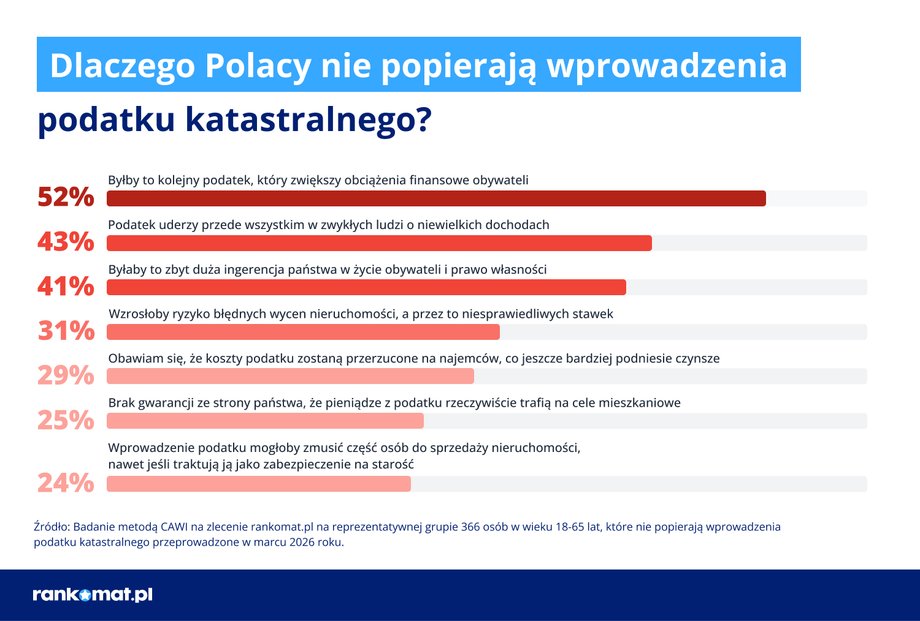
The biggest concerns are increase in property maintenance costs. More than half of the tax's opponents indicate that it would simply be another financial burden for citizens. Respondents are also afraid that the new levy would hit people with average incomes the hardestwho have an apartment inherited from their family or bought many years ago, today worth much more than at the time of purchase.
It also appears among the most frequently repeated arguments fear of excessive state interference in property rights. For part of society, the tax levied on the value of real estate is a symbol of increased control over private property.
It is also important the issue of possible errors in real estate valuation. In Poland, there is still no complete cadastral system based on a universal and uniform valuation of apartments and houses. This raises questions about the fairness of tax calculation and the risk of long-term administrative disputes.
Attorney Katarzyna Gabrysiak points out that exactly the lack of a uniform valuation system may turn out to be one of the biggest problems of potential reform.
— Basing the tax base on the municipal average is a simplified solution that will inevitably give rise to disputes: applications for overpayment, proceedings before local government appeal boards and complaints to administrative courts – emphasizes the expert.
Cadastral tax and housing speculation
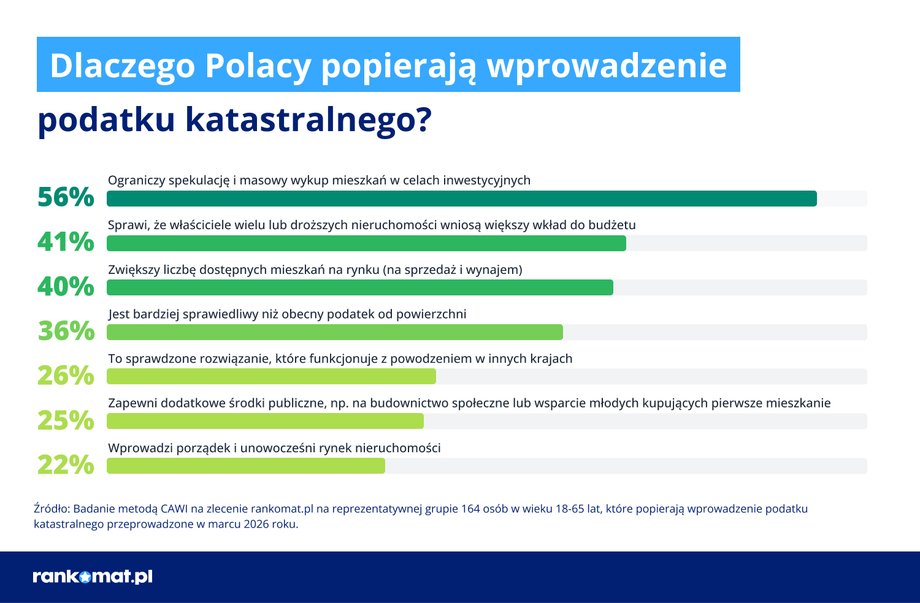
At the same time, the study clearly shows that Some Poles see the cadastral tax as an opportunity to organize the housing market. The most frequently cited argument by supporters is the belief that the new levy could limit speculative purchases of apartments and treat them solely as a capital investment. This opinion was expressed by 56 percent. people supporting the tax.
Cadastral tax
|
rankomat.pl
Cadastral tax
|
rankomat.pl
See also: Institutional leasing is growing in Poland. Such transactions arouse emotions
In recent years, the issue of investment purchase of apartments has become one of the hottest topics on the real estate market. The growing number of apartments purchased for cash, investment funds and the treatment of premises as a “safe haven” for capital result in people buying their first apartment are increasingly losing the competition with investors.
In this context cadastral tax is sometimes presented as an anti-speculative tool. Supporters of the reform argue that owners of many apartments should bear higher costs of maintaining extensive real estate portfolios. Some respondents also believe that higher taxation could increase the number of apartments available on the sales and rental market.
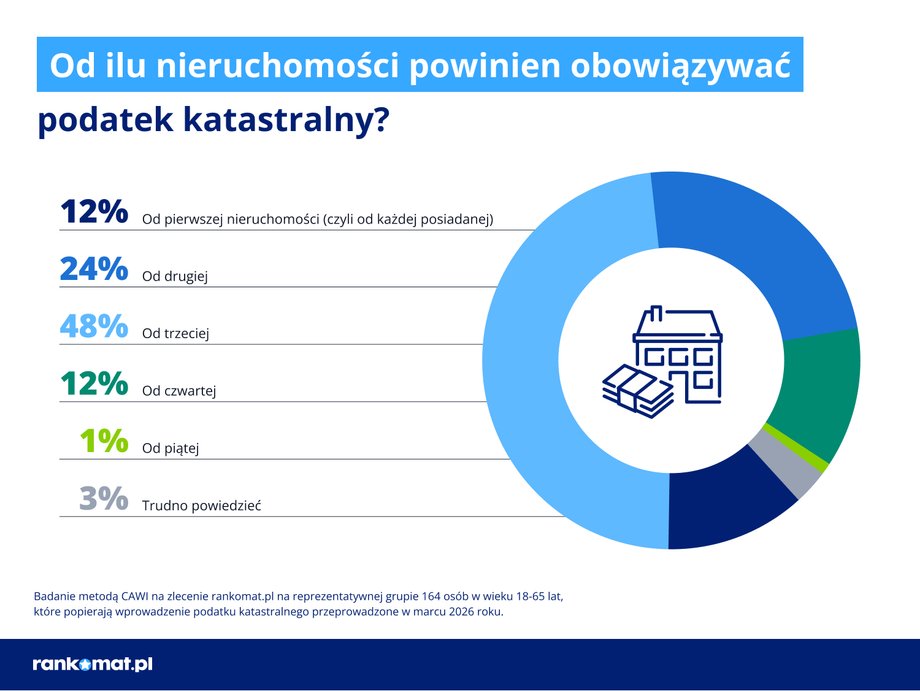
Interestingly, the supporters of the cadastre themselves most often do not want to cover all apartment owners. Almost half of the respondents declare that the tax should apply only to the third property. One quarter of respondents indicate a second apartment as the right moment to start taxation.
This is an important signal showing that public support for a tax appears mainly when it is perceived as a tool limiting mass investment in apartments, and not a burden for the average owner of one apartment.
Cadastre in Poland. What does the Left's project assume?
Although the government is not officially working on the cadastral tax, the draft changes have already been submitted to the Sejm. He assumes taxation of residential properties based on their value and not – as currently – on usable area.
The project provides a symbolic rate of 0.02 percent. values for the first and second apartment or house. Much higher taxation would apply to the third and subsequent properties. In the first year of the new regulations being in force, the rate would be 0.5% and then increase gradually to a maximum of 1.5%.
In practice, this would mean a huge difference from the current system. Today, the owner of a 50-square-meter apartment pays a maximum of several dozen zlotys in tax per year. After the changes, the owner of a third apartment in a large city would have to take into account a fee amounting to thousands of zlotys.
Read more about this topic in the material by Łukasz Zalewski.
Poles want housing more than new taxes
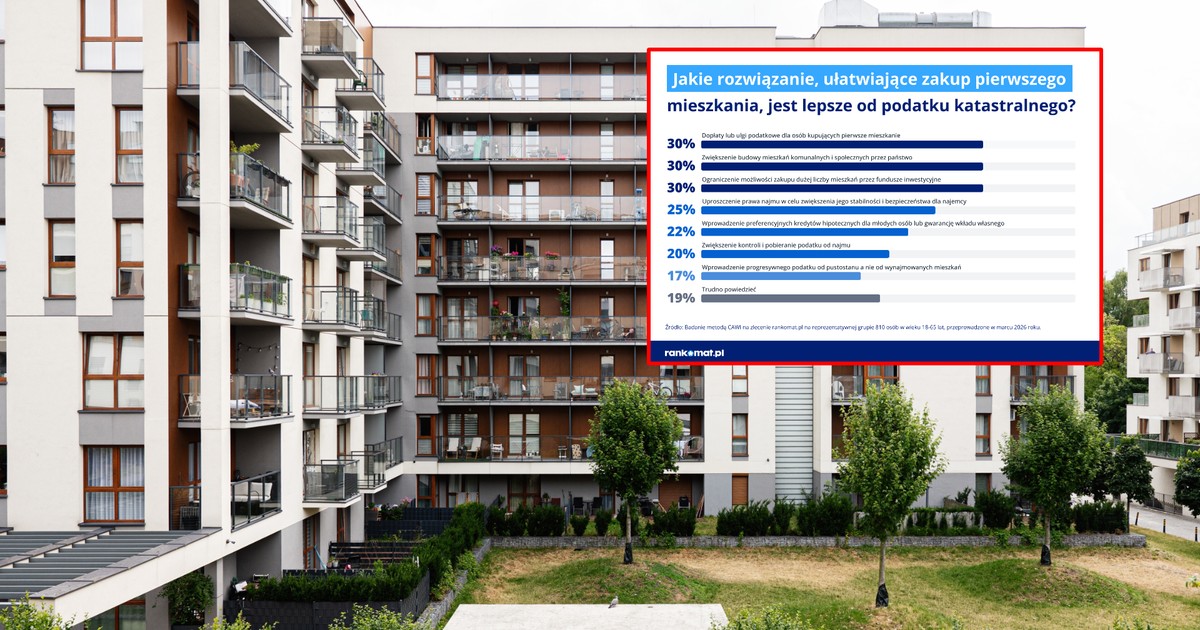
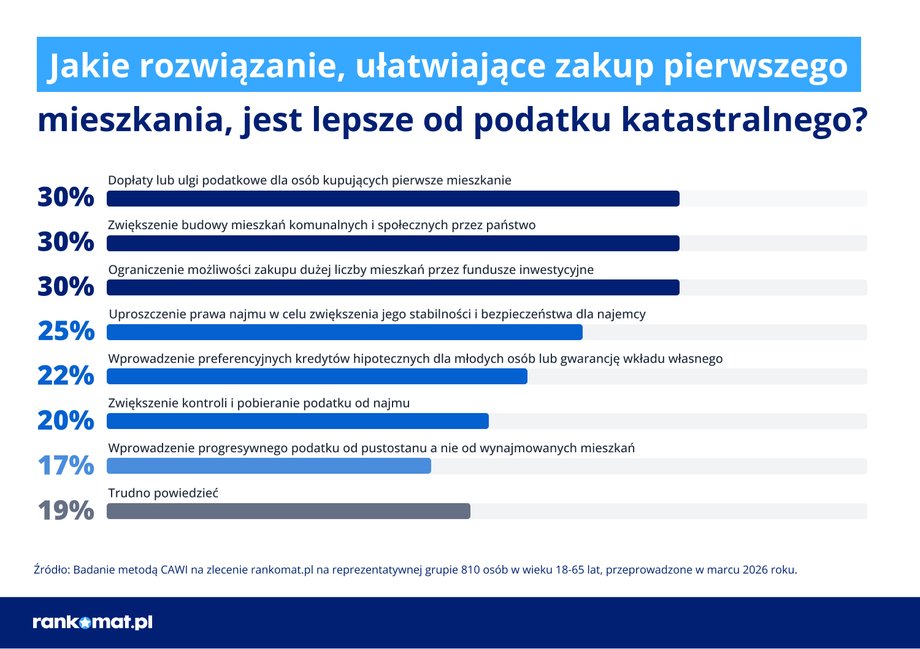
The Rankomat.pl study shows another important trend. Poles, although skeptical about the cadastral tax, recognize the need for changes in the real estate market. Respondents are much more likely to indicate other solutions as more effective support for people buying their first apartment.
Cadastral tax
|
rankomat.pl
Read: Cadastral tax project in the Sejm. There is an announcement from the Left
They gained the most support subsidies and tax relief for first-time property buyers, development of social housing and limiting the possibility of mass purchase of apartments by investment funds.
This shows that the social debate around the cadastre is in fact a discussion about a much broader problem – the availability of housing and growing inequalities in the real estate market.
Experts emphasize that The very word “cadastral tax” evokes emotions today. For some it is a symbol of a threat to private property, for others it is an attempt to restore balance in the housing market.
One thing seems certain, however: if the topic returns to real legislative work, details will be key. It is up to them whether society considers the tax to be a tool to combat speculation or just another cost burdening apartment owners.