
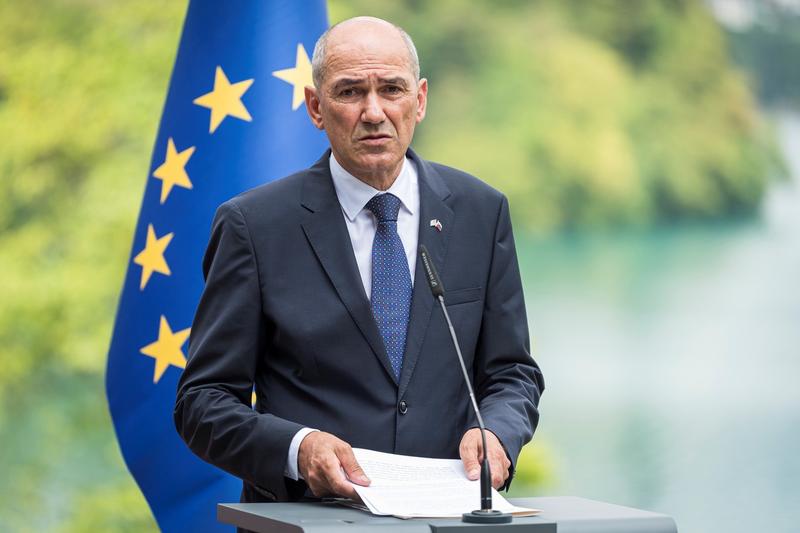
The leader of the nationalist right in Slovenia, Janez Jansa, was elected to the position of prime minister on Friday by the Parliament in Ljubljana, following the agreement of a minority coalition agreement and the fragile support of an opposition party, reports France Presse and Agerpres.
“Today an important step was taken towards a more prosperous and free Slovenia. Thank you and there will be no concessions,” Jansa immediately declared.
Janez Jansa, aged 67, obtained 51 votes from the 87 deputies present at the investiture vote and will take over his position in June, once his ministers are also approved, in a new session to be convened in the next 15 days.
Janez Jansa has already held the position of prime minister three times between 2004 and 2022 in this Alpine country with a population of two million inhabitants.
During his third term as prime minister, which ends in 2022, he sparked protests to defend press freedom and the judiciary, before losing the election to pro-European liberal Robert Golob.
This close associate of former Hungarian Prime Minister Viktor Orban and admirer of US President Donald Trump came second in the legislative elections in March, right after Golob's ruling coalition.
However, he failed to form a majority, and on Monday, Janez Jansa presented a minority coalition agreement.
His nationalist formation, the Slovenian Democratic Party (SDS, 28 seats), intends to govern together with New Slovenia (NSi, 9 seats), a Christian-democratic formation long anchored in the country's political landscape.
It also obtained the support of Demokrati (6 seats), a party founded in 2024 by Anze Logar, a dissident of the more centrist SDS.
In addition, two deputies from small lists joined this group, which brings the number of deputies who support Jansa to 43.
The party critical of the elite, Adevărul (Resnica), although it claims to be anti-system and pro-Russian, decided to support this heterogeneous coalition without participating in it, thus maintaining a pivotal position that allows it to influence the majority while remaining out of power.
“In terms of parliamentary majority, they will not be stable because of Resnica and, internally, they will not be stable either because of Anze Logar,” independent analyst Aljaz Bitenc Pengov told AFP.
The coalition remains formally pro-European, without a systematic blocking strategy. SDS is a member of the conservative EPP party, the first political force in the European Parliament. NSi and Democrats are also anchored in the European center-right zone.
However, Janez Jansa risks strengthening the block of critical leaders in the European Council.
He also intends to end the country's pro-Palestinian diplomacy.
The future Slovenian government is participating in a protest speech against elites and institutions, AFP notes.
His program revolves around a reduction in taxes, a decrease in public spending, a support for conservative values and a lack of trust in NGOs.
A civic group that also includes the Slovenian philosopher Slavoj Zizek submitted an appeal to the Constitutional Court, considering that the result of the March elections could have been influenced by the Black Cube scandal.
At the end of the election campaign, the authorities announced that they would investigate this Israeli company to determine whether it was the origin of the hidden camera videos that claimed the existence of acts of corruption within the government led by Robert Golob.
Janez Jansa admitted that he had met with a person in charge of Black Cube, but denied that he was the sponsor of these recordings.


