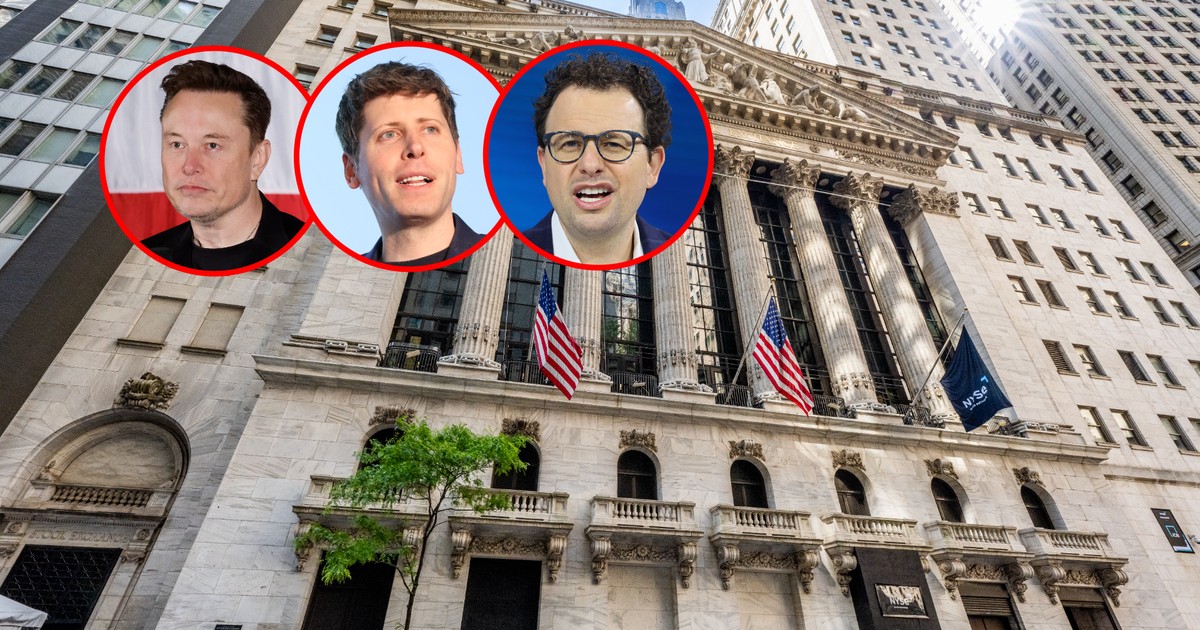
SpaceX, OpenAI and Anthropic are going to Wall Street. The race for investors' cosmic money is starting

SpaceX has just published a prospectus related to its plans to debut on the New York Stock Exchange (NYSE). This company, founded and controlled by Elon Musk, which over the years outside the stock market has grown into a space industry giant, is engaged in the design, production and launch of advanced launch vehicles and spacecraft. Its main goal is to drastically reduce the costs of orbital transportation, develop the global Starlink Internet network and enable the colonization of Mars in the future.
Read also in BUSINESS INSIDER
SpaceX plans to issue new shares to obtain money for the development of these ambitious projects. Estimated valuation range post money (i.e. after taking into account the capital raised from the issue) is as much as USD 1.75-2 trillion. (equivalent to PLN 6.4–7.3 trillion). To give you an idea of the scale: the annual Polish gross domestic product is approximately USD 1 trillion. (i.e. approximately PLN 3.66 trillion), and the total capitalization of Polish companies on the WSE is PLN 1.27 trillion (another PLN 1.34 trillion are foreign companies listed in Poland, mainly Banco Santander and UniCredit).
SpaceX can obtain twice as much from the issue alone as the entire Orlen is worth
If SpaceX's valuation estimates were true, it would be the company with the highest IPO valuation in history, overtaking Saudi Aramco (which was worth $1.7 trillion at the time).
This would also mean that Elon Musk's company would jump into the top ten most valued companies on global stock exchanges, she would probably be in the top five. The largest is NVIDIA (currently USD 5.41 trillion in capitalization), ahead of Alphabet (USD 4.66 trillion) and Apple (USD 4.44 trillion). Fourth is Microsoft (USD 3.13 trillion), Amazon is fifth (USD 2.85 trillion), and TSMC is sixth (USD 2.08 trillion).
SpaceX expects to get $75-80 billion from the IPO. from the issue of shares in the IPO (PLN 275-293 billion), which would make this offer by far the most lucrative in history. For comparison, the next leader is Saudi Aramco, which raised “only” $29.4 billion from its IPO a few years ago. The capitalization of the largest Polish companies on the WSE – i.e. the market value of all shares – is PLN 166 billion (Orlen) and PLN 124 billion (PKO BP).
See also: This CEO stood up to Trump and market rivals on AI. Now he has written an essay. Here are seven alarmist quotes
SpaceX aims to debut on Nasdaq (most likely under the ticker SPCX) in mid-June. The main engine of this astronomical – nomen omen – valuation is the rapidly growing Starlink and the recent absorption of xAI (an AI company founded by Elon Musk), which positions SpaceX as a double giant: space and technology.
SpaceX is becoming an artificial intelligence company
According to the prospectus, the group estimates its future market at USD 28.5 trillion. Interestingly, most of this amount (as much as USD 26.5 trillion) is to come from AI, language models and data centers, and the communications department – including Starlink Broadband and Mobile – is to provide up to USD 1.6 trillion. “Only” $400 billion. the remaining amount is to be the result of the space department.
Nowadays it's the other way around. In 2025, SpaceX generated USD 18.7 billion revenues, which meant an increase of one third year on year. Of this, connectivity brought 61 percent. total ($11.4 billion). This is a great operational and commercial success, because this segment has generated a large margin and is highly profitable. Spaceflight contributed $4.1 billion. revenues, and the AI segment (xAI, X.com and Grok) approximately USD 3.2 billion. Therefore, Elon Musk is selling investors a vision of the future in which the AI industry is to grow the fastest. Now this segment in his company generates an operating loss of $6.4 billion. (data for 2025) and this is probably one of the reasons for taking the company public and raising capital.
The company plans to allocate USD 20.7 billion. annual investment expenditure, which puts it in the same bracket as other AI companies such as Meta, Alphabet and Microsoft, which have also invested so much in technology development in recent financial years.
The SpaceX prospectus also includes the sale of existing shares, which will allow Elon Musk or other investors already present in the company to realize part of the profits, but this is a secondary goal to the main one, i.e. recapitalization of the company. After the debut, Musk is to maintain capital control over the company.
OpenAI and Anthropic are also preparing their stock exchange debuts in New York
There are two other technology giants in line for the New York trading floor: OpenAI and Anthropic. Before we get into the financial details, it is worth taking a look at the interesting relationships and events between the three debutants.
The case is interesting because OpenAI won a long-term court battle with Elon Musk this week. A California jury unanimously rejected Elon Musk's lawsuit against OpenAI and its CEO, Sam Altman. The case broke down over formal issues. The richest man in the world was one of the founders of OpenAI. In 2015, Musk and Altman founded this organization as a non-profit to protect humanity from threats posed by artificial intelligence.
See also: Strategic acquisition in the world of artificial intelligence. Developers are starting to worry
Now, in a lawsuit, Musk accused Altman of violating the agreement regarding the non-profit nature of the organization. Musk claimed he was deceived – supported the project with capital, believing that newly emerging artificial intelligence technologies (including the later ChatGPT) would be developed as a common good for all humanity.
In turn, Dario Amodei, president and founder of Anthropica (behind the market-conquering Claude model), together with his sister Daniela and a group of key engineers in In December 2020, he left OpenAIto start Anthropic. The official version is that as the head of security, he was afraid that OpenAI's pursuit of profit and the quick release of GPT-3 to the market would lead to the creation of AI systems over which humanity would lose control. He applied a different philosophy to the new company: Anthropic was established as a “public benefit company” (PBC) that was to put safety first (AI alignment) above profit alone, and its AI models are intended to be more ethical and controlled.
Tech giants will compete for money on Wall Street
According to preliminary estimates, OpenAI may be valued at between USD 850 billion. up to USD 1 trillion The pressure for a debut is strong and there are voices that Sam Altman wants to make it before the public offering of Anthropica, whose valuation may be lower, however, the amount is said to be USD 380 billion. (work on the IPO of this company is at an earlier stage and a possible debut could take place at the end of this year).
Market conditions are favorable, so it is not surprising that company owners want to take advantage by issuing shares and raising money for development. The Nasdaq 100 index, which includes technology companies and is dominated by the so-called the great seven (Alphabet, Apple, Amazon, Meta, Microsoft, NVIDIA, Tesla), are located near historical peaks. The record was reached in mid-May (29,679 points), and the current quotations around 29,300 points mean that since the beginning of the year the quotations have increased by 16%, and the 12-month rate of return is 37%.
The development of AI is an arms race in terms of expanding data centers and computing capacity, costing billions of dollars. This cannot be financed indefinitely from private investment rounds, so both OpenAI and Anthropic will issue new shares, although we do not know the amounts yet. This is to allow them to maintain their position as world leaders in their industries.
Wall Street investors have huge amounts of capital, but accumulating such large public offerings in one year may be a bit of a challenge. Brokers call this phenomenon liquidity drain and it consists in reducing purchases of shares of some companies on the secondary market or even reducing some of the positions held in order to accumulate cash reserves for purchases in the IPO.
This phenomenon may be even stronger the more “hot” the company that goes public is, and the more inflows to equity funds do not spoil the managers. Limits on allocation to shares are also a challenge; the statutes of some funds may have significant restrictions in this respect. All this may mean that some shares or market sectors may experience a slight shortness of breath as investors gather cash for the IPO (the most liquid companies are often targeted because their shares can be sold in large quantities without excessive price reductions).