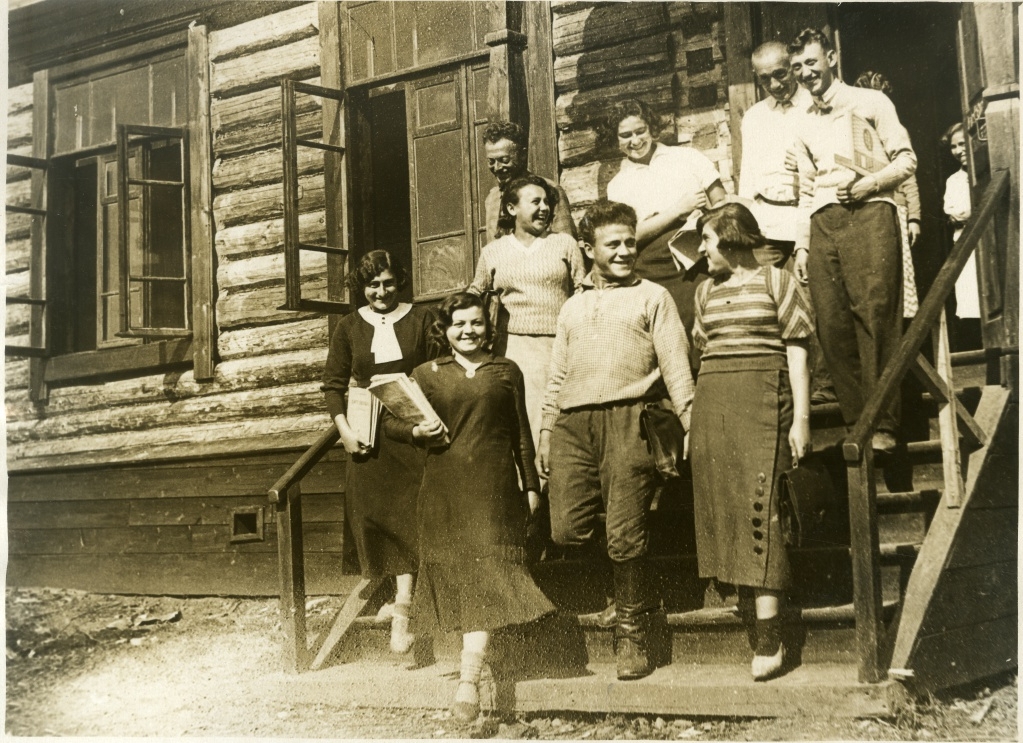
Village school teachers
Photo: Heritage JAO
May 17, 1938
The newspaper “Birobidzhan Star” (12+) on May 17, 1938 informed its readers that the first pre-election meeting of Birobidzhan enterprise teams was held to nominate candidates for deputies of the Supreme Soviet of the RSFSR from the Birobidzhan electoral district. The meeting was attended by 900 people; the meeting was opened by the secretary of the party committee of the garment factory, Comrade. Khaitovich.
Clippings from the newspaper “Birobidzhan Star”. Photo: Photo: Regional Library
The meeting unanimously nominated comrades I.V. as candidates for deputies of the Supreme Soviet of the RSFSR. Stalin, V.M. Molotov, L.M. Kaganovich, K.E. Voroshilova, N.I. Ezhova, V.K. Blucher, G.M. Dimitrov and N.S. Bigler.
At the end of the meeting, a speech was made by a deputy of the Supreme Soviet of the USSR, acting secretary of the regional committee of the All-Union Communist Party of Bolsheviks, comrade. Sukharev. He called on all voters to actively participate in the election campaign and launch campaigning for the nominated candidates.
May 17, 1939
The newspaper “Birobidzhan Star” wrote on May 17, 1939 about awarding the best rural teachers in the region with government awards. Among those awarded: the medal “For Labor Distinction” – the director of the secondary school of the collective farm named after. Stalin of the Stalin district of the EAO Sapozhnikov Mark Yakovlevich, teacher of the Smidovichi secondary school Vedishchev Sergei Dmitrievich, teacher of the Londokov secondary school Kravets Naum Abramovich.
The Order of the Red Banner of Labor was awarded to: teacher of the elementary school of the collective farm named after. Stalina Stalin district Kuzmina Antonina Anufrievna, director of the incomplete secondary school of the collective farm “Far Eastern Collective Farmer” Smidovichi district Lichtenstein Mikhail Izrailevich, teacher of the Lenin incomplete secondary school Surovtseva Evdokia Ivanovna, teacher of the Lenin rural incomplete school Shpitsa Maria Kirillovna, teacher of the Londokovsky secondary school Yuryeva Maria Leontievna.
May 17, 2005
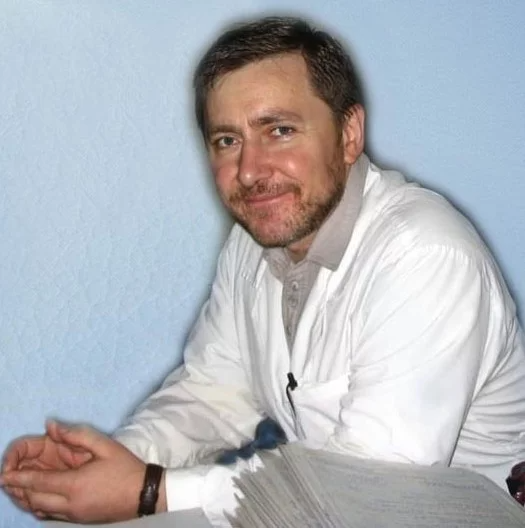
Alexander Vasilievich Lavrentiev. Photo: Photo: Website of the Sanus Medical Center
The newspaper “Birobidzhan Star” wrote on May 17, 2005 about the award for services in the field of healthcare and many years of conscientious work. By decree of the President of the Russian Federation, the honorary title “Honored Doctor of the Russian Federation” was awarded to the head of the department of the municipal health care institution “Obluchenskaya District Hospital” Alexander Vasilyevich Lavrentyev.
The newspaper reported that the Jewish Autonomous Region took part in the Internet competition of the All-Russian relay race “Eye for Victory,” in which 84 regions participated. The website of the Jewish Autonomous Region, dedicated to the role of the region during the Great Patriotic War, is recognized as one of the best in the country. The site was noted as one of the most vibrant in content and readable. As a result, the Jewish Autonomous Region remained in second place in the all-Russian competition of Internet pages dedicated to the Great Victory.
The newspaper published a large article about a participant in World War II, the oldest teacher and artist in the region, Nikolai Grigorievich Sidorov.
In 1942, Nikolai went to the front and was assigned to the 151st reserve rifle regiment stationed in the village. Sopka of Birobidzhan. He joined the engineering forces, sappers, learned electrical engineering in the army, learned how to build houses, bunkers and pillboxes. In 1945, the Great Victory came in the West, in Europe, and a short, bloody war began in the Far East. Sapper Nikolai Sidorov ended up in Manchuria, and he had to prepare to seize the airfield and establish crossings across Chinese rivers. After the end of the war, the unit where Nikolai Sidorov served was stationed in the village of Leninskoye. There, at the same time, he was engaged in the construction of fortifications on the Amur Islands, now transferred to China, and wrote notes in army newspapers.
After demobilization, Nikolai Grigorievich was invited to become the director of the House of Culture in the village of Leninskoye. Soon he entered the pedagogical school in Birobidzhan in the art and graphic department. After the war, there were not enough teachers at the artistic department and Nikolai, as the best student, was offered to teach special subjects. So he worked there for 17 years. After that, he graduated from the history department of the Khabarovsk Pedagogical Institute.
After 17 years of work at the pedagogical school, Nikolai Grigorievich moved to the newly opened light industry technical school, where he worked until retirement.
I have been seriously involved in photography for 25 years. After retiring, he took up painting again. He painted more landscapes in oils and began to participate in city art exhibitions. Over the years, his vision began to deteriorate, and his hands required work, and the artist switched to graphics. Then he stopped coping with this too, so, instead of painting, Nikolai became interested in decorative and applied arts.
May 17, 1995
The reference and information publication “Streets of the City of Birobidzhan: According to Documents of the State Archives of the Jewish Autonomous Region” (0+) contains information that by order of the head of the administration of the city of Birobidzhan dated May 17, 1995 No. 296, the newly planned street in the multi-storey building area of the village of Birobidzhan-II was named after Korolenko.
The street is named after the Russian writer, publicist, journalist, public figure, who earned recognition for his human rights activities, both during the years of tsarist rule and during the Civil War and Soviet rule. The writer was an ardent supporter of the social purpose of literature.
In the last years of his life, V. Korolenko worked on a large autobiographical work, “The History of My Contemporary” (6+). The work remained unfinished.