Only “two real possibilities to increase” the budget workers' salaries in 2027, Bolojan announces. “Because otherwise we would get into a dead end”

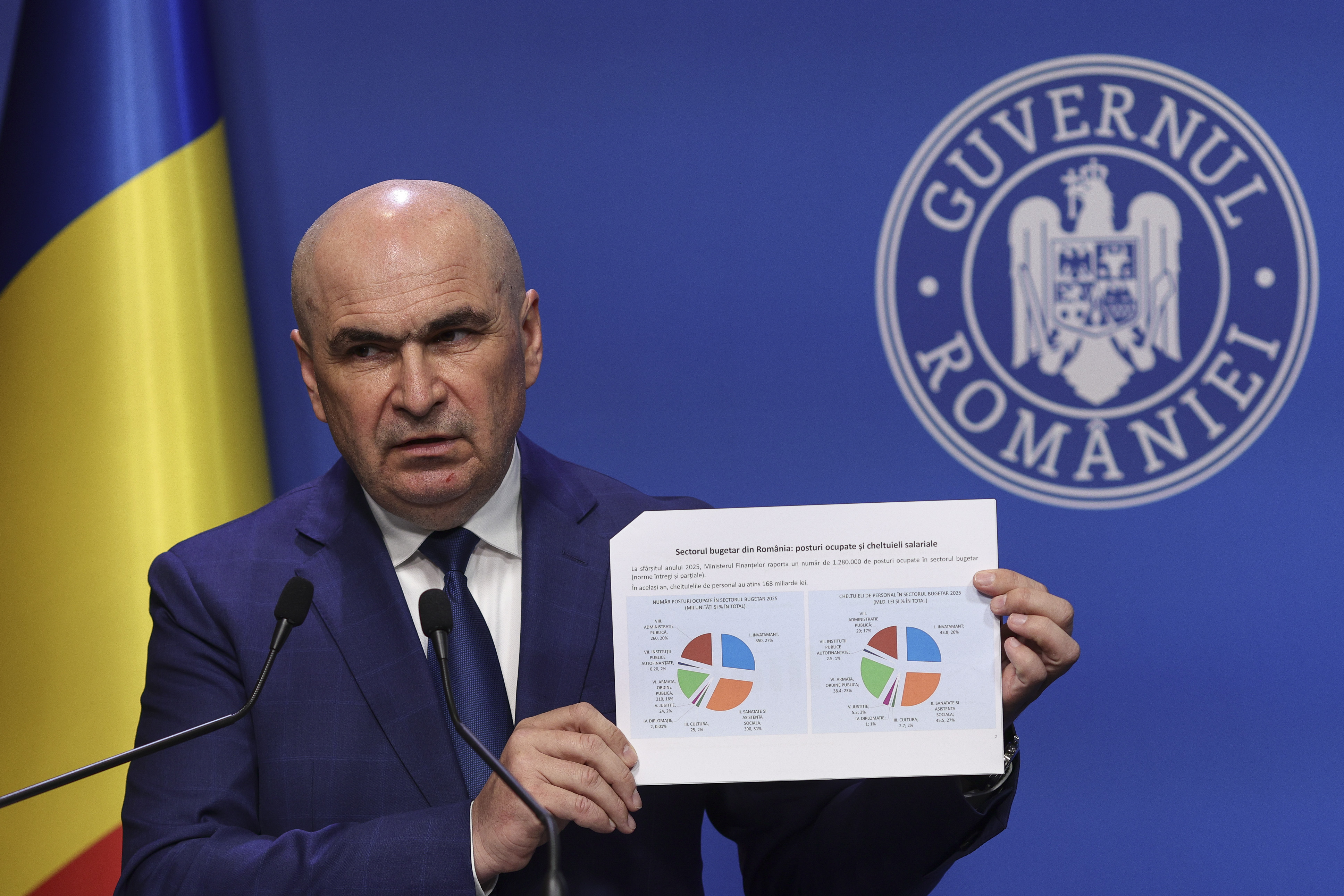
Interim Prime Minister Ilie Bolojan said on Thursday, about the law on the unitary salary of budget workers, that for the salary increase starting next year “we have only two real possibilities: either a small amplitude increase, if the public sector will not be affected, or larger increases through a staff reduction, where it is not justified”.
The head of the government warned that the level of salary expenses in the public sector reached approximately 166 billion lei, equivalent to 8.1% of GDP.
Bolojan made several statements to the Government on Thursday regarding the draft law on unitary wages in the public system, a milestone in the PNRR with a funding of over 770 million euros, money that we risk losing if this law is not adopted by the end of August this year.
“As you know, we have a commitment from previous governments to come up with an amendment to the wage law so that public sector wages are set transparently. Today there are various interventions over the years that have meant arbitrary increases in certain sectors or court decisions that have changed wage systems,” Bolojan said.
“We have wage costs disproportionately high compared to the possibilities of this country”
According to him, “it is also necessary to correlate the salary in the budget sector with productivity, equity in this sector and a salary level that takes into account the real possibilities of our economy and the context in which we find ourselves”.
“Today we have, no matter what one says, salary expenses in a total tire, to be clear, disproportionately high compared to the possibilities of this country, compared to the budget revenues we have”, declared Ilie Bolojan.
The Prime Minister announced that in the coming period there will be discussions both between the parties, as well as between the Ministry of Labor and professional representatives from each field, on this subject and presented some data that will be the basis of these discussions.
More than 1.2 million budgeters at the end of 2025
“We have one million two hundred and eighty thousand positions in the public sector in Romania, according to the data collected from the Ministry of Finance at the end of last year, distributed by professional category. We also have wage policies that are decoupled from the dynamics of labor productivity. And what do we find? That the wage gap between the public and private sectors is deepening; this trend is very clearly seen,” said the interim prime minister.
Budget wages are decoupled from productivity
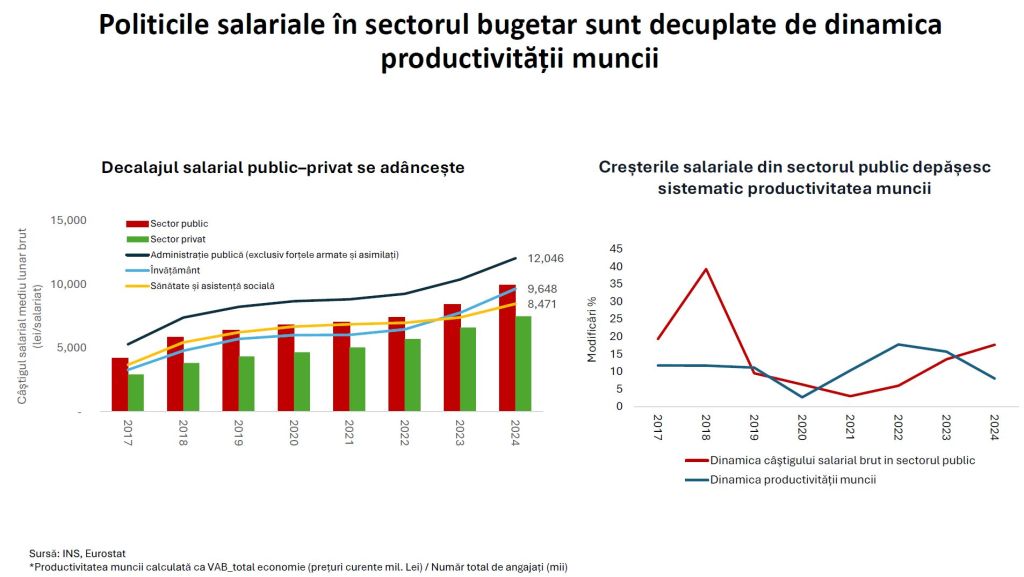
Another problem pointed out by Bolojan is that “we have salary increases in the public sector that did not take into account productivity”.
“From every leu collected, more than a third covers the salaries of budget officers”
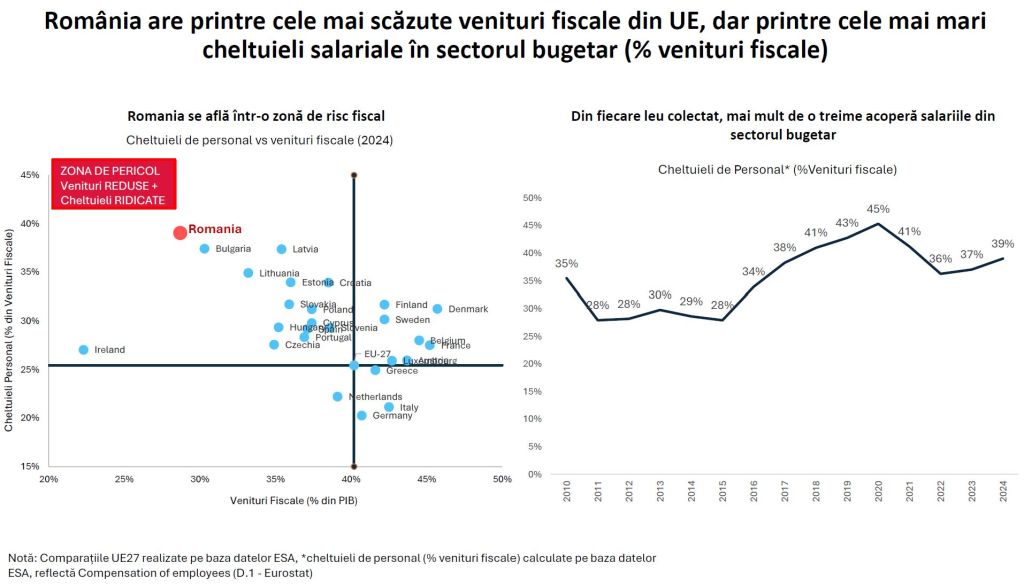
Last but not least, he said, we have a situation in which Romania has among the lowest tax revenues among the countries of the European Union, but among the highest salary expenses in the budget sector, as a percentage of tax revenues.
“And there are two important axes here. This is the axis where the average income in the countries of the European Union is 40% of GDP, public income; Romania is in an area where we are somewhere at 30%. So, far below most European public income. Also, the second axis is the percentage represented by personnel expenses as a percentage of income and, as you can see, we have a percentage of 40%, among the highest,” said the prime minister.
Any legislator must take these constraints into account, he claims.
“So, lower revenues than other European countries compared to GDP, personnel expenses with a fairly large share of revenues, in such a way that today, practically, of every leu that is collected in Romania, 39% covers salaries in the budget sector. This is the situation,” Bolojan emphasized.
The two scenarios of salary increase for budget workers
The Prime Minister emphasized that these are the salary data that will be taken into account for a salary law that is sustainable and that does not create expectations that cannot be met.
“Everything also depends on Romania's commitments regarding the reduction of the budget deficit and the constraints we have as a country, because, as you know, only the interest we pay this year represents almost 3% of Romania's GDP, so somewhere around 60 billion lei”, said Ilie Bolojan.
Wage expenses can no longer exceed 8.1% of GDP
The constraints we have are related to keeping a percentage of the wage envelope, as a share of Romania's GDP, which is very slightly above 8% of GDP.
“Today we have 8.1% of GDP and, therefore, we will not be able to have a larger share of this tire in the coming years, because, effectively, we cannot afford it. Not because someone does not want, but because otherwise we would enter a dead end. Today, for example, we have approximately 166 billion lei in total salary expenses in the public sector, which represents 8.1% of the data communicated by the Ministry of Finance”, declared Ilie Bolojan.
The prime minister presented the only scenarios for increasing the salaries of budget workers next year.
“The increase that can be made from next year must take into account these data, and we have only two real possibilities: either an increase, a correction of small amplitude, if the public sector will not be affected, or, if we really want corrections of greater amplitude, greater increases and greater reductions of inequities, then the only solution is to reduce the base of public expenditure, so the reduction of staff where it is not justified, in such a way that the freed spaces allow better payment of those who really work in the public sector,” he said.
The salary law, mediated by the president Nicușor Dan
Ilie Bolojan said that “there are alternatives that will be discussed in the next period”, specifying that everything is mediated by the Romanian president.
“And I should thank you because, in these days, the President of Romania, through Mr. Burnete, generated a debate in the Parliament, in which I participated, the Government, through Mr. Interim Minister of Labor, Mr. Pîslaru, and I hope that in the coming days the responsible political people in Romania will agree that these aspects related to the absorption of European funds, the reforms made with a head, which are sustainable, which do not generate delusions among the citizens, even those in the public sector, and who take into account the financial situation of our country, will find a normal formula to have a salary law that respects this milestone”, the prime minister said.