Article by Narcis Drejan – Published on Thursday, 14 May 2026, 00:11 / Updated on Thursday, 14 May 2026 00:11
Craiova did not play spectacularly, but won the Romanian Cupthere was no champagne football in the championship either, but Coelho has a Portuguese precision, and the people of Olten feel that the 35-year wait was worth it. There's another country, as the people of Craiova say, you too, muica, are waiting for a country, because that day is coming…
Science won the Cup and the city feels it for the 9th time in history, and here I'm not talking about statistics, nor about past performance in cold records, the people of Olten feel it like a wound that, for one night, doesn't hurt anymore, even though it's open.
In Bănie, football was never a sport, it was people's way of surviving beauty and sadness at the same time. There, between the gray blocks that still keep the echo of the 80s, between the Ciupercă terrace, the famous “Stadion” pub, although everyone called it “La Ciupercă”, where people talk about Balaci's passes as if they saw them yesterday and among the old people who still say “Science” before they say “Craiova”, football does not end at the referee's whistle.
He remains on the streets, in the family, in the way people greet each other the next day, in every T-shirt bought with the lion on the chest for children, grandchildren or relatives.
The city that can't love a little
To understand, Craiova loves as Marin Sorescu and Fănuș Neagu wrote about the south: exaggerated, hot, tragic and beautiful. With people who laugh out loud and suffer even louder, with great prides, cold heads, and souls impossible to hide. If you've spent at least one night on Calea București after a big match, you've understood that there are places where football becomes the mother tongue.
If you crossed the city from May 1 to Craiovița, after a victory in the rain, you would have seen the rainbow as the sun in Banie. This is how people from Craiova feel when they love. And over all this the same good shadow always hovers: Ion Oblemenco.
The gunner from Bănie has not been just a great striker for many years, he has become something more difficult to explain, since Barbu from Panaghia erected a statue to him during the time of Ceaușescu, a kind of sentimental patron of the city.
In Craiova, when the team falls, people say his name almost religiously, as if his legend could still put the ball in the goal. That's what a true myth means, staying present even after time has passed you by. From Oblemenco to Craiova Maxima is just a breath for this city, and the fans are not kidding, and their history is suffering!
Balaci, with his elegance of a South American prince lost in Romanian communism, was also called the Blond Wonder, a paradox of Oltenia, Cămătaru, the attacker who seemed made of strength and instinct, Costică Ștefănescu, calm like a general who knew that great battles are won without panic.
Long, the man who defended as if the whole of Oltenia was in his gloves, Țicleanu, Donose, Geolgău, Negrilă, names that in Craiova are not former footballers. They are relatives, they are pieces of collective memory, because the first names of today's children are taken from Maxima's legends.
When the present is enjoyed
When Craiova wins, not only the present is happy, it seems as if the beautiful ghosts of the old stadium, the Central of our childhood, also rise a little, as if you hear again the European evenings in which Science made the continent discover that there is a crazy city in the south of Romania that plays football with Latin talent and pride.
Because no one has ever felt football like this city, Bucharest consumed it politically, Transylvania organized it, but Craiova lived it viscerally, with excess, with drama, with passion, with arguments and reconciliations, with supporters whistling their own players and then crying for them at the end.
Maybe that's why the comparison with Naples comes so naturally, that we have cities that can't stand half measures, cities where football is linked to identity, pride and the permanent feeling that you have to prove something to the whole world.
If Napoli had Maradona, Craiova had Balaci, and those who saw them say the same thing, almost in a whisper: “there will never be another!”
And look, years have passed. Patrons, scandals, lawsuits, bankruptcies, revivals and hubris came. Generations have passed that have grown up with more stories than trophies, but the city has remained the same, stubborn to believe, with a patron who did not give up and felt that the team was the supporters, not his own business.
The man Laurentiu Popescu
Tonight, destiny chose its hero again among those who suffered, maybe he didn't defend in a perfect final, maybe the match didn't have the beauty of the great recitals. But great stories don't demand perfection, they demand sincerity, and his truth lay in a saved penalty and an explosion of people who felt, for a few seconds, that all the footballing pains of recent years were washed away in one parade. He did the same in 2021, he also scored the penalty that brought the 8th Cup to the city of Craiova.
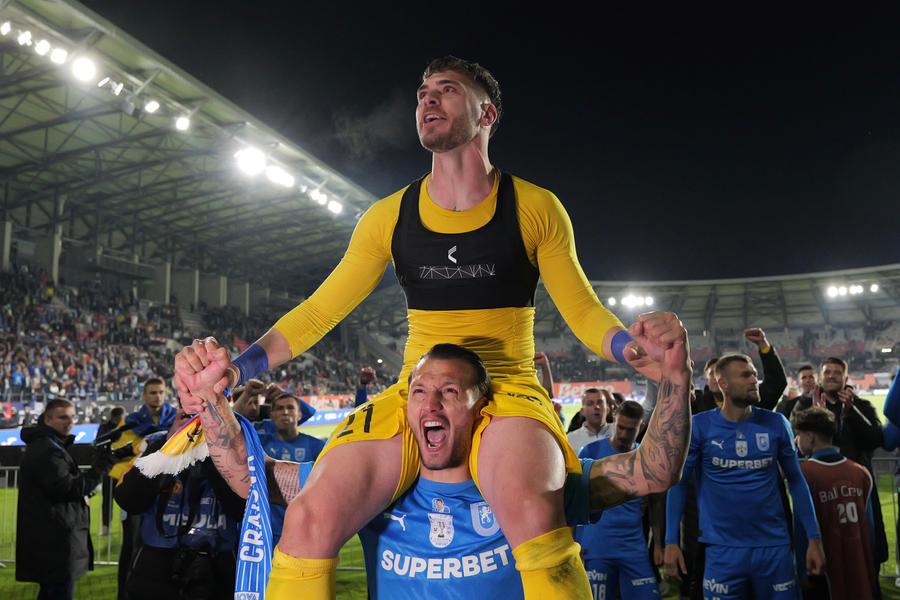
A goalkeeper who cried and came back stronger. How could Craiova not love such a story? This city has a cult for people who fall gracefully and rise stubbornly. That's why the anthem hurts so much when you hear it in the stadium: “We rarely have joy…”.
I told you, in Craiova happiness is not a habit, it is an exception, and it is precisely this rarity that makes it so violent. Trophies are counted everywhere, only the people of Oltenia feel, they don't bother with statistics, and that makes Craiova a phenomenon difficult to explain for those outside Oltenia. And when Craiova receives a soul, it never forgets!