This solution could virtually cut off the Persian Gulf countries, including the huge computing centers of technology giants, from the Internet.
According to Iran International, Tasnim, Iranian news agency affiliated with the Islamic Revolutionary Guard Corpspublished an article titled “Three Practical Steps to Generating Revenue from Internet Cables in the Strait of Hormuz.” The article describes thatsubmarine fiber-optic cables running through the strait carry more than $10 trillion. in financial transactions per daybut argues that Iran has been deprived of the economic and sovereign benefits of this critical communications infrastructure due to what it calls a traditional view of the strait.
According to the website, the Islamic Republic should take three steps:
- download preliminary license fees and annual fees for their renewal from foreign owners and cable operators
- require that technology companiessuch as Meta, Amazon and Microsoft, which use cabling, they operated in accordance with Iranian law
- provide to Iranian companies exclusive access to cable inspection and maintenance
The agency said the measures would transform the Strait of Hormuz into a “strategic center for legitimate wealth creation.” The idea of charging and managing fiber optics is a big shift in Iran's policybecause so far it has mainly threatened to destroy infrastructure.
Also, Fars, another prominent Iranian website linked to the Islamic Revolutionary Guard Corps, published a similar post on X, describing Iran as the ruler of the “hidden highway” in the Strait of Hormuz. The portal quoted that over 99 percent international internet communications are carried out via undersea cables, which are the backbone of global technology giants such as Google, Meta and Microsoft.
The post stated that a significant part of this communication route passes through the Strait of Hormuz and that the cables are legally located in an area where Iran can exercise sovereign control over themadding that the transit law does not deprive Iran of this authority.
Fars also stated that a cable outage lasting just a few days could result in losses of up to hundreds of millions of dollars to the regional and global economy.
Fars proposes the same three steps as part of its proposed Strait governance model. According to the website, it is would make Hormuz one of Iran's “digital power” assets.
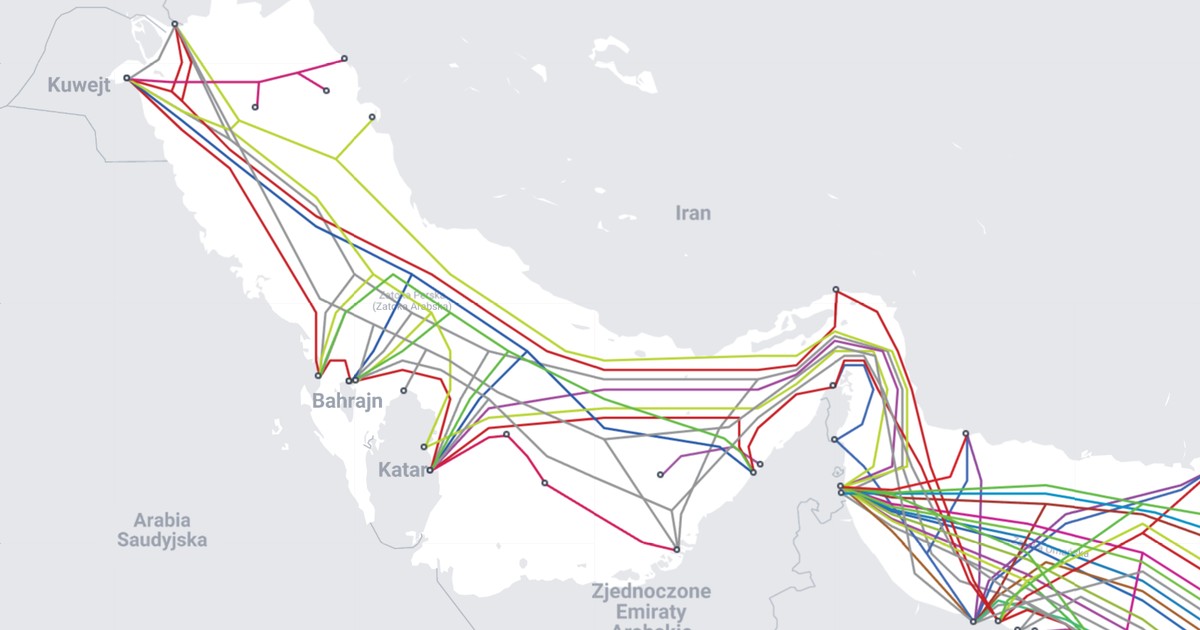
These articles refer to an earlier Tasnim report from April, which it showed a map of seven major undersea internet cables and cloud infrastructure around the Persian Gulfincluding routes through the UAE, Qatar, Bahrain, Kuwait and Saudi Arabia.
Map of submarine cables in the Persian Gulf region
|
Submarine Cable Map
The report argued that countries on the southern side of the Persian Gulf are more dependent on maritime internet routes than Iran, and landing stations were indicated (connecting undersea optical fibers with terrestrial ones), data centers and cloud infrastructure as strategic pressure points in the conflict.
Cables running through the Strait of Hormuz and the Red Sea account for 17 percent. global traffic – including to AI centers in the United Arab Emirates and Saudi Arabia – potentially causing disruptions of many months.
2Africa Pearls
Back in March, the war between Iran and the US dealt a critical blow to global digital infrastructure, forcing Meta and its partners to halt work on the project 2Africa Pearls — an extension of the larger 2Africa submarine cable system. The extension was intended to connect Oman, UAE, Qatar, Saudi Arabia, Bahrain, Kuwait, Iraq, Pakistan and India. The entire project was supposed to have a total value of 45,000. km long and was supposed to provide cheap internet to 3 billion people in the world. Activation 2Africa Pearls was planned for 2026.
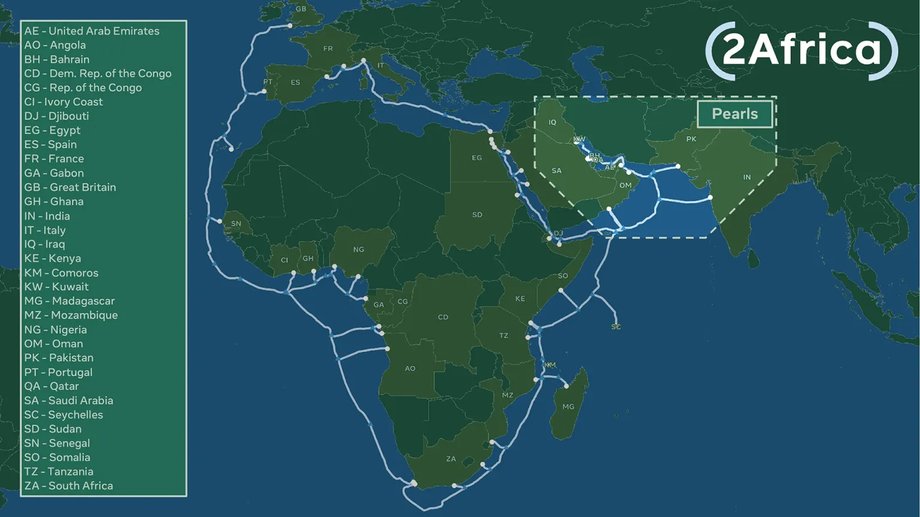
2Africa Pearls
|
engineering.fb.com
The impact of the Iran conflict goes far beyond the 2Africa Pearls project. Many digital infrastructure projects in the region – including SEA-ME-WE 6, Fiber in Gulf (FIG) and the WorldLink transit cable project – have come into question.
Al Khaleej
SEA-ME-WE 6 is a major next-generation undersea cable system connecting Asia, Europe and Africa, developed by a consortium including France's Orange and Singapore's Singtel, and provided by the American company SubCom. As the southern Red Sea region became an increasingly risky chokepoint, the SMW6 consortium prioritized a ground bypass through Saudi Arabia. Instead of relying solely on the sea route, SMW6 adopted a hybrid subsea-land architecture.
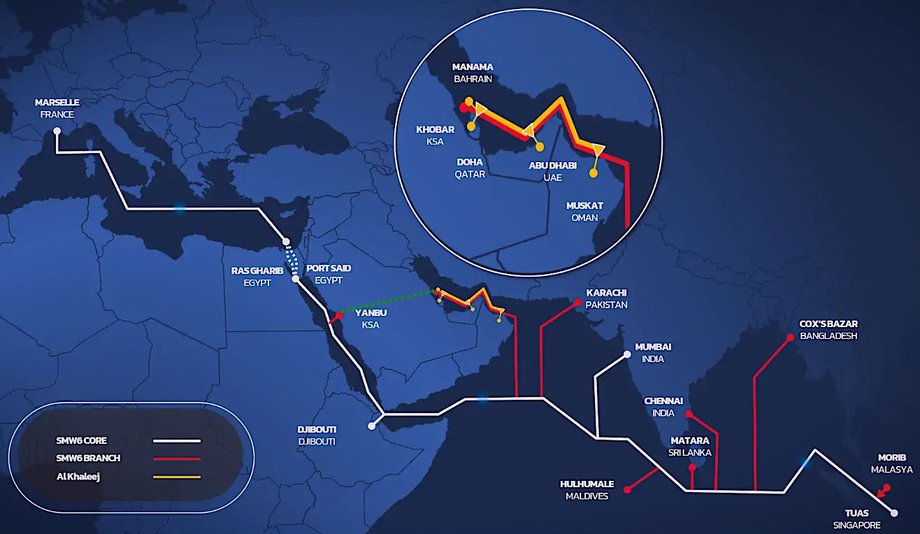
SEA-ME-WE-6 Gulf Extension – Al Khaleej
|
SMW6 Consortium
Similar to 2Africa Pearls, extension SEA-ME-WE 6 Gulf Extension, also known as Al Khaleej, was planned to pass through the Strait of Hormuz. On to the eastern coast of Saudi Arabia, and from there the traffic would continue through the Arabian Peninsula above 1,000-kilometer land bridgeall the way to the western shore of Saudi Arabia, where it would reconnect to undersea fiber optics at Yanbu. Thus completely bypassing the Bab al-Mandab Strait in Yemen.
Other
Iran has also threatened to destroy other fiber-optic cables in the Persian Gulf, which are the main cables running through Iraq's Al-Faw port, including Falcon, Fiber in Gulf (FIG), Gulf Bridge International (GBI), WorldLink.
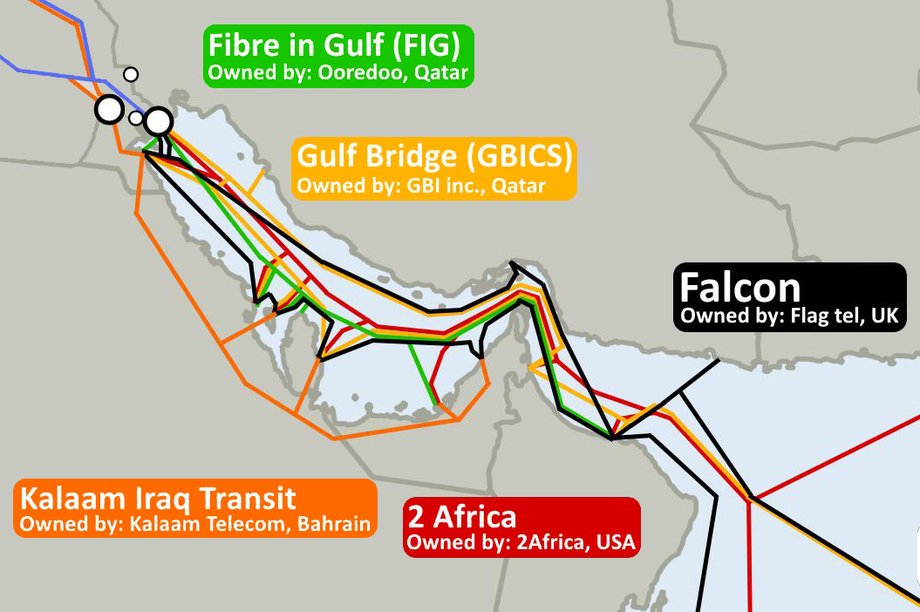
Fiber optics passing through Al-Faw port in Iraq
|
reddit/Assyrian_Nation