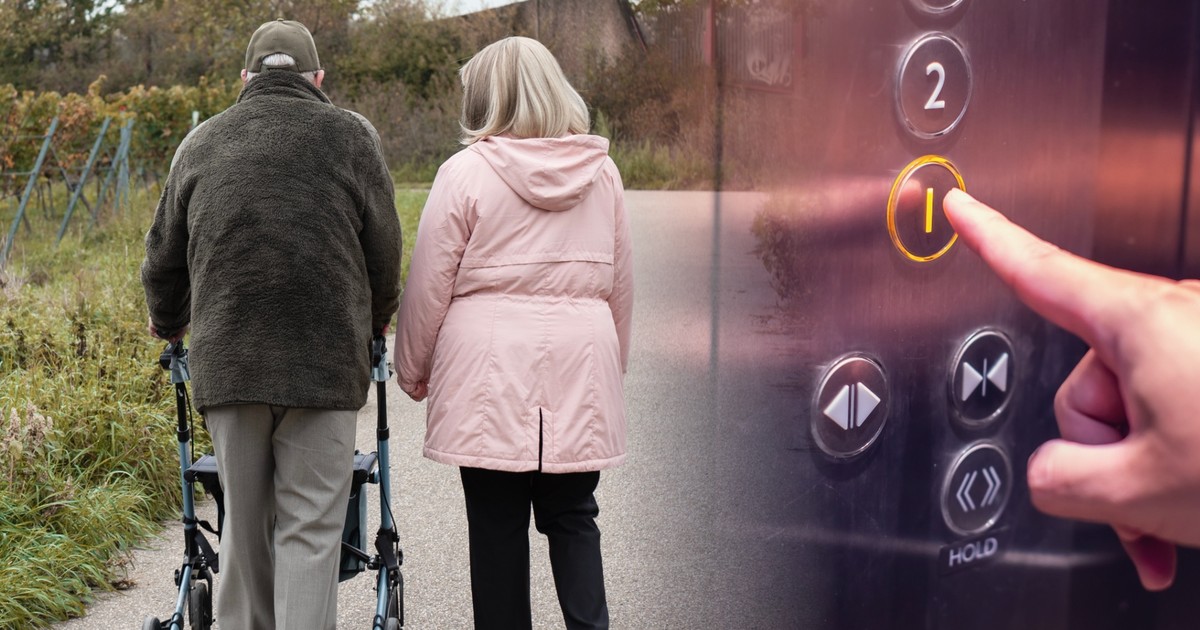
Poland is aging rapidly, and the housing market is increasingly faced with the problem of inaccessible buildings. According to data from the Central Statistical Office people aged 65+ already constitute over 21%. society, and the old age index was 148 in 2025. This means that there are already 148 seniors per 100 children. The average resident of Poland is now almost 44 years old. This changes not only the labor market and the social welfare system, but also the way apartments and multi-family buildings are designed.
Senior housing is no longer a niche. The aging of society and the growing number of people over 60 years of age mean that the senior living segment is becoming one of the most important trends in the real estate market. The problem, however, is that a huge part of the existing housing stock was built at a time when architectural accessibility was practically not considered.
That is why the changes in the regulations regarding elevators announced by the Ministry of Development and Technology caused such great emotions. For many months, there has been information in the media suggesting that from 2026, communities and cooperatives will also have to install elevators in existing buildings.. This aroused hope among seniors and people with disabilities, but also fear among residents and opposition from property managers who raised alarm about the gigantic investment costs, even in millions of zlotys.
However, as our conversation with the Ministry of Development and analysis of the draft regulation shows, the reality is different.
Read also: Decisions on development conditions under the microscope. Freedom expert warns investors
“Prisoners on the Fourth Floor”. Report from blocks of flats without elevators
So I walked around Ożarów Mazowiecki, where I have lived for several years, to look for local “prisoners of the fourth floor”. I talked to seniors from blocks of flats near Poznańska, Floriana and Obrońców Warszawy streets. Mostly they are 3- and 4-story buildings, several dozen years old, without elevators.
I met two ladies, around 80 years old.
“Luckily, we live on the ground floor,” one of them tells me. “I don't know how I would cope if I had to live on the first floor,” she adds.
“But there's a lady named Krysia who lives in my staircase on the fourth floor,” adds the second interlocutor. — He walks with a cane and a stroller on special wheels for stairs. He comes down these stairs very slowly. But somehow he manages.
I go further and meet Mr. Zygmunt. He lives on the second floor.
— It's not easy, I admit. But what can you do about it? – says.
I inform him that regulations regarding elevators in buildings as tall as his are supposed to come into force in a few months.
“Oh, I guess I won't live to see it,” he replies. — But it would be useful, oh, it would be useful.
A few streets away, I see a woman returning with groceries and laundry from the laundromat. Mrs. Grażyna lives on the fourth floor.
— I'm still coping. But I don't know what will happen in a few years, he says. – The worst thing is, as you see, when you have to bring in larger purchases.
He reacts to information about planned changes with a slightly cynical smile.
— The previous Prime Minister already promised us this. I don't really believe it will be any different this time.
I ask if she has considered moving to the lower floors.
— I've considered it. But When you look at today's apartment prices, this is where the considerations end – sums up.
It is difficult to meet people in the building who are actually “prisoners of the fourth floor”, because they often simply do not leave their homes anymore. Mrs. Grażyna remembers her disabled neighbor.
“He couldn't even get out of the ground floor,” he says. A neighbor died a few years ago.
On the way back, I meet Mr. Maciej, who walks with a cane.
“I don't live high up, but it's still not easy,” he says. — The children offered to take me to their place, but I prefer to stay on my own.
Similar stories can be heard all over Poland. My parents, mainly for health reasons, moved from a two-story house in the countryside to a ground-floor apartment in a block of flats. Today they only have ten steps to climb, but even that becomes a problem over time.
This is even stronger in the story of Mrs. Łucja, a 93-year-old living on the third floor of a block of flats in Nakło nad Notecią.
— I'm getting older, I've had hip and spine problems for some time. It's not easy, he says.
When I inform her about possible new regulations, she responds enthusiastically.
– Oh, I'd be happy if the elevator worked! Let those in power start with Nakło, the senior woman laughs.
She emphasizes that without the help of her family and assistant, she would not be able to cope with everyday life.
— Not long ago, I did everything myself: shopping, cleaning, walks, meetings. Today I try to leave the house at most once a day.
Interestingly, 18 years ago, after her husband's death, she moved from the apartment on the first floor to a smaller apartment on the third floor.
— Back then, I didn't even think about future problems related to the lack of an elevator. I was in good shape, I even thought that climbing stairs was great exercise.
Elevator regulations 2026. What will really change?
It is with such people in mind that new regulations regarding the accessibility of buildings have been prepared. Key changes included draft regulation of the Minister of Development and Technology on the technical conditions to be met by buildings and their location.
The project assumes that from September 20, 2026, the obligation to equip elevators will cover:
- multi-family residential buildings with at least three floors,
- public buildings with at least two floors,
- collective housing buildings with at least two floors.
Today, the obligation to install an elevator applies as a rule, buildings higher than 9.5 metersi.e. usually four-story and higher. The new regulations significantly lower this threshold.
However, the most important thing is what the project does not provide for.
Contrary to earlier signals from the media the new regulations do not mean an automatic obligation to add elevators to all existing blocks.
— I want to clearly emphasize that contrary to previous media reports the new regulations do not mean the obligation to add elevators to all existing multi-family buildings. This type of information is false, says Tomasz Lewandowski, Undersecretary of State at the Ministry of Development and Technology.
As the ministry explains, the obligation will apply primarily to new investments and situations involving the reconstruction of buildings requiring a building permitę.
– Nobody expects the owners or managers of blocks of flats that currently do not have elevators to add them compulsorily – emphasizes Lewandowski.
The Minister points out that full coverage of all existing buildings would simply be unfeasible.
— If we assumed that all buildings would be equipped with elevators from September, it would be simply unrealistic – both for financial and technical reasons.
See also: Investment in an apartment for rent. We checked how Poles do it
Legal analysis: draft regulation and scope of obligations
Currently ongoing advanced legislative work on the draft regulation of the Minister of Development and Technology of June 9, 2025 on the technical conditions to be met by buildings and their location. As announced by the ministry the new regulations are to enter into force on September 20, 2026, replacing the currently applicable 2002 regulation.
As legal advisor Marta Kancelarczyk points out, one of the key areas of change is increasing the architectural accessibility of buildings for older people and people with disabilities. The proposed § 49 provides for an extension of the obligation to equip buildings with passenger or passenger-goods lifts.
The expert emphasizes, however, that in accordance with the justification of the project, the provisions regarding the equipment of multi-family residential buildings will apply primarily in the design, construction, reconstruction and change of use of the building or its part.
“In the case of existing buildings in which no construction works, reconstruction or change of use are being carried out, there will be no obligation to automatically adapt the facility to the new regulations,” the lawyer notes in the analysis prepared especially for us.
The project also provides for exceptions to the obligation to install elevators. They concern, among others: three-story buildings, in which the top floor is only part of two-story premises, as well as parts of attic conversions in older buildings.
Costs of elevators in blocks. Where do the concerns of communities and cooperatives come from?
It was the potential costs that caused the greatest concern among residents and property managers after the first publications about the new regulations.
Marta Kancelarczyk points out that the proposed regulations will result in a significant increase in the costs of investment and modernization of existing buildings. According to analyzes prepared at the request of the ministry construction of an elevator shaft and installation of an elevator in an existing building may cost from approximately PLN 470,000. PLN to even over 1 million 200 thousand. PLN gross.
They generate the greatest expenses panoramic external glass installed on taller buildings. In practice, however, the problem is not only the price of the elevator itself, but also the need to rebuild staircases, build new foundations or adapt the building to fire protection and evacuation requirements.
Investments in older prefabricated blocks and in dense downtown buildings, where there is often simply no space for an elevator shaft, may prove particularly difficult..
The Ministry indicates at the same time possible sources of financial support. Communities and cooperatives can use, among others: With:
- Government Accessibility Fund run by BGK,
- PFRON programs supporting the elimination of architectural barriers,
- local government programs.
Support can partially reduce costsbut experts have no doubt that the new requirements will also translate into apartment prices and the amount of fees paid by apartment owners in the future.
Elevators for seniors. A revolution more for the future than for the present
Although the new regulations will not bring an immediate revolution in existing blocks of flats, they may gradually change the way Polish housing estates are designed. In practice, this means that future generations of seniors will be much less likely to be forced to live in apartments cut off from the world by stairs.
However, for the current “prisoners of the fourth floor”, changes may come too late.
And perhaps that is why cautious hope appears more often than enthusiasm in conversations with seniors. Because for many of them, an elevator is not a symbol of comfort or luxury, but simply an opportunity to leave the house normally.