Military procurement through SAFE. “Why does Romania only buy from European producers?”. Responses to a public confusion

Romania must sign military contracts of over 8 billion euros in the next month, through SAFE (Security Action For Europe). Such a military procurement program, perhaps too little explained, has given rise to confusion.
At the end of April, the Minister of Defense, Radu Miruță, went to the Parliament to ask for approval for military purchases of 8.33 billion euros through the SAFE program. It was not the first time that it was publicly discussed what kind of equipment and systems Romania wants to buy, but it was the first time that the public found out the exact and broken down amounts, but especially to which companies the contracts will go.
We found out that in the area of military procurement through SAFE, the German group Rheinmetall receives the most consistent share – 5.7 billion euros. Another package of more than 1 billion euros will go to French companies such as Airbus and Thales.
Parliament approved, and MApN has until May 31 to sign the contracts, a mandatory deadline imposed by the SAFE mechanism.
There were some details from the Army about what military equipment Romania wants to buy and what are the conditions for purchases through this program, details taken over by the press, but perhaps too little was explained. Because among the general public there is a repeated question – “Why do we only buy from European companies and not from American ones?”, but also a confusion “We buy from the shelf, instead of producing in Romania”.
I'm trying to give an explanation, without deciding whether what the Romanian Army is buying is good or bad.
Why do we only buy from Europe?
SAFE (Security Action for Europe) was adopted by the European Union in 2025 with a clear political and strategic objective: to become an “umbrella” through which the EU can strengthen its European defense pillar, revitalize its military industry, and the member states can make joint purchases for a homogenization, as much as possible, of the military capabilities used. But, more than that, to strengthen the military independence of European states against American manufacturers, after the tensions that arose as a result of the positions of the Trump administration.
In the last decades, most EU member states have massively bought military equipment from the US – such as F-35 planes, Patriot systems, HIMARS or Abrams tanks in the case of Romania. Although these are top products, total dependence on a foreign supplier, even a strategic ally like the US, is now seen as a risk. Basically, the EU believes that if supply chains are controlled by Washington, Europe has limited freedom of movement in case of political divergences, which to some extent has already happened.
The program has a total budget of almost 150 billion euros and basically represents credits granted on favorable terms, for relatively short-term military purchases and productions, until 2030. Romania has an allocation of 16.6 billion euros, the second largest after Poland.
Yes, it is not free money that Romania is receiving – they are loans for 45 years that must be returned, but the conditions are very good: an interest rate of 3% (on the free market Romania would borrow with an interest rate of at least 7% or maybe even more now due to the political crisis) and with a grace period of 10 years – that is, we will make the first repayments only from 2036.
The SAFE program does not dictate what Romania should buy, but offers a “cheaper” way to do it quickly, until 2030.
But the program imposes strict eligibility conditions, and for this reason the idea that only companies from the EU can benefit has been somewhat false. The SAFE framework also allows companies from countries such as Ukraine or EFTA (Norway, Iceland, Liechtenstein) to participate. Even American companies can participate, as long as they are industrially present in Europe and produce locally – I detail below such a purchase from Romania's portfolio.
The conditions for buying through SAFE, quite strict, are designed specifically to “armor” the European defense industry. It is not enough for a company to have a headquarters in Europe.
The most important factor is that the purchased equipment has a European content of at least 65% – a production localization factor that would encourage states to invest in local manufacturers or European consortia instead of importing technology from outside the bloc. This means that American products, where most of the parts and technology are from the USA, automatically fail this test.
The money spent through EU programs is, in fact, thought of as investments in the own economy – that is, the goal is for the funds made available to the member states to reach both the large European military companies such as Rheinmetall (Germany), Thales (France), Airbus (France), MBDA (France-UK) or Leonardo (Italy), but also to smaller, local companies that can innovate and present some solutions specially tailored for the needs of each country, keeping production at the local level.
US companies can also be part of SAFE, but only in a certain scenario
In theory, American arms companies could also be caught in the SAFE program, but only if they are present in Europe at an industrial level, with production facilities and products built on the continent, respecting that 65% European percentage. Most American companies are not.
In addition, most US weaponry comes with ITAR (Strict Export Technology Regulations) restrictions, which runs counter to the EU's desire to have total control over its own weapons.
However, there are exceptions, and in the case of Romania this “doorway” was used: it buys Piranha 5 armored personnel carriers from a company owned 100% by Americans.
General Dynamics European Land Systems (GDELS) is a wholly owned subsidiary of the US parent corporation General Dynamics. But legally and operationally, it is considered a European entity. GDELS is a company registered in Spain, based in Madrid, which was formed by acquiring historical European manufacturers such as MOWAG (Switzerland), Steyr-Daimler-Puch (Austria) and Santa Bárbara Sistemas (Spain).
Because the factories and production facilities, research centers and employees are in Europe, their products – such as the Piranha 5 armored personnel carrier, also used by the Romanian Army – are considered products of European design and manufacture.
In the case of Romania, the 139 Piranha 5 armored vehicles will be produced in Bucharest, at the Uzina Mecanică (UMB), as they have been produced so far and the remaining almost 200 from a previous contract. According to MApN, the degree of local production will be 100% for the vehicle and 65% for the turret, which is made by the Elbit company in Măgurele.
Do we buy off the shelf or even produce something locally?
And so we arrive at the other wrong idea, that through SAFE Romania only buys, not produces.
According to MApN, the average share of production in the country for the contracts of around 8.33 billion euros will be around 50%. Some will be almost entirely domestically produced (the Piranha 5 vehicles or the 35mm ammunition), while others will have only a partial degree of domestic production.
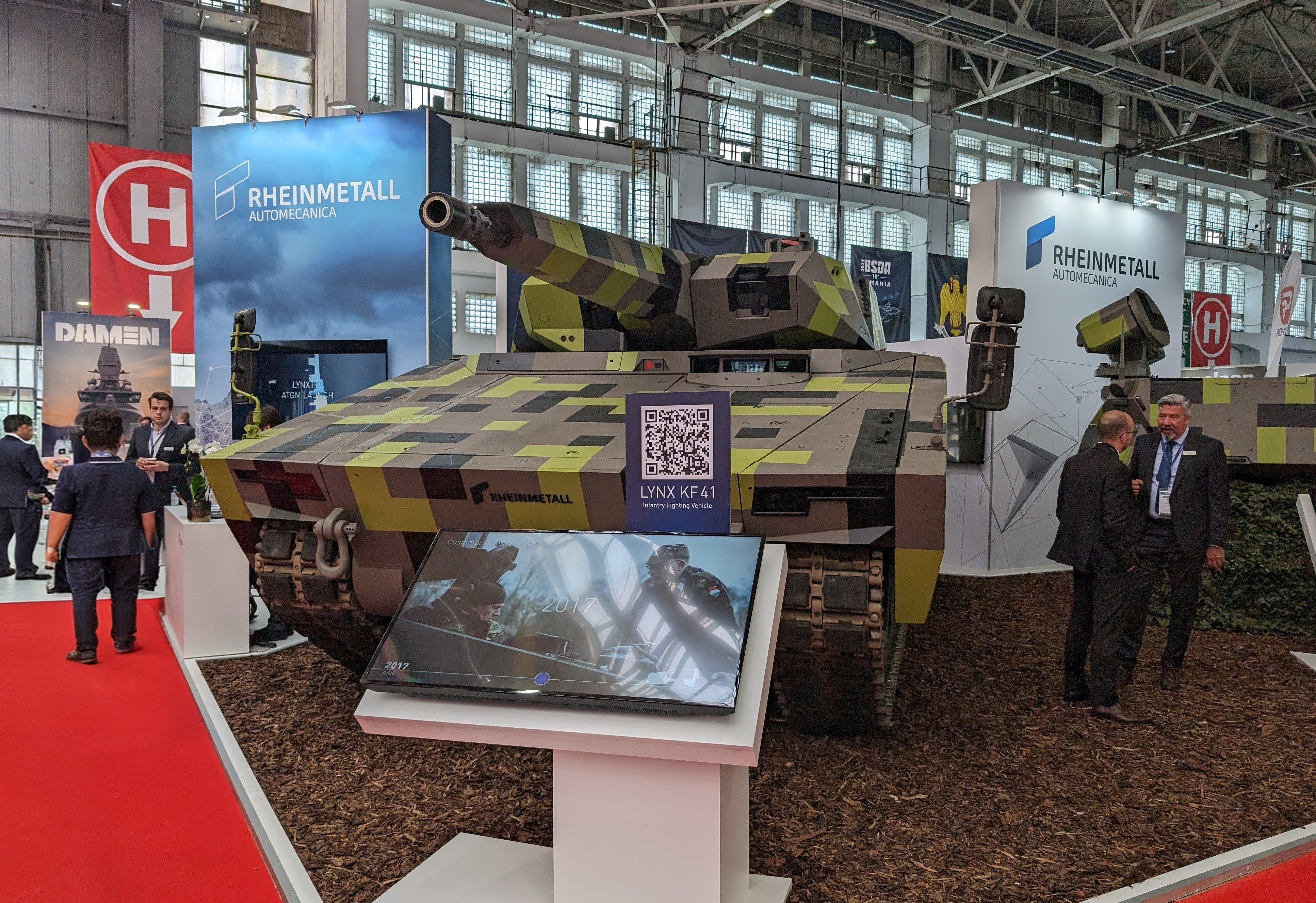
For the largest military contract in SAFE, nearly 2.6 billion euros for 232 KF-41 Lynx armored fighting vehicles, Rheinmetal will make about 40% of the product in Romania, at Automecanica Mediaș, a company already bought by the German group.
As HotNews has learned, most of the armored vehicle will be domestically produced, minus the Lance 2 turret.
“Half of the value of the Lynx is the turret, and the technique to produce the turret cannot be made in Romania. And then it is an obligation for them to make almost 100% of the rest of the vehicle here”, answered Minister Miruță to HotNews' question.
The same is true for other contracts.
The more than 1,000 IVECO trucks will be produced 60% at the company's factory in Petrești, Dâmbovița county, the UAS class I mini drones will be assembled locally 100% by the company Quantum Systems, and Rheinmetall will completely produce the powders and 35 mm ammunition at the factory in Victoria, Brașov county.
Local production will mean an interaction of large firms with local companies in the country – smaller firms that would not have the capacity to deliver an entire product, but which can be subcontracted for various components.
The Minister of Defense says that he sets the mandatory condition of interaction with the local business environment:
“It will be done by publishing a marketplace, an application that will be made available in the next period by STS, in which all these large suppliers will be obliged to list the components for which they want to subcontract. Next, Romanian companies will interact commercially there – price, conditions, time”.
There are two other contracts with local production: almost 900 million euros will also go to the Rheinmetall group to build in Romania two stars for divers and two patrol ships (which will be equipped more like two corvettes). The key to these two contracts is the obligation for the ships to be built at the Mangalia Shipyard – 2 May.
The Mangalia shipyard, one of the largest in the EU, went bankrupt, with debts of almost 200 million euros. The authorities see the contract with Rheinmetall through the SAFE mechanism as the way to solve the problem and restart the production of ships, military and civilian.
“It is the token that saves this construction site”, says Minister Miruță.