What does the PSD risk even if it wins today's motion and why the anticipated scenario may become likely

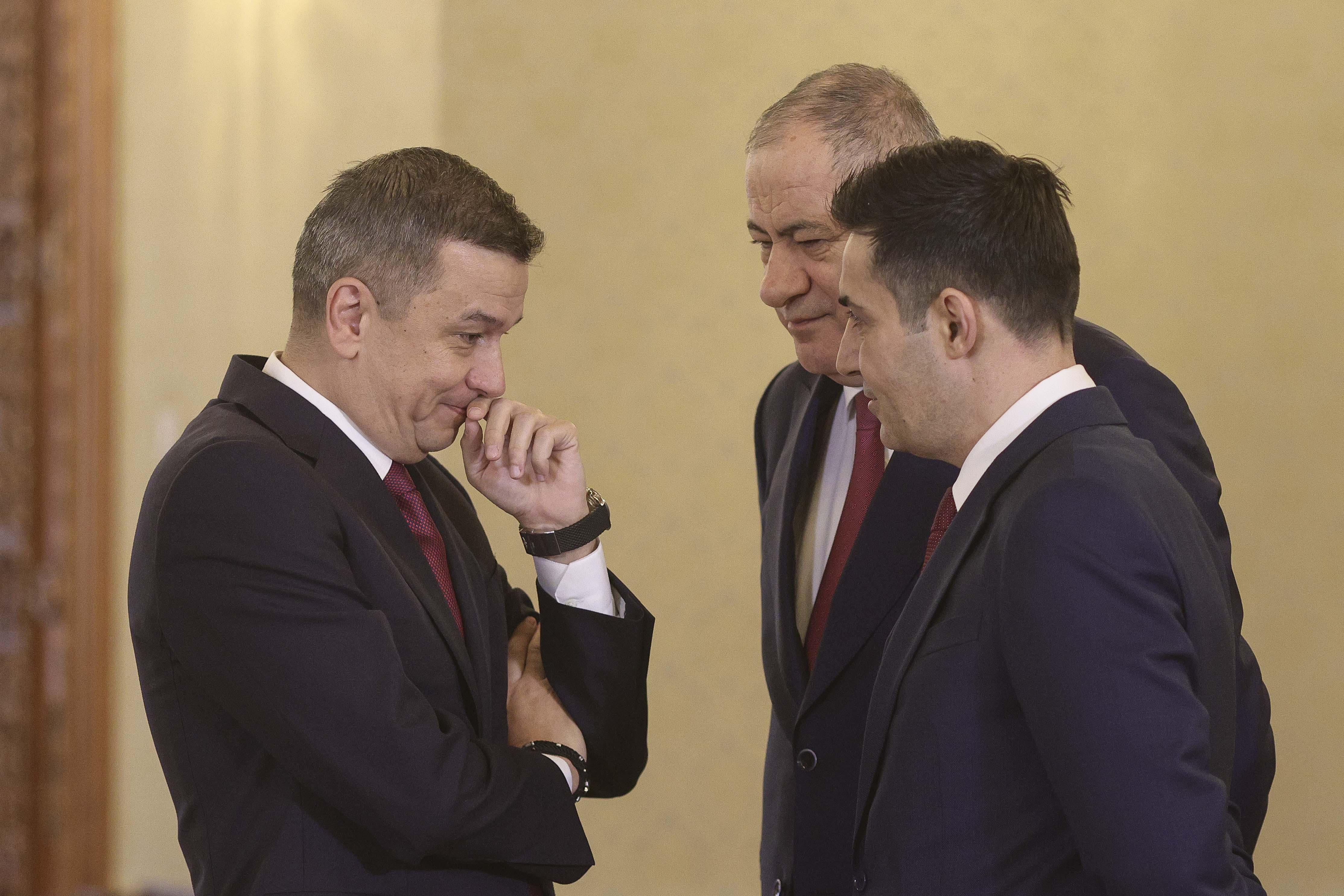
In the logic of rational choice, irrationality does not exist. Actors act on the basis of calculations, even when these permanent calculations of costs and benefits, as they are interpreted from their own perspective, in the shorter or longer term. However, judging by the elements that can be seen with the naked eye and for the moment abstracting from speculation, PSD seems to be a rational actor in the very short term at most. Otherwise, we cannot talk about strategy, about long-term coherence, but at most a bluff, writes George Jiglău, doctor of political sciences at UBB, in a text published by HotNews.
In the very short term, PSD seems very close to achieving its goal of removing Ilie Bolojan from the head of the Government. Then, the PSD hopes to force the hand of the PNL to get rid of Ilie Bolojan, so that the PSD-PNL relationship returns to the “default” of the Ciucă-Ciolacu period, at most with UDMR support, without the element of USR noise inside such a coalition. If the PNL does not give in, the PSD is forced to remain associated with the AUR and must manage the consequences of this long-term association, with a compromised image at least as weak as the one until the fall of 2024.
The first cost that PSD generates is the reputational one. After the electoral crisis of 2024–2025 and after the rise of AUR, PSD had managed to obtain a more popular position in relation to a part of the public that had constantly rejected it after 1990. It had not become a party loved by this public, but it had become part of a pro-European stabilization formula. In relation to the risk of nationalist-populist radicalization, PSD could be treated as the lesser evil. Pairing with GOLD weakens this gain. The PSD could be included in the pro-European camp precisely because it seemed to participate in the isolation of the AUR. The exit from the governing coalition (at least in relation to Bolojan) changed the perception, and the motion initiated alongside the AUR confirms the change. Even if the PSD insists that it is a one-off collaboration, the common political objective is major: the dismissal of the government. The distinction between technical collaboration and political collaboration, on which Sorin Grindeanu obsessively insisted in the announcement of the motion, becomes difficult to defend both in front of the domestic public and in front of the European public.
PSD costs
The second cost concerns the PSD-AUR power ratio. In the logic of the current Parliament, PSD remains a larger, more institutionalized and more experienced party. However, AUR is more electorally dynamic and has a more advantageous position in the logic of the anti-system protest (which system includes PSD). In addition, AUR has less to lose from a collaboration with PSD. For PSD, association with AUR produces identity and credibility costs. For AUR, association with PSD produces legitimacy and the chance to be the party that makes and breaks Romania's governments. AUR shows that he has become strong enough that PSD has to negotiate with him. In symbolic terms, the PSD risks becoming the second party of a party that it should have kept out of the governing formulas.
This problem becomes more serious if PNL, USR and UDMR do not accept a new government with PSD after a possible fall of the Bolojan Government. If these parties maintain a common front, the PSD is left with limited options, and the European dimension of the PSD thus risks collapsing.
In May 2025, PES and the S&D group explicitly demanded the maintenance of a “sanitary cordon” against the conservative extreme in Romania and expressed the expectation that the PSD would support the pro-European alternative. PSD-AUR collaboration, even presented as punctual, comes into tension with this European positioning. The PSD already had a problem of doctrinal clarity in relation to the European socialist family.
In 2025, with the election of Sorin Grindeanu as “full” president of the PSD, the party gave up calling itself “progressive”, arguing that this formula no longer corresponds to the party's identity. The new wording emphasized explicitly conservative values, an obvious contradiction to the identity assumed by the European Socialists. The only aspects that still work in favor of the PSD are effectively the size of Romania, which comes with a large number of MEPs, and the fact that the European Socialists are in a vulnerable position due to the even more radical socialists in the European Parliament and in European states such as France or Germany, as well as the dominant position of the European People's Party, which is showing increasing signs of abandoning the coalition with the Socialists in the European Parliament and approaching the ultraconservatives.
If the motion passes, President Nicușor Dan becomes more important than ever before in this mandate. The Constitution provides that the President appoints a candidate for the position of Prime Minister after consulting the party that has an absolute majority in Parliament or, if such a majority does not exist, the parliamentary parties that together assume a majority.
If PSD and AUR propose a joint prime minister and claim a majority, President Dan will have to decide whether to accept this formula or reject it. If the President refuses, PSD and AUR could argue that the refusal violates the logic of the parliamentary majority. As happened in 2021 with the previous Iohannis-Orban, the dispute could move to the CCR. Depending on the decision of the CCR, but even without it, there is also the suspension scenario. PSD and AUR could use this tool to put pressure on the president. But even this scenario has an important political limit: the interim presidency is provided by the president of the Senate, that is, by the liberal Mircea Abrudean. If the PNL does not give up its current positioning, a suspension of Nicușor Dan would in no way guarantee PSD and AUR control over the crisis. And if they give up Ilie Bolojan, there is every chance that the PSD-PNL alliance will be restored, President Dan will accept it, but then PNL would assume costs at least as high as those of PSD.
The scenario where anticipated becomes a possibility
Whenever a government falls and we enter the logic of forming a new government, the anticipated scenario must be taken into account, bearing in mind that Romania often talked about anticipated in moments of crisis, but never reached them. Their probability increases if several conditions are simultaneously maintained: the president does not accept a PSD–AUR formula, PNL does not give up on Bolojan, USR and UDMR keep the common front, alongside PNL, and PSD cannot rebuild an alternative majority. The anticipations could bring a “punishment” by the electorate of those who caused this crisis, and the main suspect would be the PSD. But the risk of AUR scoring high, in line with recent polls or even higher, is too high, so the president will most likely force the appointment of a prime minister who meets at least minimal consensus.
All this shows the major limits of the PSD rationale. The party caused a crisis but cannot control its effects. It can try to force the PNL, but it cannot guarantee that the PNL will yield. It can use AUR to increase pressure, but it cannot control how AUR politically capitalizes on this collaboration. He can invoke the parliamentary majority, but the President and the CCR can become decisive actors. It can threaten suspension, but the interim can also benefit the PNL.
The PSD versus anti-PSD cleavage does not disappear, but becomes secondary
The ultimate question is who gains more from such a collaboration. For PSD, the benefits are immediate and uncertain. For AUR, the benefits are clearer. AUR gains access to the game of the majorities, reduces its isolation and presents itself as an actor without which governance can no longer be decided. A radical party that moves closer to the center through a collaboration with a major party wins starts to look common. A mainstream party that approaches the extreme loses credibility.
This crisis forces a resettlement of the party system in Romania. For a long time, from the 90s until AUR entered Parliament in 2020, the political competition was structured around the PSD versus anti-PSD cleavage. PSD has always been the main governing party, with a strong territorial organization, constant access to administrative resources and a relatively stable electorate (at least numerically speaking). On the other hand, the opposition to the PSD was organized in successive formulas, dominated by fights about which party is more anti-PSDist. In this logic, the PSD was the fixed point of the system, and the rest of the political scene was organized in relation to it, with bridging moments between the two sides of the divide, such as the USL period or the short PDL-PSD government in 2009.
The appearance of GOLD shook this structure, and the rise in the fall of 2024 changed this structure for good. The PSD versus anti-PSD cleavage does not disappear, but becomes secondary in relation to a wider tension: between a pro-European, mainstream, institutional zone, and a nationalist-populist, radicalized, anti-system zone. This change created a rare opportunity for the PSD. In a context where the AUR became the main vehicle of political radicalization, the PSD could be reframed, at least temporarily, as part of the pro-European camp. Not because antipathy towards the PSD has disappeared, but because the hierarchy of risks has changed. For a part of the electorate loyal to liberal democracy, “pro-European”, the PSD could become acceptable as the lesser evil in relation to the AUR.
This is precisely where the strategic cost of getting close to GOLD appears. PSD risks losing the relatively advantageous position acquired in the new configuration. If it approaches the AUR, the party does not recover the radicalized electorate, which already has a more authentic option in the AUR, but it may lose the tolerance of the pro-European electorate that had accepted it in the logic of defending democratic principles. The PSD is thus caught between two cleavages: in the old cleavage, it remains the party towards which there is a historical suspicion; in the new cleavage, it becomes less credible as part of the pro-European camp.
And the role of the PNL is decisive in this resettlement. If PNL remains in solidarity with Bolojan and maintains the pro-European line together with USR and UDMR, PSD becomes even more isolated. If the PNL gives way, the PSD can try to restore the old logic of PSD–PNL collaboration, the two risking to lose in relation to both the AUR and the USR (or other new actors). But if the PNL does not give in, the PSD remains exposed between the AUR, which gains legitimacy, and the pro-European bloc, which may treat it as an ambiguous actor. So, the PSD may enter into a long-term erosion, produced by a wrong positioning in a party system in transition.
One last scenario must be discussed, briefly – that of Băsescu 2009/2010 or Băsescu 2004. In 2004, Băsescu broke PUR from the electoral alliance with PSD to install a DA Alliance government. In 2009, after the resignation of PSD ministers from the PDL-PSD Government led by Emil Boc, President Băsescu orchestrated the most significant rupture of PSD by leaving what later became UNPR, with prominent figures such as Gabriel Oprea, Marian Sârbu or Cristian Diaconescu. In a PSD left with no options, faced with the prospect of a government with the AUR or a catastrophic defeat at the polls, some of the MPs and members of the party could find their pro-European moods by supporting a pro-European government. Just as others might choose to bet their political future explicitly and implicitly on the ultraconservative card.
*text originally appeared on Contributors.