Who makes our food more expensive? Road transport represents only 2.6% of the price of products


The increase in shelf prices is often blamed on transport, especially during periods when fuel prices rise. However, those in the industry say this explanation is incomplete and often exaggerated, with other factors driving these price increases.
The cost of transport represents, on average, only 2.6% of the final price of the products. Archive photo
The cost of transport represents, on average, only 2.6% of the final price of products sold in Romania, according to an analysis by UNTRR. This level confirms that the impact of transport in the cost structure is limited and cannot explain the significant increases observed in retail. Even with a sharp increase in the price of fuels, the effect on the final price remains moderate: a 25% increase in the price of diesel leads to an increase of about 10% in transport costs, which means a marginal impact on shelf prices.
Moreover, the share of transport varies by category between about 0.3% and 3.7%, and in most cases it is below 1%. A concrete example is that of mineral water: for a transport of about 15,000 bottles over a distance of 400 km, the average cost is about 0.16 lei per bottle. Compared to an average price of 3.99 lei, it results in a share of approximately 4% of the final price. Therefore, price increases above these levels cannot be attributed to road transport, even if it is frequently invoked.
At the same time, carriers directly feel the pressure of increasing operational costs, but these increases are not fully transferred to customers. For example, according to the Diesel Index released by UNTRR, based on data from the European Commission, the price of diesel reached a peak at the end of March, being 38.03% higher than at the beginning of the year. To cover this increase alone and maintain their profit margins, carriers would have had to raise fares by about 15.2% in a very short time. In practice, however, such adjustments have not been widely applied, which shows that much of the pressure is being absorbed by carriers. This discrepancy can lead, in the medium and long term, to financial difficulties and even to the exit of some operators from the market.
Less obvious logistics costs
On the other hand, there are a number of less visible costs in the logistics chain, which contribute to the increase of final prices, but which are not as easy to identify. The transport and logistics industry is facing, from the beginning of 2026, an accumulation of factors that affect not only the obvious expenses, such as fuel, but also the operational efficiency.
Among these hidden costs are failed deliveries, according to an analysis carried out by experts Raben, a Dutch provider of road transport services and logistics solutions. When the recipient is not available at the address, the goods cannot be delivered, and the impact goes beyond simple rescheduling. In the case of palletized shipments, this blocks space in the truck and prevents other goods from being loaded on the return route, which may require the allocation of an additional vehicle and therefore higher costs.
Data errors are another important source of loss. In the context of digitalisation, customers enter their transport information and mistakes in weight or dimensions can lead to the wrong vehicles being allocated. For example, an order declared at 3,200 kg may actually reach 5,000 kg, requiring re-arrangement of the shipment or sending a second truck.
How public policies can change the impact of energy prices on the economy
Also, improper packaging of goods can cause damage during transport. In addition to direct loss, there is a risk that the affected products will damage other goods in the truck, amplifying costs throughout the logistics network.
Last but not least, the limited availability of distribution vehicles, especially in the context of pollution norms, puts additional pressure on the industry and indirectly contributes to rising costs.
In conclusion, road transport cannot be considered the main responsible for shelf price increases. Although the fuel price increase has a real impact, it is limited in the cost structure. Explanations for significant price increases must be sought throughout the economic chain – from production and energy, to distribution, logistics efficiency and how companies manage costs, including the less visible ones.
How the price of a product is formed
The cost of a product is the sum of all resources consumed, starting from raw materials – the materials from which the product is made (for example, flour for bread or plastic for packaging), labor – salaries of employees directly involved in production, energy and utilities – electricity, gas, water used in the manufacturing process, operating costs – maintenance of machinery, rents, depreciation of equipment, but also other indirect costs – administration, management, quality control.
For example, for a bottle of mineral water, the production cost includes water extraction, water treatment, packaging (bottle and label), energy used in the factory and employee wages. This cost is only part of the final price. Added to it is transportation, warehousing, distribution, merchant margin and taxes. That's why, even if transport has a small share (like that of about 2.6%), other components – especially production and energy – can influence the shelf price much more strongly.
INS data for March, the last month for which official statistics exist, show that road transport rose in price in March compared to February by 1.68%, while electricity and natural gas prices fell by between 1.02% and 4.86%.
Energy and fuels account for 49% of the “inflation basket”. The price of oil will affect the pace of the Romanian economy
The average increase in fuel prices in Romania, starting from February 28, when the war in Iran broke out, until the end of March was ~15–20%, which explains the pressure felt in the economy, without being fully reflected in the prices of products on the shelf.
On the other hand, according to INS data, in March compared to February, the most expensive vegetables and canned vegetables – 2.27%, potatoes – 1.81% and coffee – 1.58%, but also postal services – 6.53%, subscriptions – 2.05% and medical care services – 1.37%.
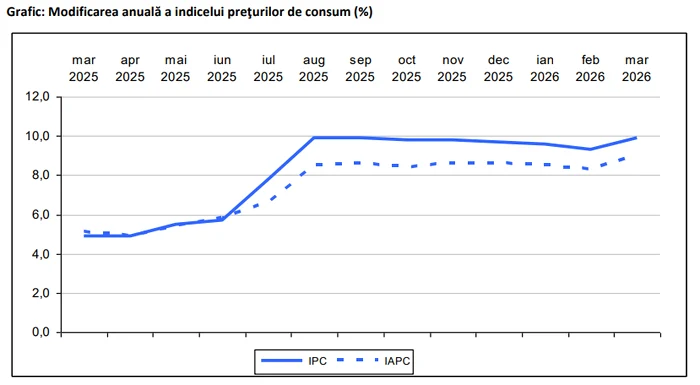
Overall, the consumer price index in March 2026 compared to February 2026 was 100.78%.
However, the annual inflation was 9.9% in March, the biggest price increases being caused by the liberalization of electricity prices in July last year and the VAT increase in August, as can be seen from the INS chart below.