Who is the Romanian woman for whom a famous tsar of Russia had a mad passion. She was 28 years younger, beautiful and extremely influential

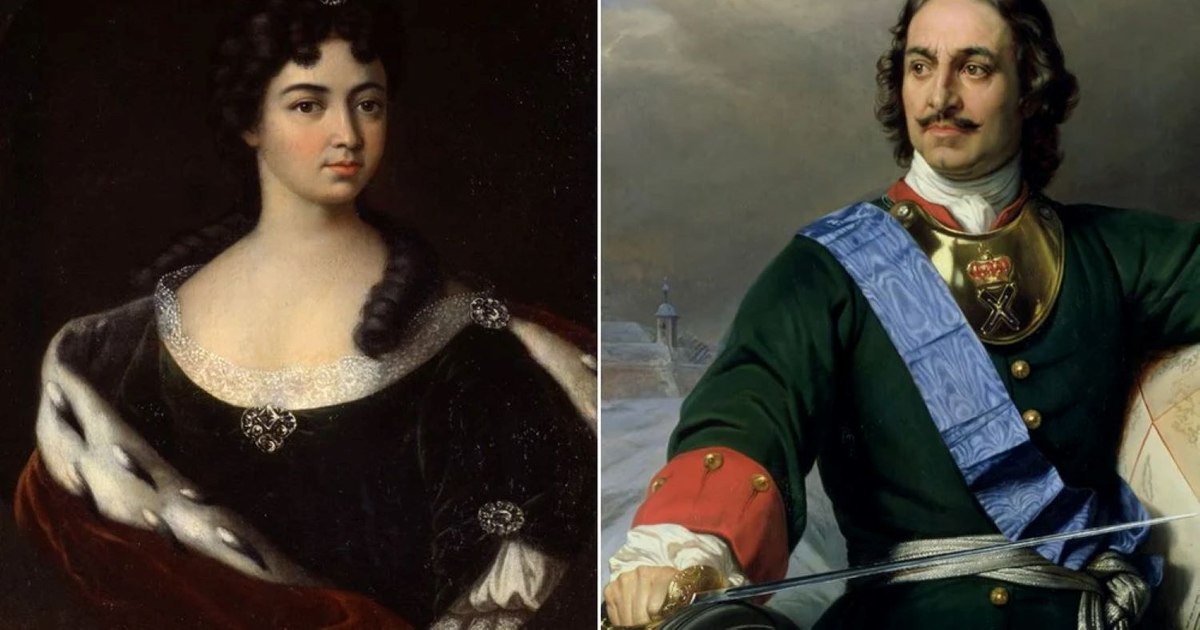
Maria, the daughter of the well-known voivode-scholar of Moldova, Dimitrie Cantemir, is one of the most controversial characters in the history of Romanians, but also of Russia. Of particular beauty and intelligence, young Maria is said to have twisted the mind of Tsar Peter I the Great.
Maria Cantemir and Peter I the Great, a supposed idyll PHOTO historia
Romanian women are famous throughout Europe for their beauty. And this reputation, it seems, has been since the world and the earth. Well, a beautiful Moldavian woman charmed one of the most important tsars of Russia and, at the same time, one of the most powerful monarchs of the continent at the beginning of the 18th century. The young woman's name was Maria Cantemir, the daughter of the famous gentleman-scholar Dimitrie Cantemir, who was in exile at the Russian court until the end of his life.
And the Tsar who would have fallen in love with the gorgeous Moldavian princess was none other than Tsar Peter I the Great, the founder of the Russian Empire, transforming Tsarat Russia from an isolated and backward country into a great European power. Contemporary Russian authors from the Russian court, as well as other characters close to the Cantemiresti, suggest that Maria Cantemir became the tsar's mistress, giving birth to a flower child.
Maria, the first born of the Cantemirești family
Maria Cantemir was Dimitrie Cantemir's first child. His mother was Casandra Cantacuzino, the daughter of the former mountain ruler Şerban Cantacuzino. Dimitrie and Casandra got married in 1699, after a movie-like love story. Cassandra was only 17 years old when Dimitrie, a Moldavian prince, the son of the former ruler Constantin Cantemir, fell madly in love with her. Cassandra, for her part, falls irresistibly in love with the young Moldavian.
Although Constantin Brâncoveanu tried to break up the relationship between the two, for dynastic reasons, Dimitrie and Casandra got married, after many vicissitudes, in Iasi. They remained together until the young lady's death, in 1713, living one of the most beautiful love stories in Romanian history. They had eight children together. The first born, as I mentioned above, was a girl, Maria. He was born in 1700, in Istanbul, in the Ottoman Empire.
Her father, Dimitrie Cantemir, was at that time a Capuchehaie, that is, a diplomatic agent or representative in the Ottoman Empire. Moreover, his childhood, until the age of 10, will be spent in Istanbul. Later, in 1710, when her father becomes ruler of Moldavia, she returns to her real country. He would only stay in Moldova for eight months. After the battle of Stănilești in 1711, between the Russians and the Turks, lost by Peter I the Great, but also by her father, an ally of the tsar, exile in Russia follows with the family. She will never return to the lands of her ancestors.
A sophisticated, intelligent, erudite woman
Maria basically grew up in Russia. She had a sparkling intelligence and inherited her father's passion for science and books. Dimitrie Cantemir enjoyed a special position at the court of tsarist Russia, being the personal adviser of Peter the Great. Cantemir received numerous estates, and on August 1, 1711, he was invested with the title of prince serenissim of Russia. In this context, his daughter, Maria, enjoyed all the comforts of a young woman from high nobility, having access to a special education. She was, moreover, a sophisticated presence that impressed as much in beauty and intelligence as in attitude. Over the years spent in Russia, Maria Cantemir became a person perfectly adapted to court life, knowing how to skillfully manage family problems.
“Maria, however, does not live only in the hard world of spirit essences. She asks her brother to send her books, she takes care of the social relations of the family, she is a factor of influence for her brother. Aware of the eternal game of social obligations – oblige me so that I oblige you – she asks Antiochus to do various favors, such as, for example, to take under his protection “the sons of Doctor Tellis”. At the same time, Maria Cantemir is also a good administrator. He gives an account of what he did with the money received from the sale of the family estates, he sends his brother furs with which he can open his salons to quality ladies from Paris or London. Intelligent, sophisticated, but also proving a remarkable practical sense, Maria realizes the different socialization of power. Those on the lower rungs of the social pyramid react differently if the master, the man, is the one dealing with them. In a note to her brother, Maria complains: “I had to deal with men.” It was a matter related to the contact with the administrator of one of the Cantemiresti's properties. She is tempted by monasticism, but gives up this option at her brother's request. Her voice, through the ages, in the letters that have survived, shows us as a true lady of the spirit, who in no way disgraced either her family or her people”states university professor Dr. Mihaela Mudure in “Maria Cantemir: identity and re-presentation”.
The woman who charmed Peter I the Great
A young woman so charming and, at the same time, so intelligent and sophisticated could not fail to arouse passions. It is said that Tsar Peter I the Great himself fell madly in love with the young Moldavian princess. More precisely, he would have known her during the festivities organized in the winter of 1721 to mark the conclusion of the Peace of Nystadt, which ended the Great Northern War (1700–1721) between Sweden and Russia. The treaty marked the end of the rise of Sweden and the transformation of Russia into a major European power, after Peter the Great had annexed Livonia, Estonia, England and part of Karelia.
How the father of two rulers of Moldova and Wallachia became the most influential Christian in the Ottoman Empire
Historian Leonid Nikolaevich Maikov claimed that the tsar fell in love with the princess during those festivities and that, more than that, the feelings were mutual. Maria Cantemir was 21 years old, while the tsar was 49. The same Maikov, relying on information extracted from epistles and memorial works, claims that Maria Cantemir began a secret relationship with the tsar. Soon, the passion between the two made them careless.
The Tsar's extramarital affair became notorious; even his wife, Empress Catherine, would have found out. It is said that Dimitrie Cantemir discovered the whole story quite quickly, but did not object for a moment, hoping that the Tsar would take his daughter as his wife and thus regain the throne of Moldavia. Moreover, it is said that Maria also had a child with Tsar Peter I.
According to the same Leonid Nikolaevich Maikov, Princess Maria, being pregnant, would have followed Peter to Astrakhan, in 1722, where Dimitrie Cantemir had also traveled to serve the tsar as an advisor on Oriental issues and a translator. Maria would have given birth to a boy in Astrakhan.
There are, however, two main hypotheses: one that indicates that the fetus was stillborn, and a second that speculates that the baby was poisoned a few months later by Tsarina Catherine's confidants, especially since the birth of a boy would have posed a threat to her position. In any case, the relationship between Peter and Mary is said to have continued after this episode. Indeed, a question mark was raised by the fact that Maria never married, although she was courted by important figures from among the Russian nobility. However, the Tsar never raised the issue of marrying Maria Cantemir or repudiating his wife, Catherine. Some suspect that it would have been only a very passionate relationship, for at most three years, after which the Tsar would have given up.
Putin, in the footsteps of Peter the Great. How the Tsarist Empire rose on the corpses of the surrounding countries, which spared the Russians at Stănilești
Gossip, rumor and a slander passed down through the ages?
Some recent researchers suggest that, in fact, there is no concrete evidence of a relationship between Maria Cantemir and Tsar Peter I of Russia. Moreover, the birth of a flower child can be relegated to gossip, they say. Maria refused to marry on principle, which would have attracted gossip, conjecture, malice, especially from rejected suitors.
“Apparently, the first to subject to a critical examination the alleged relationship of Princess Maria Cantemir with Tsar Peter I was Ștefan Ciobanu in the well-known work “Dimitrie Cantemir in Russia”. In the section dedicated to Maria Cantemir in the work “Dinastia Cantemirestilor”, published in Chisinau in 2008, the undersigned (acad. Andrei and Valentina Eșanu – no), analyzing the information on which Maikov relied, tend to believe that what was said about Maria does not correspond to reality. A little later, also in Chisinau, the work “The epistolary legacy of Dimitrie Cantemir” by Victor Țvircun appears, which also rejects the existence of a novel of Peter I with Maria, showing that the relations between the tsar and Catherine, his wife, were particularly strong and left no room for other passions of this kind. In his work dedicated to the Cantemirești, published in Paris in the spring of 2009, the historian Ștefan Lemny, putting together the notes left by the same Ivan Ilinskii, those recorded by Campredon in his dispatches, but also analyzing the opinions of some historians, shows, in our opinion quite well, that the so-called idyll between Petru cel Mare and Maria Cantemir sooner did not take place. And, as the tsar's biographers claim, even if this had taken place, as in other such cases, Peter I did not attach any importance to it”specify the academicians Andrei and Valentina Eșanu in “Princess Maria Cantemir between artistic fiction and historical reality”, in Academos.