The first mission to intercept an asteroid, planned by a start-up in California. The event could be streamed live

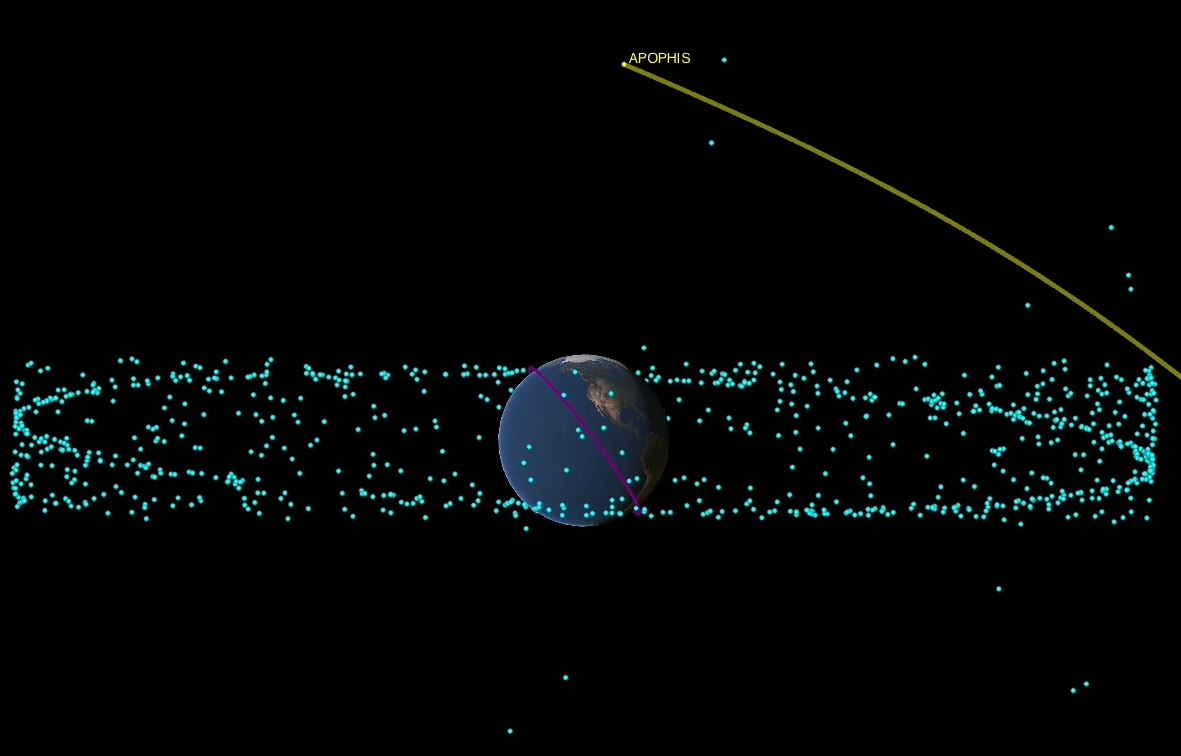
The asteroid Apophis is to pass near the Earth in 2029, a passage that represents an alarm signal regarding the danger represented by an impact with such wandering cosmic bodies, a danger perfectly illustrated in the history of the Earth by the disappearance of the dinosaurs approximately 66 million years ago, according to a material published on Thursday by Space.com, reports Agerpres.
Astronomers have shown that Apophis will not hit Earth in 2029, but it will pass closer to Earth than our geostationary communications satellites. Radar measurements estimate that Apophis is about 450 meters wide and about 170 meters high. The passage of Apophis on April 13, 2029 (it will fall on a Friday) will be visible to the naked eye and is sparking considerable multinational action plans to spy on the asteroid at various stages as it heads toward Earth, helping scientists plan possible planetary defense scenarios.
Impact risk assessment
Southern California-based startup Exploration Labs (ExLabs) has proposed what it calls the first commercial mission to intercept an asteroid in deep space, known as Apophis EX. At this year's 41st Space Foundation Space Symposium, held April 13-16, ExLabs said the mission aims to rendezvous with asteroid Apophis before and after its flyby and provide unprecedented scientific data for planetary defense, resource prospecting and future deep space exploration.
James Orsulak is co-founder of ExLabs and president of the Planetary Defense Trust. The company's objective is to study the dynamics of near-Earth asteroids, refine impact risk models, and evaluate deflection strategies to protect Earth from future threats.
Orsulak said Apophis EX is the first mission of its kind, marking the beginning of a new era, one that heralds “consistent, collaborative and commercially oriented” deep space exploration, while elevating planetary defense “from a niche discipline to a global priority” and emphasizing the importance of coordinated planetary defense strategies.
“NASA's budget for planetary defense is less than one percent of the space agency's total,” Orsulak told Space.com. “This is not enough to ever do anything.”
James Orsulak and ExLabs are eager to promote the Apophis flyby by engaging IMAX and others to tell the story through an immersive live, prime-time broadcast. “We could get a bigger audience than the Super Bowl,” he said.
Asteroid deflection methods
David Bearden, manager of the Strategic Planning Office at the Jet Propulsion Laboratory (JPL), said there is a need to reduce risk and maximize opportunity. On the planetary defense table is a wide variety of asteroid deflection methods, from gravity tractors, ion beams, kinetic and nuclear detonations, and other concepts. “We need to learn about these techniques. If they work and under what conditions they work,” he stressed.
Edward Lu, former NASA astronaut and now head of the Asteroid Institute and co-founder of the B612 Foundation, said there is no single asteroid deflection technology that can be considered the best. “You have to put that out of your mind,” Lu said. It's a multi-step process, he noted, a need to fine-tune and verify what works for each situation.
With a high rate of flights, “you get safety, reliability, because you know what works, what doesn't work, and you also get a reduction in costs. Those are the things we need,” he argued. “This will make Earth safe, to have the industrial capability to request a launch tomorrow or next week.”