
How much time do residents of the GREENFIELD Băneasa neighborhood spend leaving the neighborhood in the morning and entering in the evening?

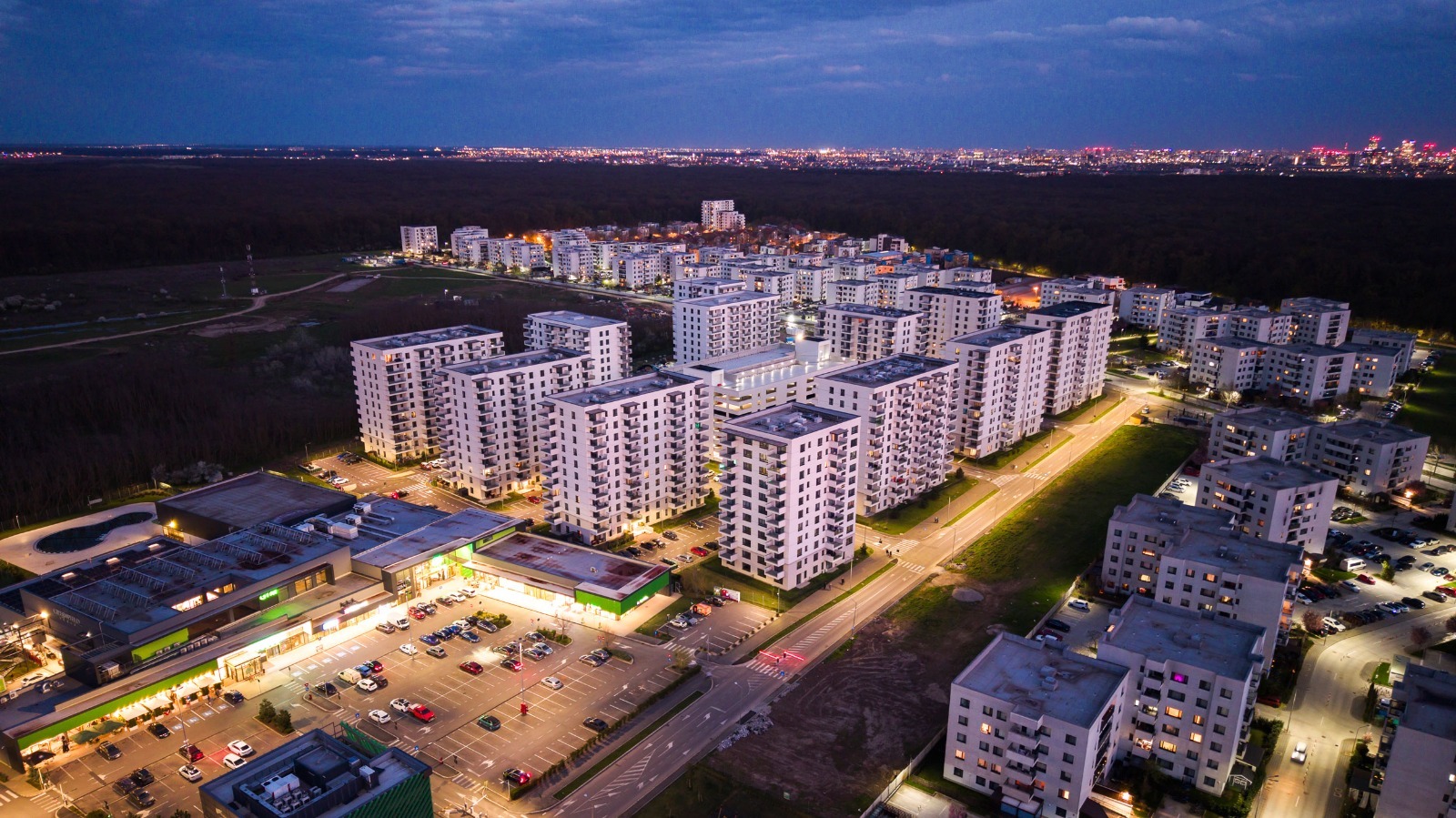
Seven video-monitored days on the GREENFIELD Băneasa – Aleea Teișani – DN1 route and return. What does the field data show us? Because there is a lot of information circulating on this topic in the public space, we proposed to do an experiment and find out how long the journey by car takes, leaving at 8:00 a.m. from GREENFIELD Băneasa towards DN1 and returning around 5:00 p.m. I walked on Aleea Teişani every morning and evening between March 16 and 24, 2026. The times speak for themselves: minimum 8 minutes and maximum 11 minutes in the direction GREENFIELD Băneasa – DN1, respectively between 6 and 11 minutes, in the direction DN1 – GREENFIELD Băneasa.
10 minutes and 34 seconds spent on average in the morning in the car, from the tranquility of nature in the GREENFIELD Băneasa neighborhood, to the dynamics of the city on DN1
Mornings that involve a drive start with the question that every resident of Bucharest asks: “How long will I be in traffic?” For the residents and future tenants of GREENFIELD Băneasa, the answer is given by monitoring the mornings and evenings spent by car over 7 days, on the route GREENFIELD Băneasa – DN1, respectively DN1 – GREENFIELD Băneasa. The main access from GREENFIELD is with the exit towards Aleea Teișani, a connection that connects with key arteries such as DN1 or the ring road. From here, the city opens up in several directions: the business area from the North via DN1 – Aerogării Boulevard, the central area with Piața Presei – Arc de Triumf – Piața Victoriei or Aviatorilor area, Henri Coandă International Airport or the commercial and entertainment areas in the Herăstrău district.
Less than 8 and a half minutes, the shortest time achieved by car
Following the monitoring of seven working days (Monday – Friday) and without school holidays, the shortest time achieved by car from the GREENFIELD Băneasa neighborhood to DN1 – the MOL gas station, via Aleea Teișani, was 8 minutes and 27 seconds, on March 17, on a Tuesday. The longest interval observed on the same route at the same time of day was on Thursday, March 19, which was 11 minutes and 46 seconds.
Less than 7 minutes spent by car on the way home, Monday evening rush hour, from DN1 to GREENFIELD Băneasa
The traffic situation at peak hours in the evening reveals a series of shorter times traveled in traffic, according to the same monitoring carried out during the week of March 16-24, 2026. Thus, the shortest time recorded from DN1 to the entrance to the GREENFIELD Băneasa neighborhood was on Monday, March 16, with 6 minutes and 40 seconds spent by car on the road, while the longest recorded interval was was 11 minutes and 46 seconds on Thursday, March 19.
Everyday mobility beyond the perspective behind the wheel
The reduced times recorded on Aleea Teişani are supported by the existence of an alternative route, through the Consolight – Padina connection, which operates in a controlled regime and where access is regulated by a set of measures designed to ensure both traffic safety and the protection of the area. The traffic is monitored and controlled by the LPR (automatic number plate recognition) system, and access is allowed exclusively to vehicles with a maximum mass of 3.5 tons, from Monday to Friday, between 07:00 and 10:00 and 15:00 and 18:00. Outside these intervals, as well as on weekends, the road is reserved exclusively for pedestrians and cyclists. On the entire section, the maximum allowed speed is 20 km/h, traffic is one-way, from Consolight to Padina, and the parking and abandonment of flammable materials is strictly prohibited.
In addition to the road infrastructure, the mobility of the residents of GREENFIELD Băneasa is supported by public transport. Inside the neighborhood there is an STB terminal that provides direct connection to the Capital's transport network, through line 203, with a connection to Piața Victoriei, one of the most important urban mobility hubs in Bucharest. In the future, the area's accessibility will be significantly improved through the development of the Bucharest Metro Highway 6, a project already underway, according to Metrorex's public information. The new line will connect the existing network with Otopeni Airport and will include stations in the vicinity of major landmarks in the north of the city, such as Băneasa Shopping City, the US Embassy, the French High School and the Otopeni bridge area. With an estimated completion date of late 2029, this strategic investment has the potential to significantly transform the way residents in the area get around, providing a fast and predictable alternative to surface transport.
The city is changing. And the access roads to the Greenfield neighborhood with it
Last year, IMPACT obtained the town planning certificates for three new traffic solutions in the GREENFIELD Băneasa neighborhood and signed the design and execution contracts for them. The investment amounts to over 2 million euros and is fully borne by the developer.
The new projects concern the connection between Aleea Teișani – DN1 – Bucharest Ring Road, the connection between Aleea Teişani and Şoseau Odăi with a crossing over the railway, as well as the reorganization of the Bulevardul Platanilor – Aleea Teișani intersection. They are intended to support the growth of the neighborhood and improve accessibility for the more than 7,500 residents, as well as for new families choosing to live in GREENFIELD.
Greenfield Băneasa, integrated residential complex
Beyond the time measured on the way from home to the areas of interest, the accessibility of a neighborhood is also given by the way it integrates all daily activities. GREENFIELD Băneasa is designed as an integrated residential complex, with facilities that cover to a great extent the daily needs of the inhabitants, from educational units and commercial spaces, to areas dedicated to sports and recreation activities. Within the neighborhood there are parks, playgrounds, restaurants and proximity services, which reduces the dependence on daily trips outside the neighborhood.
The location remains, however, the main benefit of the neighborhood. GREENFIELD Băneasa is located in the north of the Capital, with access to major interest poles, the office areas of Aviații and Pipera, commercial centers such as Băneasa Shopping City or Henri Coandă Airport. In parallel, the direct proximity to the Băneasa Forest, one of the most extensive green areas near Bucharest, introduces a precious dimension for an urban residential complex, i.e. immediate access to nature, because the choice of a home takes into account how much time you spend on the road, but mostly by how much you earn when you get home.
IMPACT, 35 years of excellence in large-scale residential projects
GREENFIELD Băneasa is part of the portfolio of residential projects built by IMPACT Developer & Contractor, the first real estate developer listed on the Bucharest Stock Exchange. With over 3 decades of experience, the company has grown along with the local market: from the first residential complex in Romania, a neighborhood of luxury villas started in 1995, to large projects such as GREENFIELD Băneasa, Boreal Plus in Constanța and ARIA Verdi, the company's newest project, located in Barbu Văcărescu Street in Bucharest. A leader in large-scale sustainable residential projects, IMPACT aims to develop communities that have a positive impact on people's lives.
Article supported by Greenfield


