“It's hard with the Russians – what they manage to take, is well taken!” – Isărescu, about the gold from Moscow and the stories that the Treasury is in Berlin, Paris or at the bottom of Lake Baikal

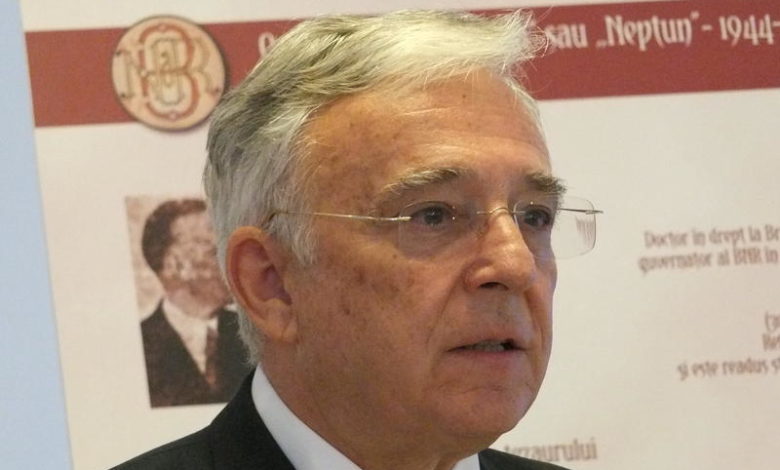
Theories about the fate of the Romanian gold shipped to Moscow during the First World War still abound today.
“On Romanian television, there are Romanians who are simply campaigning on the topic of the Treasury. And we hear stories like, in fact, our gold is no longer in Moscow, but that it has reached either Vladivostok, or the bottom of Lake Baikal, or Berlin or Paris,” said Mugur Isărescu at a conference at the BNR headquarters on Wednesday.
Another theory is that in Brest-Litovsk, where Lenin, after taking power, signed peace with the Central Powers. The price, proponents of the theory argue, was paid in Romanian gold—not Russian gold, although Russia had its own gold.
And at Versailles, the Governor added, according to the same narrative, Germany returned exactly 91.5 tons to the French, also in the form of Romanian gold. The practical conclusion is that Romania should ask for its gold from Paris. A strategy that would simultaneously damage Romania's relations with two NATO states.
Mugur Isărescu, the governor of the National Bank of Romania, experienced closely the attempts to recover the Treasury.
Among his notable meetings is that with Jacques de Larosière—former managing director of the IMF, former governor of the Banque de France and, at the time, president of the European Bank for Reconstruction and Development. At each meeting, de Larosière put the same number: “Governor, how is the treasury?” The answer was invariably: “Also in Moscow.”
When Vladimir Putin came to power, de Larosière called Isărescu aside – they were at an international conference – and drew his attention to the fact that Russia has a new, younger president. And he asked him what he would do if Putin decided to return the gold? “We'll take it, of course”the governor replied, adding that he does not want to fall prey to optimism: “It's hard with the Russians — what they get is good,” Isărescu said
The advice from Larosière was to promote the claims as often and through as many channels as possible. “I followed his advice. My colleagues and I published a series of books documenting this matter. We expanded our approach in the diplomatic field, according to a treaty between Romania and the Russian Federation,” added the Governor.
“He then asked if I would sell it. I told him definitely not, because the Romanians would hang me for it”, recalls the Governor
Meanwhile, the Russian narrative — that the gold either does not exist or does not belong to the Romanians — continues undisturbed.
Last year, the National Bank of Romania inaugurated a new section on the institution's website, dedicated to the history of the Treasury evacuated to the Russians in the period 1916-1917 and the ongoing efforts to repatriate it. The initiative comes in the context of an international campaign to raise awareness of a problem that has remained unresolved for more than a century.
The story of 91.5 tons of gold
In December 1916, amid the advance of the troops of the Central Powers towards Bucharest, the Romanian authorities took the decision to evacuate the national treasury to the territory of Russia, the only allied state with which Romania bordered at the time. The first shipment included 1,738 boxes with the gold of the National Bank of Romania and two boxes with Queen Maria's jewels, with a total value of over 321 million lei at the time.
The convention signed with the representative of the Russian Empire in Iași explicitly stated that the Romanian values were “under the guarantee of the Russian government regarding the security of the transport, the security of the deposit, as well as the return to Romania”. Stored in the Kremlin, in the Hall of Arms, the tapes were inventoried in January-February 1917, when full agreement with the NBR declarations was confirmed.
In October 1917, the Bolshevik revolution radically changed the situation. In January 1918, the Council of People's Commissars announced the severance of diplomatic relations with Romania and the confiscation of the treasure, declaring that “the Soviet power assumes the responsibility of preserving this treasure which it will hand over into the hands of the Romanian people”. The promise remained unfulfilled.
The confiscation seriously affected Romania's monetary balance. Gold represented the legal metallic reserve, the basis of the bank note issue. According to the BNR Statutes, the bank had to maintain a metallic gold reserve of at least 40% of the amount of issued notes, thus ensuring the convertibility of the leu.
The file kept for a century in the vault
Governor Mugur Isărescu recounts an emblematic moment from September 1990, when he took over the management of the National Bank of Romania. His predecessor, Decebal Urdea, led him to the governor's office, opened a safe and took out an old file, which he handed to him with trembling hands. It contained the original bilateral protocols of 1916 and 1917, signed by the governments of Imperial Russia and Romania.
“This file is still kept in the vaults of the National Bank as a sign and under the commitment that every governor will do everything in his power to bring back this precious Treasure”, testified Isărescu. The document had been drawn up especially for the Genoa conference of 1922, where Soviet Russia was strongly demanded to return all valuables deposited in Moscow.