The legacy of the previous negotiation with Iran and the JCPOA standard
The last time the United States managed to reach a workable deal with Iran, the process took nearly two years, involved dozens of rounds of negotiations and mobilized an impressive team of diplomats, nuclear experts and CIA operatives both at the negotiating table and in the capitals involved. The result of that colossal effort was the Joint Global Plan of Action (JCPOA), signed in 2015 under the presidency of Barack Obama. The final document was 160 pages long and included five detailed technical annexes, precisely regulating the parameters of Iran's nuclear program.
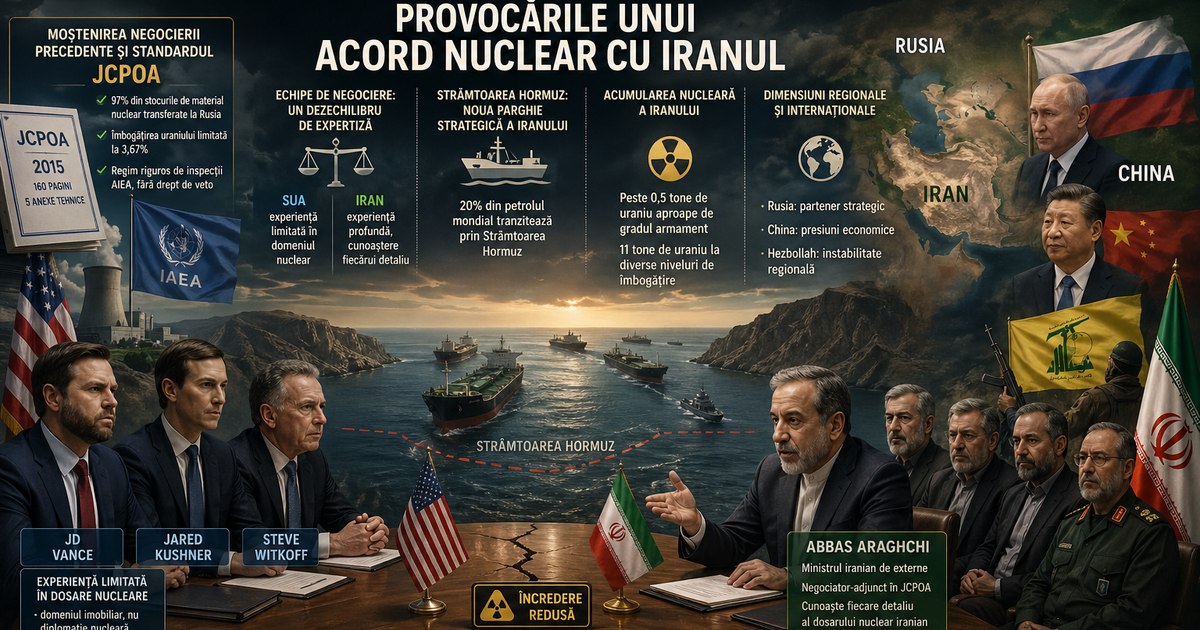
The JCPOA set out three key conditions that Iran had to meet in exchange for the lifting of international sanctions. First, Tehran pledged to transfer 97% of its stockpile of nuclear material to Russia, reducing the stockpile to a level insufficient to make a bomb. Second, any continued enrichment of uranium was to be limited to 3.67%, i.e., to the level of civilian reactor fuel, well below the threshold required for military use. Third, Iran accepted a rigorous inspection regime led by the International Atomic Energy Agency (IAEA), with no veto and unannounced access to nuclear facilities.
The deal wasn't perfect. Its legitimate critics pointed out that the JCPOA did not impose limits on Iran's ballistic missile program, did not stop Tehran's funding of proxy organizations in the region and, perhaps most importantly, contained sunset clauses that would have allowed Iran to resume nuclear activities after 2030. These were the arguments the Trump administration invoked in 2018 to unilaterally withdraw from the deal, calling it a “guaranteed path to a nuclear weapon”. This decision, however, set off a chain reaction with dramatic consequences that are still visible today.
The historical paradox of this situation is profound: it was the American withdrawal from the JCPOA that removed the constraints that kept Iran away from the nuclear threshold. By 2018, Iran had shipped virtually all of its nuclear material to Moscow under the terms of the deal. In his absence, Tehran began enriching uranium to ever higher levels, amassing substantial stockpiles that international inspectors today estimate at over half a ton of near-bomb-grade uranium and a total of 11 tons of uranium at various levels of enrichment. This amount, subjected to further processing, would be enough, according to nuclear security experts, to manufacture up to 100 nuclear weapons.
Negotiation teams: an imbalance of expertise
Any international negotiation is essentially a duel of skills and information. From this perspective, the current configuration of parties is highly asymmetric, and not in favor of the United States. During the 2015 negotiations, the US team was led by career specialists with decades of experience in nuclear matters. The chief negotiator came to the negotiating table accompanied by a whole army of experts: the director of the CIA department for Iran, the secretary of energy and one of the most reputable American specialists in the design of nuclear weapons regularly participated in the working sessions. The technical depth of the team was a deliberate component of the American strategy.
Donald Trump's team has a fundamentally different structure. The main figures involved in the limited negotiations so far are Vice President JD Vance, the president's son-in-law Jared Kushner, and special envoy Steve Witkoff. The latter two acquired their reputations and skills in New York real estate, not nuclear diplomacy. International security experts do not dispute their intelligence or negotiating abilities in general, but point out that familiarizing themselves with such a technical and sensitive file requires years of immersion in the specifics.
The contrast becomes even more striking when placed next to the profile of the Iranian side. Iranian Foreign Minister Abbas Araghchi is no novice in these matters. He served as deputy negotiator in the negotiations that led to the JCPOA and is intimately familiar with every technical parameter of Iran's nuclear program, every disputed clause, and every painful compromise reached during those months of negotiations. According to observers who followed him at the negotiating table, Araghchi knows “every centimeter” of the Iranian nuclear file. This disparity in experience is not a minor detail: in nuclear negotiations, technical details are often decisive.
Beyond the negotiating team in the strict sense, the Trump administration also faces a time pressure that narrows diplomatic room for maneuver. Midterm elections are on the horizon, fuel prices have risen significantly as a result of tensions in the region and the blockade of the Strait of Hormuz, and the American public is increasingly sensitive to the economic cost of conflict. This domestic urgency can be exploited by Iranian negotiators, who know that their American counterpart needs visible results in a limited time frame.
The Strait of Hormuz: Iran's new strategic lever-geography as an instrument of pressure
The Strait of Hormuz has become, in the current context, the most powerful instrument of pressure that Iran has in negotiations with the United States. This narrow sea passage, about 33 kilometers wide at its narrowest point, is the channel through which about 20% of global crude oil exports and a substantial part of the world's liquefied natural gas trade pass daily. Any disruption in transit through this strait has immediate and measurable effects on global energy prices. Iran's de facto control of the strait gives Tehran a coercive capacity it did not have in 2015, when the JCPOA negotiations took place. At that time, Iran was coming to the negotiating table from a position of relative weakness, pressured by international sanctions that were suffocating its economy. Now, while US sanctions continue to hit Iran's oil sector hard, the existence of this maritime leverage allows Tehran to make bolder claims and more easily resist pressure to make quick nuclear concessions.
The current Iranian proposal and the American reaction
In this context, Iran formulated a diplomatic proposal with a coherent internal logic: the reopening of the Strait of Hormuz and the cessation of hostilities, in exchange for the lifting of the American naval blockade of Iranian ports, with the actual nuclear negotiations being postponed for a later stage. This sequential approach is favorable to Iran for several reasons: it lifts immediate economic pressure, keeps its nuclear stockpile intact, and gives it additional time to strengthen its negotiating position.
President Trump described the Iranian proposal as “much better” than Tehran's previous initiatives, acknowledging progress, even as he said it was “not enough” to trigger a deal. The US administration has reaffirmed two non-negotiable objectives: guaranteeing freedom of navigation through the Strait of Hormuz and eliminating Iran's stockpile of highly enriched uranium. These two requirements are difficult to reconcile with the Iranian proposal, which just postpones the talks on highly enriched uranium.
Iran has already rejected two of the main US demands that would have been improvements over the JCPOA: refusing to surrender its nuclear stockpile and refusing to suspend uranium enrichment indefinitely. This Iranian position reflects a clear strategic assessment: the larger the nuclear stockpile and the more advanced the enrichment capabilities, the greater Tehran's bargaining power. Giving up these assets, without solid guarantees, would be tantamount to unilateral disarmament before signing a treaty.
Russia: strategic partner and complicating factor
US-Iranian negotiations do not take place in a geopolitical vacuum. Russia plays a significant role in this equation, and Moscow's position is far from neutral. Iranian Foreign Minister Abbas Araghchi recently met with President Vladimir Putin in St. Petersburg, underscoring the depth of the strategic partnership between the two countries. This relationship materialized concretely during the recent conflict: Russia provided Iran with satellite images of US military assets and infrastructure in the Gulf states, information of direct tactical value to Iranian operations in the region.
From the Kremlin's perspective, a weak, isolated Iran willing to make major concessions to Washington does not correspond to Russia's strategic interests. Moscow benefits from chronic tensions between Iran and the West: they keep energy prices high, weaken Western cohesion, and provide Russia with a de facto ally in resisting the US-dominated international order. Consequently, it is plausible that Russia would quietly encourage Tehran to remain firm in the negotiations and not make hasty nuclear concessions.
Global economic effects and pressures on China
The crisis around the Strait of Hormuz is not only a regional security issue; it has measurable global economic reverberations. Within just a few weeks of the escalation of tensions, the global economic outlook has been significantly revised down. Oil and natural gas prices have risen, generating inflationary pressure that is being transmitted through global supply chains and affecting consumers in energy-importing countries. China is one of the actors most directly affected by this dynamic. The Chinese economy, already weakened by trade pressures and slowing domestic growth, is exposed to energy price shocks with particular acuteness. Beijing heavily imports Iranian oil and is therefore affected by both the disruptions in the Strait of Hormuz and US sanctions targeting the Iranian supply chain. This situation creates a tension between China's short-term economic interests and its desires to maintain functional relations with both sides.
Lebanon, Hezbollah and regional instability
The geopolitical picture is also complicated by developments in Lebanon, where Hezbollah has declared it will not lay down its arms, despite international pressure. This position of the pro-Iranian organization comes in the context in which the Lebanese authorities reported civilian casualties following Israeli attacks. Hezbollah remains a central component of Iran's regional security architecture and one of the main tools through which Tehran projects its influence beyond its borders. Any US-Iranian nuclear deal that would require Tehran to abandon its support for Hezbollah would face formidable resistance from Iranian power structures, particularly the Islamic Revolutionary Guard Corps. In conclusion, the challenges facing the Trump administration in trying to overcome the JCPOA and sign a “much better” deal with Iran are formidable and multidimensional. They combine an imbalance of expertise at the negotiating table, unprecedented Iranian strategic leverage in the Strait of Hormuz, an unprecedented nuclear build-up that amplifies Tehran's bargaining power, internal fractures within the Iranian power system, and a geopolitical context in which Russia, China and regional actors such as Hezbollah have vested interests in the final outcome. Any lasting solution will require not just technical agreement, but a deep realignment of the interests of all parties involved—a prospect that, at present, remains highly uncertain.