Where did the Bucharest disappear when the children were kicking the ball in front of the block / How can people “reconquer” their city


10-20 years ago, you could still see around Bucharest children kicking the ball on the street in front of the block or in front of the house, drawing the sotron on the asphalt, running and enjoying the outdoors, while the adults socialize. Sure, things weren't perfect even then: we had mess, slums, poverty, but at least the city belonged to people, not machines. Now, cars occupy not only the boulevards, but also the side streets and large parts of the sidewalks. How did we get here and what should we do to make the city belong to the people again?
- “In Bucharest, there is nothing else but traffic, it is a form of citizenship,” says anthropologist Bogdan Iancu.
“Cities have become rather huge parking lots. There are no more areas that can be used as informal spaces, neither on boulevards, nor on secondary streets,” notes anthropologist Bogdan Iancu.
Another reason why people no longer have a place on the street is the appearance of navigation applications, Google Maps or Waze, which, in order to optimize time, direct drivers to secondary streets, which were once known only to residents.
“I have the example of the area where I live, in Chitila Triaj. Since Waze appeared, I have noticed that the streets where I walk peacefully with the dogs, at 8-9 in the morning, there are lines of cars. There is nothing else but traffic, it is a form of citizenship,” says Bogdan Iancu.
The pandemic and a reason for optimism
There was a time when things were different: during the pandemic, when there were restrictions on mobility, and people weren't even allowed to go out to parks.
“I illustrated this in a research I did called 'Covid Street.' It is a Facebook page, where I have collected several images and texts about the use of the street. Many people were optimistic that it would continue, but it was not like that”, explained Bogdan Iancu.
But there are other explanations why people no longer use the street for socializing. Sports and play have moved elsewhere – to the specially designed grounds, to the playgrounds, perhaps to the specially designed gardens and terraces.
Has street play disappeared because “children and teenagers only sit on phones and computers/TV” or, on the contrary, do they take refuge in this form of entertainment because they have nowhere else to safely do other activities?
“In the research done by the Faculty of Political Sciences, for the City Hall of Sector 1, we discovered, for example, that for teenagers there is no design for parks, games, hanging out, and then the refuge in the computer comes from here. Young people have no other option, but to pay. In fact, teenagers are not taken into account by local urban planning,” says Bogdan Iancu.
What are we doing to take back our streets?
“One solution would be to limit the speed on the weekend to 5km/hour, in the neighborhoods, on the secondary streets. Such initiatives must be encouraged, both by the people and by the town hall. Many said that the world would be scandalized when Calea Victoriei or Şoseaua Kiseleff were closed. At first, people were upset, but after that the summer evenings became fantastic”, continues Bogdan Iancu.
At the level of the Bucharest authorities, there were two initiatives to restore the streets to the people. In 2010, the Capital City Hall started the “Via Sport” program from the “Capital Grows Green” campaign.
Thus, every weekend, from July 16 to August 8, on Kiseleff road, between Piaţa Victoriei and the intersection with Ion Mincu street, basketball, foot tennis and badminton courts were set up, as well as ping-pong tables.
The program was closed in 2016 by the mayor Gabriela Firea, after 6 years in which it operated every summer. The mayor reasoned that this event blocks traffic every weekend, and the queue of cars on the road, one of the main gateways to Bucharest, stretches all the way to Băneasa.
The “Open Streets” initiative, known mainly for the transformation of Căia Victoriei into a pedestrian street during the weekend, started in 2020, as a proposal for the temporary expansion of recreation and socializing spaces (parks, squares, squares), by transforming some road areas adjacent to them into pedestrian spaces.
The project was taken over by the Capital City Hall and grew year by year, being also organized on the streets of the neighborhoods, according to the same model, for example in Drumul Taberei.
“Open Streets” had over a million participants in 2025 who rediscovered the city step by step, according to the data communicated by the Capital City Hall. There were also critics who said the events were noisy. That was not the idea, just for people to reclaim their street, they said.
How a handful of people from the Domenii neighborhood recovered their street
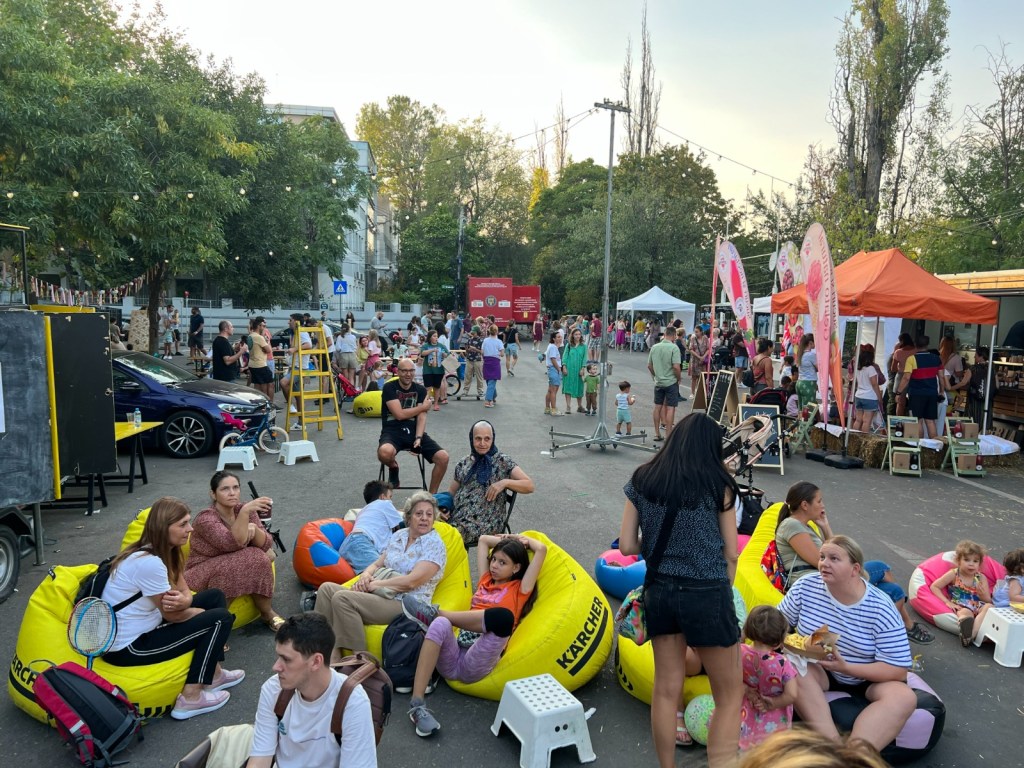
Beyond the public initiatives, there was also a case when things started from the opposite direction, i.e. from the local community.
Since 2021, the “Părinți de Cireșari” Association organizes a community event every year, on the last weekend before school starts. Then Copilului street is closed to cars and given back to people. Children play on the street, splash water, kick the ball, adults talk, spend time together.
“I've never received any complaints. The first time was with a song, because it happens every time. People have the impression that you're taking something from them, not giving it to them. But they saw what it's like to walk down the street without looking behind, that the car is coming, what it's like to leave your children and forget about them on the street, without worrying that they'll get hurt, and they got used to it. Now they like it better this way. About 500 people from the community participate,” says Elena Lucaci, co-founder of the “Parents of Cherry Trees” Association, for HotNews.
From this year, the street will become pedestrianized every weekend, at the initiative of the association, in partnership with Sector 1 City Hall.
“We will transform the street. It will no longer be possible to park on the edge of the crossing because we are using nature-based solutions. That means those 25 meters up to the pedestrian crossing will be green. And the street will turn into a weekend pedestrian street for children.
I wrote a project and submitted it simply, out of the need not to give up. And I got an unexpected answer. “Yeah, let's do it.” We entered our project in a European project, it seems that it was liked a lot, so it will be done this year. It seems, somehow, that the effort was not in vain”, declared Elena Lucaci.
She says she still has fears about the project and people's reaction, but is optimistic.
“I don't know, this disease with parking spaces drives me crazy. And I'm afraid that there will be a scandal, that obviously you can't please everyone and that people are still asking for parking spaces for more cars,” says Elena Lucaci.
“I discovered comfort in cars”
Elena Lucaci is of the opinion that the city we all knew disappeared because people discovered the comfort in cars.
“It seems to me that we can no longer get rid of this comfort. We can no longer return to what we have lost. We have quieter streets in the neighborhood on the weekend and you see how children, naturally, use the street, hit the ball, you even see balls caught in the branches of the trees. During the week, Waze puts the drivers on our streets, they drive from bar to bar at peak hours where before, barely a single car passed,” explained Elena Lucaci.
She says that now parents don't let their children walk to school alone for fear of their car being run over.
“We take them up to 10-11 years old by the hand to school, because you can't do it otherwise. Many drivers don't make eye contact with the pedestrian. I'm on the phone while I'm driving. You can actually see their eyes on the phone, how they type, and they are not paying attention to the traffic”, concludes Elena Lucaci.