“Iran will never surrender nuclear material.” What follows after the expiration of the armistice with the USA

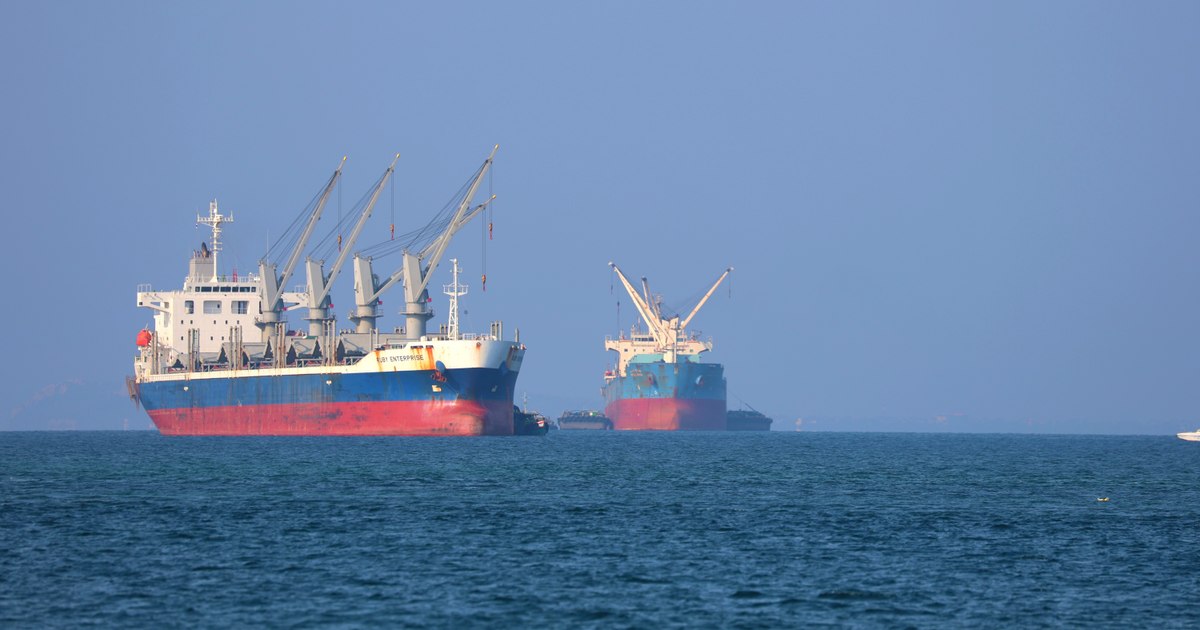
Iran announced on Saturday that it is closing the Strait of Hormuz, and the largest aircraft carrier in the world – the USS Gerald Ford is returning to the Middle East. International relations expert Ioana Mateș claims that despite these tensions, the fact that a ceasefire has been reached in Lebanon reveals that serious negotiations are underway and there are high chances of reaching a peace agreement.
Iran announced on Friday that it is opening the Strait of Hormuz. PHOTO: Shutterstock
Iran reversed its decision to reopen the Strait of Hormuz and reimposed restrictions on one of the world's most important sea routes on Saturday (April 18), accusing the United States of reneging on commitments to lift the blockade.
A representative of the General Staff of the Iranian Police “Khatam al-Anbia” announced that transit through the Strait of Hormuz has returned to “a state of strict military control” due to the blockade imposed by the US.
Authorities in Tehran have warned that transit through the strait will continue to be blocked as long as the US maintains restrictions on Iranian ports.
The decision comes shortly after US President Donald Trump said the US-imposed blockade would remain in place until Iran reaches a deal with Washington, including on its nuclear programme.
The return to normal of the transit in the Strait of Hormuz lasted practically only one day. On Friday, Tehran's Foreign Minister Abbas Araghchi said that under the ceasefire agreement in Lebanon, maritime traffic through this strategic route is being resumed for the duration of the truce. The announcement was made public via a message on the X network.
According to the Iranian official, all commercial ships can transit the Strait of Hormuz on a previously established route, the decision being coordinated with the maritime authorities of the Islamic Republic.
The decision comes shortly after US President Donald Trump announced a ten-day truce between Israel and Lebanon, which took effect on April 16. The initiative is seen as an important step to reduce tensions and relaunch diplomatic dialogue between Washington and Tehran.
A two-week truce between the US and Iran is set to expire on Wednesday, as the two sides held indirect talks to reach a long-term solution.
Ioana Mateș, expert in international relations and lawyer specialized in the region, who represented hundreds of Romanian companies in Iran, the possible scenarios regarding the evolution of the situation.
Ioana Mateș: “It's also a psychological game”
The Truth: Almost a day after announcing the opening of the Strait of Hormuz, Iran announced the closure of the Strait citing the US refusal to lift the blockade on vessels coming to or from Iranian ports. what's going on
Ioana Mateș: Iran has made it very clear that as long as the blockade imposed on Iranian ports is not lifted, they will not allow passage through the Strait of Hormuz.
In this context, it will go towards a slight escalation. I was now waiting for the weekend to see if the second part of the negotiations materializes. As I told you, substantial red lines and maybe a lot of issues could be resolved.
How do you explain these inaccuracies in your statements?
Obviously, this is also a psychological game between two powers that are in conflict and each is trying to maximize the gains from the negotiation, but I can tell you with certainty that there will be no agreement on this issue, not on the handing over of nuclear material to the United States or even to other partners.
It is a civilian reactor, the one in Bushehr, which was made with the transfer of know-how from Russia, from where I saw, and it is worrying, a withdrawal of civilian personnel almost entirely the other days, which did not give me a necessarily positive signal, especially in conditions where an end to hostilities was foreseen. We saw a massive withdrawal of all personnel there, an evacuation by Russia of the personnel they had in Bushehr.
But with regard to the other reactors, we must say that they were all built with Iranian know-how and the Iranians appreciate that it is a national right and a sovereign right to dispose of not only how they control these assets, but they are depositories of the knowledge acquired in the field. The United States cannot erase the knowledge that can at any time produce this type of technology. This cannot be taken away from Iran, regardless of the fate of the nuclear material under the rubble.
I don't think that soon or in the medium term, I don't think that we will have American specialists in Iranian territory who, on top of that, will help locate and remove the enriched uranium from where it is buried.
What happens from Wednesday onwards: The most important step has been taken
The cease-fire period agreed by the US and Iran expires on Wednesday. Trump justified keeping the American blockade in Hormuz with the need to advance in the negotiations. What do you think will happen?
I think the US thought that imposing a blockade might force Iran's hand to negotiate, but they know that being in a truce, Iran can't attack the US Navy either. Such a position would be a violation of the agreement concluded with the United States. I see the world's largest aircraft carrier – the USS Gerald Ford – returning to the region.
LIVE TEXT Iran blocks Strait of Hormuz again. Trump sent the USS Gerald R. Ford aircraft carrier into the Red Sea: “They will not escape again”
We have seen analysts and even representatives of the United States military establishment, such as General McChrystal, who have pointed out that an attack on civilian facilities would amount to a war crime as stipulated by international treaties.
However, for me the most important step, which is the clear sign of de-escalation, is the ceasefire in Lebanon.
This is the significant step without which any talks between Iran and the United States could not proceed. Let's hope that despite these gropings and despite these tensions, the negotiations will lead to a ceasefire.
As you said in previous interventions, without a ceasefire in Lebanon, the Strait of Hormuz will not be unblocked. After Israel and Lebanon agreed to a ceasefire, Iran agreed to unblock the Strait of Hormuz. Why is the situation in Lebanon so important for Iran?
All this conflict and the whole situation in the Middle East is generated by old tensions between Israel and Lebanon, in the sense that there have been attempts at expansion in southern Lebanon. Large communities of Shiite Islamists live in southern Lebanon. Even in the Quran it is very clear that it is the duty of every Muslim to protect Muslim communities. For Iran it is simply about supporting the Shia community, because after all Hezbollah is the military expression of the Shia groups and the Shia community in the region. What for us is a military wing of a civilian population, for Iran it is a community and it is a legitimate organization, it is a representation of the Revolutionary Guards in Lebanon, this does not mean that there is a subordination of Hezbollah to the Revolutionary Guards. Protecting the Shia communities in the region is for Iran the manifestation of a duty of faith, a religious duty.
Iran will certainly condition the agreement with the US, in the future, on the cessation of hostilities in Lebanon.
The fact that Israel has agreed to cease attacks on southern Lebanon is a clear sign that the negotiations are real and serious.
“Under no circumstances will Iran hand over nuclear material. The most difficult negotiating point”
I have seen several conflicting statements regarding Iran's enriched uranium. How do you think this point will be negotiated?
Under no circumstances, under any circumstances, will Iran hand over the nuclear material, that enriched uranium that would lie under the rubble from last year's US attack.
This will be the most difficult negotiating point, because in the end any other formula takes us back to the 2015 nuclear agreement, and then what would have been the need for war? Or then we should consider whether at the time the analysis of the American political establishment was substantial enough to justify withdrawing from the Nuclear Deal. Because a development of a civilian nuclear program by Iran had been agreed upon under the supervision of the International Atomic Energy Agency since that time. What would actually be the new framework now? What should Iran do in addition to what happened then? What could he do more than he did in 2015?
That agreement was supported by Tehran and the European Union, and the European Union continued after the United States withdrew from the agreement to conduct bilateral economic activities with Iran and did not impose sanctions at the time.
India raises alert level after two of its ships were attacked in Strait of Hormuz: Iran's ambassador urgently summoned to New Delhi
Trump said he would bring that uranium to the US…
I cannot figure out what the American president is relying on when he declares that the most important points of negotiation have been agreed, including the nuclear issue, because we also saw the immediate response given by the most important negotiator from the Iranian side, Mr. Mohammad Ghalibaf, the president of the Iranian Parliament, who said very clearly that the claims of President Donald Trump are not real, that no agreement was reached on the nuclear issue.
There will be no deal with Iran without respecting and recognizing Iran's sovereign right to develop civilian nuclear facilities and technologies. So it is out of the question. This point is non-negotiable.
Under no circumstances will any agreement be signed requiring the surrender of that uranium. As I said, although they have previously expressed their willingness, know that even the Russian partners will not be handed over the uranium. Surrender of uranium will not be accepted given the real work and sacrifice of several generations of civil nuclear researchers and engineers.
Compensation for civilian victims
What other important points do you think are still being negotiated?
From what I have seen and read from all sources, including Iranian sources, there would have been no question of the United States' obligation to provide compensation for all loss of life and all material damage resulting from attacks on civilian infrastructure in Iran. Obviously, I think that's a point that's not only non-negotiable, but I think the United States has taken that point because it's a collateral obligation anyway, at least in the case of civilian casualties, like the bloody attack at the Minab Girls' School. The obligation to indemnify derives from the very principles of international law and could not even be circumvented by the United States. It would simply mean a flagrant violation of all that international law means.
This point seems to be clarified, however, the details of these compensations are still likely to be discussed in a more extensive framework.