On September 20, 1941, Jewish residents of Niemenczyn under the supervision of a German SS officer they were taken to a nearby pine forest, where dug pits were already waiting for them. When the prisoners saw this – as the website “Studienkreis Deutscher Widerstand 1933–1945” describes – “they tried to escape, but most of them were shot.” Today, a memorial stone standing near this place commemorates this massacre.
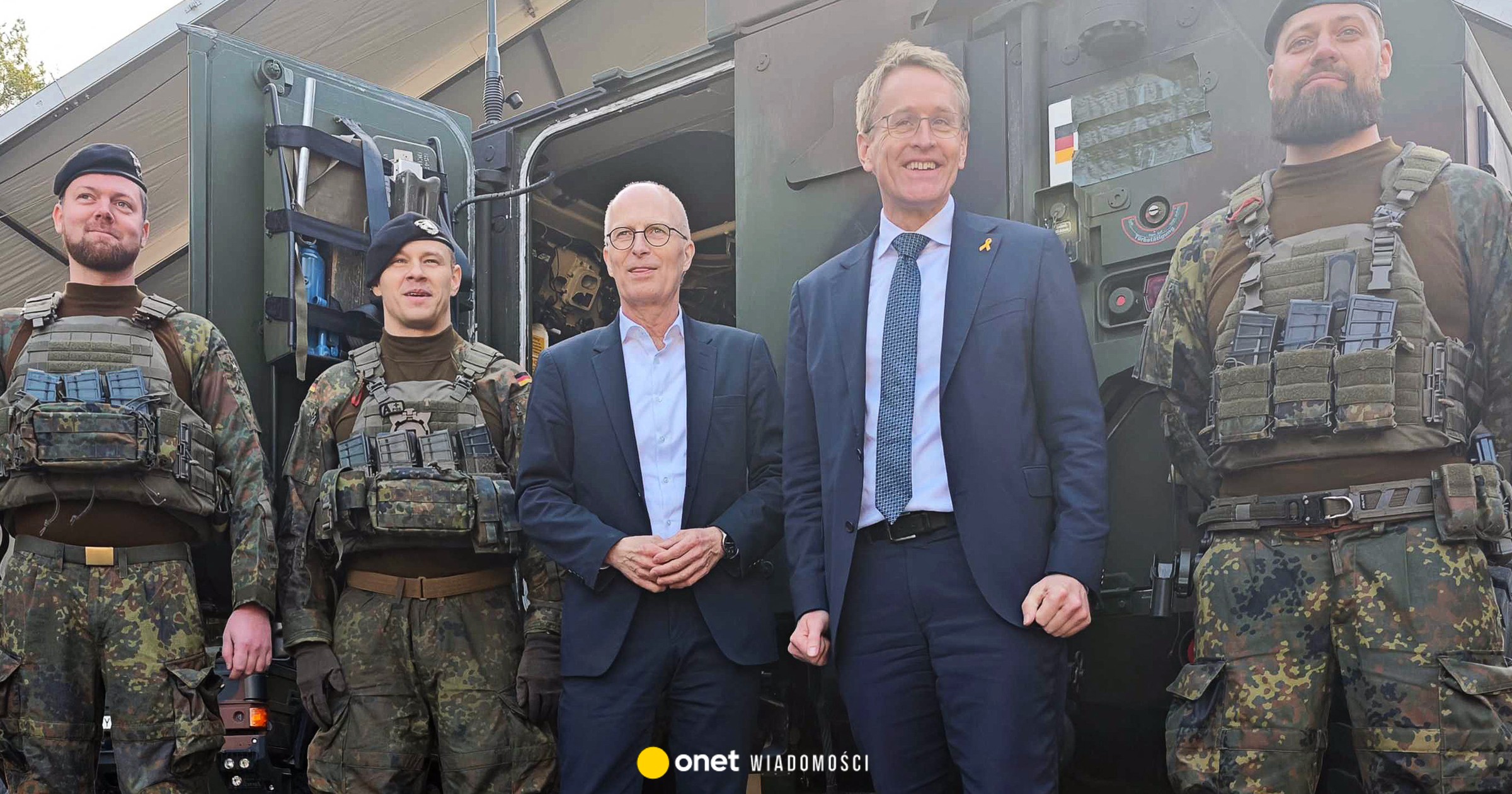
Okay. 2 km from this monument and less than 19 km from the Lithuanian border with Belarus, on Wednesday morning the mayor of Hamburg, Peter Tschentscher, and the prime minister of Schleswig-Holstein, Daniel Guenther, stood in the rays of the spring sun. On the site of the former command post of the Russian army, and later the Lithuanian army, now transformed into a Bundeswehr base, they admire the weapons 45th Armored Brigade “Lithuania” stationed in Niemenczyn.
This is the Bundeswehr unit that is currently being created, It is to have nearly 5,000 soldiers by the end of 2027 and support the protection of NATO's eastern border. German Defense Minister Boris Pistorius described the project as “the most important project of a breakthrough era.” There are currently 1,600 soldiers on site.
This is how Germany wants to strengthen NATO's eastern flank. “Ready for Tomorrow's War”
Tschentscher and Guenther watch in Niemenczyn, among others: drone, anti-drone gun and various armored personnel carriers. All this, as Captain Robin J., responsible for the weapons presentation, says, “the cutting-edge means we use to be ready for the war of tomorrow”. Main battle tanks, including the announced latest version of the Leopard, have not yet been deployed in Lithuania.
Instead, politicians can enter what Captain Robin J. calls “a Fuchs A8A1 armored personnel carrier in the command version.” But both politicians feel only moderately comfortable in its cramped interior. But this short visit to NATO's eastern flank is not about comfort.
The Mayor of Hamburg and the Prime Minister of Schleswig-Holstein went on a joint trip to Eastern Europe to obtain information in Poland, Lithuania and Latvia primarily on civil defense and port cooperation. They believe that both of these issues can, should and should be improved as quickly as possible in these times full of global crises. By visiting the armored brigade, Tschentscher and Guenther also want to show “that they greatly respect and appreciate this work, that men and women soldiers here can be sure that they have support for their service in Germany.”
The article continues below the video
To convey this message, the heads of government are meeting in Niemenczyn with several soldiers from northern Germany stationed in Lithuania. The conversation takes place without the participation of the accompanying journalists, so only the report of both politicians can be presented here.
Tschentscher reports that the soldiers know perfectly well what their task is. — They consciously decided to serve here. – says. Politicians also heard that there are “no diseases” among soldiers stationed in Lithuania. “I mean, these people are not only healthy, but also motivated and committed to this mission,” Tschentscher emphasizes.
Guenther adds that the soldiers did not report any complaints. They only expressed the wish that “those who serve here will be well provided for.” This demand will be taken to Germany “for the political discussions we are having at our level with the federal government.” But then they go back to Vilnius for talks with the country's Minister of Transport and Minister of Science. The memorial stone for the victims of the Niemenczyn massacre that day remains unnoticed.
A bitter history lesson for German politicians
Not only this visit to Bundeswehr soldiers stationed in Lithuania shows that it is radically changing The international situation today also influences the policy of the states in northern Germany. For decades, delegations of federal state authorities have traveled abroad almost exclusively to strengthen existing contacts and establish further cooperation with regional companies and institutions in mind.Nowadays, it is also increasingly about preventive actions in the field of security and defense policy. In case the worst happens.
Daniel Guenther, Prime Minister of the state of Schleswig-Holstein, and Peter Tschentscher, Mayor of Hamburg, visit the German 45th Armored Brigade “Lithuania”. Niemenczyn, April 15, 2026MARTIN FISCHER / DPA / AFP
In Gdańsk – the first stop on this joint journey through the Baltic countries – leading representatives ports in Gdańsk, Gdynia, Hamburg and Kiel assure each other that in the event of a crisis they will help each other. The idea is to support each other if, for example, the port infrastructure of one of the parties – in Poland or Germany – is used for military purposes and is not available for civilian transshipment. – What's new – says the head of strategy for the Port of Hamburg, Lennart Kienau – is that it's primarily about cooperation. One port is responsible for the other.
Even during traditional business meetings, there is less and less talk about orders for local companies, economic expansion or trade with the visited regions. The number one topic now is threats, resilience and building mutual trust.
Standing against the background of the Old Town of Gdańsk, rebuilt after the destruction of World War II, Tschentscher puts it this way: – The world has become harder, there are more conflicts. There is also a fight between regimes, for democracy and freedom for Europe. That is why partners in Poland and the Baltic region are more important to us today than others. – he emphasizes. You could add: also more important than in those long post-war years when Poland and the Baltic states rarely attracted the attention of German politicians as it is happening now.
Nothing is simple in eastern Europe – neither in Niemenczyn nor in Gdańsk. It is there, on the Polish Baltic coast, At the beginning of their journey, Tschentscher and Guenther laid two wreaths at the post office buildingwhich was attacked on September 1, 1939 at the very beginning of the German attack on Poland. Then, about 50 people were murdered, burned alive or later shot on the spot. Almost simultaneously, the German battleship attacked Westerplatte near Gdańsk. Ship name: Schleswig-Holstein.
I’m Ashley Davis as an editor, I’m committed to upholding the highest standards of integrity and accuracy in every piece we publish. My work is driven by curiosity, a passion for truth, and a belief that journalism plays a crucial role in shaping public discourse. I strive to tell stories that not only inform but also inspire action and conversation.