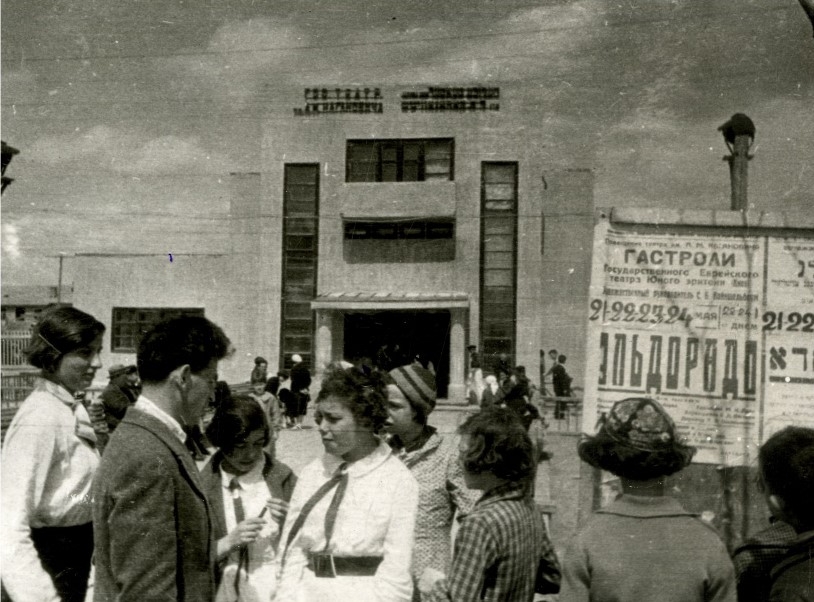
Schoolchildren near the building of the State Jewish Theater. Birobidzhan. 1936
Photo: Heritage JAO
April 15, 1937
The newspaper “Birobidzhan Star” (12+) on April 15, 1937, in the regular column “Around the City and Region” wrote that employees of the telegraph, telephone exchange and communications department conducted their first experience of working in a gas mask. Telephone operators sent and received telegrams, and also talked to subscribers wearing gas masks.
Clippings from the newspaper “Birobidzhan Star”. Photo: Photo: Regional Library
The newspaper informed its readers that the registry office noted an increased number of marriages in the region. In 1936, the registry offices registered 985 marriages. In January 1937, 99 marriages were registered.
For the 3rd anniversary of the Jewish Autonomous Region, Kharkov Komzet sent a piano to the Birobidzhan Marble Worker artel as a gift.
In this section, the newspaper informs the population that the regional branch of Daltorg has begun manufacturing “mobile stores.” Store parts are manufactured on the construction site, and then assembled and installed in specially designated retail areas. The first such mobile store was installed on Oktyabrskaya Street (next to the communications department building).
In the same newspaper, in the article “Traces of Ancient Settlements,” there is information that the Far Eastern geologist B.V. Vitgeft discovered traces of ancient settlements on the Lesser Khingan. In elevated places near rivers, wide pits are seen, sometimes located side by side, around them traces of a ditch surrounding them are visible. The geologist found traces of ancient settlements along the Manchzhurka River and its tributary Kedrovaya, along the Pompeevka, Shakhin, Bidzhan, Klyuchevaya rivers and near the Birakan station. “Further archaeological excavations in the Lesser Khingan will help shed new light on the history of the ancient cultures of the region.”
April 15, 1949

Boris Naumovich Geltsberg. Photo: Photo: Regional Library
The book by D. Wasserman “Birobidzhan: Dreams and Tragedy” (12+) contains information that on April 15, 1949, Boris Naumovich Geltsberg was approved as director of the State Theater named after L. M. Kaganovich. He replaced the excellent director and leader Efim Gelfand in this position.
Boris Naumovich Geltsberg was a unique and legendary personality. Born in 1910 in Kharkov. Since 1922 he lived in Moscow. He was a pioneer of the first pioneer detachment in the Soviet Union – at Krasnaya Presnya. Geltsberg was among the first graduates of the All-Union State Institute of Cinematography, receiving a degree in screenwriting there. After graduation, he studied in graduate school.
In 1935, on a permit from the Central Committee of the All-Union Leninist Communist Youth Union, he came to the Jewish Autonomous Region. At first he was an instructor in the district committee of the Komsomol.
During the war he was a political instructor, military commissar, and head of the Ussuri garrison theater. From 1946 to 1949 he served as a correspondent for the newspaper “Soviet Army for the Korean Population”. In 1948, in Korea, he wrote a book in Korean about the local population. From 1951 to 1956 he worked as a lecturer at the Knowledge Society in Khabarovsk. I visited all regions of the Far East – from Chukotka to Primorye. He wrote a lot about current problems of the region. In 1956, Boris Naumovich moved to Komsomolsk-on-Amur. Worked as a correspondent for Khabarovsk Radio Broadcasting. And in 1958 he was appointed director of the Komsomolsk-on-Amur Drama Theater.
In 1976 he joined the Union of Journalists of the USSR. In 1985, he was awarded the Laureate Prize of the Lenin Komsomol of the Khabarovsk Territory. In 1988, Boris Naumovich published a book of memoirs, “Distant Years, Near Time” (12+).
April 15, 1964

Clippings from the newspaper “Birobidzhan Star”. Photo: Photo: Regional Library
The newspaper “Birobidzhan Star” wrote on April 15, 1964 that representatives of the region's sports community gathered in the hall of the Birobidzhan Palace of Culture to hear a report from the presidium of the regional council of the Union of Sports Societies and Organizations on the work done over the past year.
“In 1963, the number of athletes in the region increased by 7,625 people. Of these, one master of sports, 115 athletes of the first and 894 of the second category were trained. 3,108 people received the third sports category, 5,095 people have youth categories…”
In the same newspaper, in the section “On the 30th anniversary of the Jewish Autonomous Region,” the article “Our Birobidzhan” by V. Panman tells how Birobidzhan grew, developed and became more beautiful over the thirty years of its existence.
“…The car glides almost silently along the smooth, dry asphalt. Descent, ascent, another descent and another ascent – and now Birobidzhan is visible – glowing with thousands of lights. As if some naughty genie threw a handful of diamonds into the evening darkness. Silhouettes of tower cranes traced the blue sky like fantastic birds… It’s hard to imagine Birobidzhan in 2000 What will it be like? But over its 30 years, the city has grown amazingly… And today the young socialist city greets the whistles of factories and factories, the cheerful noise of children rushing to school, the clatter of wheels of trains running away somewhere. The pride of the young city is the Palace of Culture. Honored Artist of the RSFSR Mikhail Aleksandrovich sang here, famous pianist Gleb Akserold played, and artists are frequent guests of Birobidzhan residents. Khabarovsk theaters…”