April 14: The day on which, in 1457, Stephen the Great overthrew ruler Petru Aron and ascended the throne of Moldavia

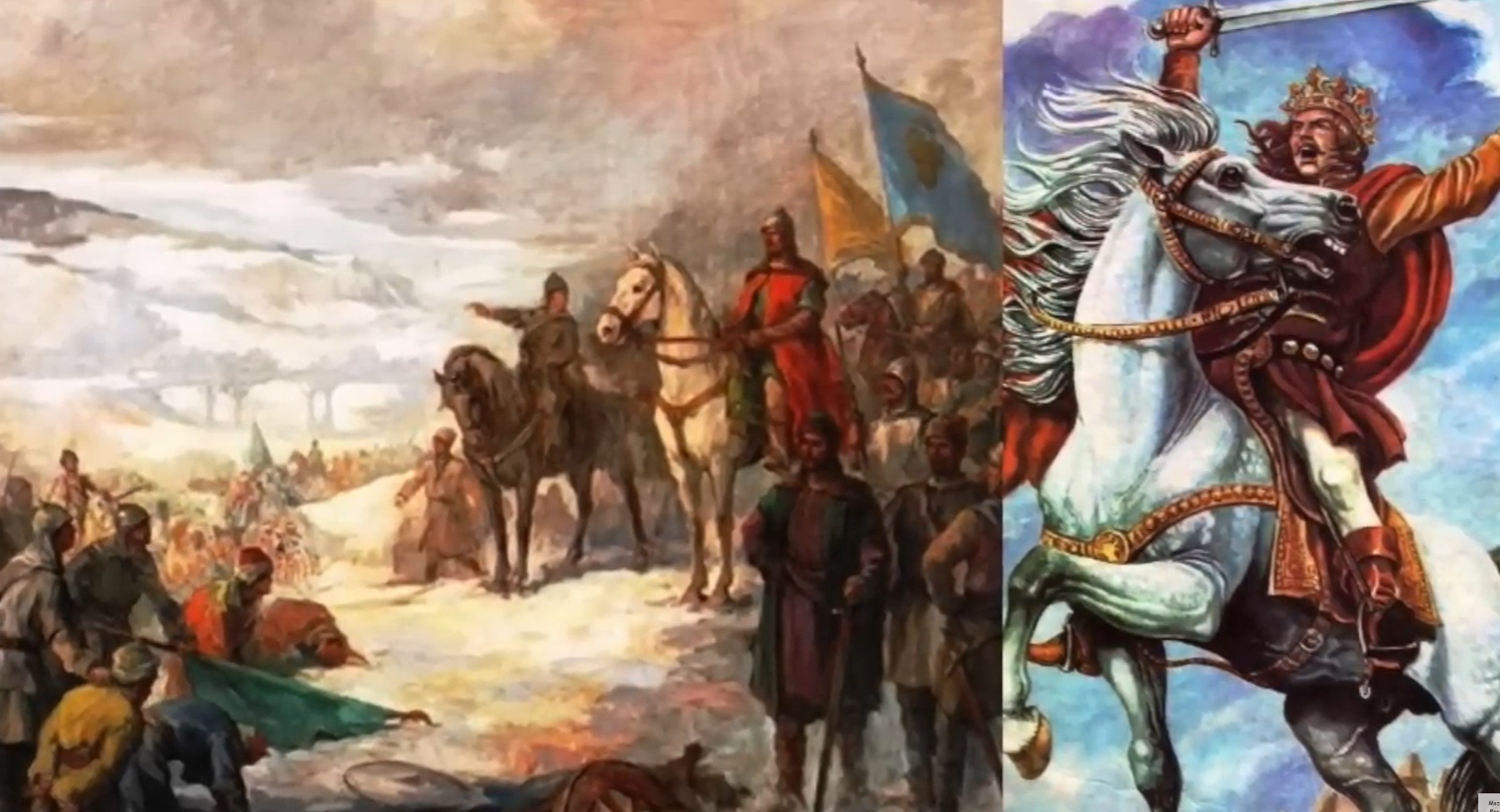
On April 14, in 1457, Stephen the Great defeated for the second time the ruler Petru Aron, becoming ruler of Moldova, and in 1865, the American president Abraham Lincoln was shot. On the same day, but in 1828, the Russo-Turkish war began, and in 2022, the Russian cruiser Moskva was sunk by a Ukrainian attack.
1457 – Stephen the Great became the ruler of Moldavia
At the beginning of April 1457, Stephen entered Moldova from Wallachia, accompanied by approximately six thousand soldiers. The army consisted of Moldavians from the Netherlands and about a thousand mountaineers sent by Vlad Țepeș.
Ruler Petru Aron (who had promised to pay the Turks a tribute of 2000 guldens) tried to resist him, but was defeated at Doljești, on April 12, and again at Orbic, on April 14, being forced to flee to Poland, Stefan thus becoming lord of Moldavia, a reign that would last until 1504. Petru Aron took refuge in Poland, then in secuime, from where he provoked hostilities between Stephen the Great and Matthew Corvinus. After the Battle of Baia in 1467, when Stephen the Great defeated Matia Corvinus, Petru Aron was caught by Stephen the Great and killed (probably in 1469).
Stephen the Great remained one of the most influential figures in Romanian history, a leader endowed with remarkable skills as a statesman, diplomat and military commander, according to Wikipedia.
These qualities allowed him to overcome numerous crises, generated both by the military interventions of his neighbors and by internal or external attempts to remove him from the reign. Under his leadership, Moldova experienced the highest stage of state development, benefiting from political stability, economic prosperity and social balance.
Internally, Ștefan consolidated his authority by forming a new political elite, mainly composed of members of the small boyars, promoted on the basis of military merit, loyalty or family ties. The ruler also supported the development of the razesi, granting collective ownership to the razesi communities, especially after military campaigns. This policy ensured the support of the population, social stability and a solid basis for the mobilization of the “great army”.
Externally, Ștefan followed a realistic strategy, oriented in two directions: the installation or support of favorable rulers in the small neighboring states – Wallachia and the Crimean Khanate – and maintaining a balance between the great powers around Moldova: the Ottoman Empire, the Kingdom of Poland and the Kingdom of Hungary. He tried unsuccessfully to create an international anti-Ottoman alliance, sending envoys to Rome, Venice, Hungary, Poland, Bohemia and Persia.
In the military field, Stefan developed an extensive system of border fortifications, consolidating fortresses such as Suceava, Neamț, Chilia, Cetatea Albă, Tighina, Orhei, Lăpușna and Hotin. At the same time, he modernized the army, combining a permanent, professional component with a mass one, made up of recruits mobilized in major campaigns.
During his reign, he participated in more than 40 battles, most of which ended in victory. Among the most important are those from Baia (1467), Lipnic (1469) and Codrii Cosminului (1497).
The pinnacle of his military career was the victory at Vaslui on January 10, 1475, when he crushed a powerful Ottoman army led by Suleiman Pasha. The following year, Sultan Mahomed II personally led an expedition to Moldova, which ended with the defeat of the Moldavians at Valea Albă-Războieni.
After 1476, Stephen accepted Ottoman suzerainty, but obtained advantageous conditions: a reduced tribute and the preservation of the country's internal autonomy and institutions.
The ruler was a great protector of culture and the church, building numerous monasteries and churches in Moldova, but also in Wallachia, Transylvania or Mount Athos. For his spiritual and historical contribution, he was canonized by the Romanian Orthodox Church on June 20, 1992, under the name of Stephen the Great and Holy.
Ștefan was married three times – to Evdochia of Kiev, Maria from Mangop and Maria Voichița – and had seven children. From 1497, he associated his son Bogdan III, who succeeded him to the throne. Stephen the Great died on July 2, 1504, and was buried at the Putna Monastery, a place that became a symbol of national identity.
1574 – Victory of Ioan Vodă the Brave at Jiliștea
Lord of Moldavia between 1572 and 1574, Ioan Vodă the Complete refused to double the tribute demanded by the Ottoman Empire, which triggered the conflict with the Turks. The first major confrontation took place on April 24, 1574, in Jiliștea, where the Moldavian ruler defeated Alexandru Vodă of Muntenia, supported by the Ottomans.
Although he initially rejected the attacks, Ioan Vodă was defeated at Cahul, after the betrayal of Ieremia, an episode recorded by the Polish chronicler Leonard Gorecki.
1828 – The beginning of the Russian-Turkish war
The Russo-Ottoman conflict of 1828–1829 took place in the Balkans and Transcaucasia, involving Romanian infantry units. 18,000 Turks, 200 modern guns and the entire Danube flotilla were captured by the Russians, and numerous towns in Dobrogea were devastated.
1865 – US President Abraham Lincoln was shot
On the evening of April 14, 1865, during a performance at Ford's Theater in Washington DC, Southern actor John Wilkes Booth shot President Abraham Lincoln. Witnesses reported that the attacker shouted the Virginia state motto, “Sic semper tyrannis!”, before fleeing the scene.
That same night, an accomplice of Booth broke into the home of Secretary of State William H. Seward and seriously wounded him in a coordinated attack, but the American official survived.
Lincoln's injuries proved fatal, and the president died on the morning of April 15, 1865.
1884 – The “Tribune” publication appeared
On April 14/26, 1884, Ioan Slavici founded the political newspaper “Tribuna” in Sibiu, which became one of the most influential publications in Transylvania. The newspaper campaigned for the unity of Romanians through culture and had important collaborators such as George Coșbuc, Octavian Goga and Ion Agârbiceanu.
1924 – Literary critic George Munteanu was born
George Munteanu, born in the former Orhei county, became one of the most important eminescologists. Among his works is “Hyperion 1. Viața lui Eminescu”, awarded with the “BP Hașdeu” Prize of the Romanian Academy. He collaborated with magazines such as Romania Literară and Tribuna.
1932 – Loretta Lynn, “Queen of Country Music” was born
Kentucky-born Loretta Lynn became one of the most influential country artists in history. His hits include “Coal Miner's Daughter,” which also inspired an Oscar-winning film.
During his career, he released more than 60 albums and received the Presidential Medal of Freedom.
1943 – The literary historian Florin Faifer was born
Critic, theatrologist and lexicographer, Florin Faifer contributed to reference works such as “Dictionary of Romanian Literature from the Origins to 1900”.
He was a researcher at the “A. Philippide” Institute and a university professor, influencing generations of philologists.
1950 – Poet Daniela Crăsnaru was born
Daniela-Carmen Crăsnaru, poet, prose writer and cultural diplomat, has published volumes translated into more than 15 languages.
He was an FSN deputy in the period 1990–1992 and received the Romanian Academy Award for his entire activity. Currently, he is deputy director of the Academy of Romania in Rome.
1975 – Tennis player Gabriel Trifu was born
A former professional player, Gabriel Trifu won an ATP doubles title in 1998, alongside Andrei Pavel.
He represented Romania in the Davis Cup and the Olympic Games in 2000, and since 2017 he is the non-playing captain of the national team.
2018 – The writer Jean Băileșteanu died
Author, editor and typographer, Jean Băileșteanu published prose, articles and plays, being involved in the Craiova literary press.
He was elected president of the Craiova Branch of the Union of Writers just a few days before his death.
2022 – Sinking of the Russian cruiser Moskva
The flagship of the Russian Black Sea Fleet sank following a Ukrainian Neptun missile attack, according to Kiev. There were “396 people” on board.
The episode raised tensions between Ukraine and the United States in the first weeks of the war.
2023 – Launch of the European space mission JUICE
The European Space Agency launched the JUICE mission to study Jupiter's icy moons: Callisto, Ganymede and Europa. The probe will travel 6.6 billion km, arriving in the Jovian system in 2031.
2013 – Musician Sir Colin Davis died
Sir Colin Davis, one of the most respected British conductors of the 20th century, died in 2013 at the age of 85. Born on 25 September 1927 in Weybridge, Surrey, Davis has had an impressive career, marked by collaborations with some of the world's most prestigious orchestras.
Over time he conducted the BBC Scottish Orchestra and Sadler's Wells Opera House, and from 1967 to 1971 was principal conductor of the BBC Symphony Orchestra. In 1971 he took over the position of music director of the Royal Opera House Covent Garden, one of the most important opera institutions in the world.
His international career has included collaborations with the Boston Symphony Orchestra, the New York Philharmonic, the Bavarian Radio-Symphonic Orchestra and the Staatskapelle Dresden. However, his relationship with the London Symphony Orchestra was defining: he conducted it for the first time in 1959, became principal conductor in 1995, and since 2006 has been its honorary president. His interpretations of Mozart, Sibelius and Berlioz have remained benchmarks.
Recognized worldwide, Sir Colin Davis was ennobled in 1980 and has received numerous honors, including two Grammy Awards, the Royal Philharmonic Society's Gold Medal and the Gramophone Award. He gave concerts on the great stages of the world, being considered one of the great ambassadors of British classical music.