Polish bonds are back in the game. Are fears about interest rate increases no longer valid?

Last week in the financial markets there was euphoria following reports that the US and Israel had reached a two-week truce. Stock indices around the world went up significantly, and new records were broken on the Warsaw Stock Exchange.
At the same time, yields on treasury bonds began to fall (meaning price increases) after a sharp decline in oil prices eased fears of rising inflation, slowing economic growth and rising interest rates.
Read also in BUSINESS INSIDER
The relief rally was also visible in the case of Polish treasury bonds. Only on Wednesday, the yield on 10-year securities fell by as much as 37 basis points (bps), to 5.53 percent, which means about half of the increase in yields seen as a result of the U.S. and Israeli attack on Iran has been erased.
See also: Surprisingly large profits on the Warsaw Stock Exchange. But experts are divided
Abrupt changes in bond yields
In March, the yields on our 10-year treasury bonds jumped from 4.9%. to temporarily almost 6 percent and this despite the Monetary Policy Council cutting interest rates by 25 basis points a month ago, to 3.75%. As a result, the difference between the yield on 10-year bonds (which takes into account not only the monetary policy assumed by the market – this is mainly the domain of short-term securities – but also inflation and risks such as fiscal and geopolitical) and the reference rate increased again.
In the case of 10-year bonds, the spread temporarily reached approximately 220 bp, the last time it was similar was in mid-2022, when the market was destabilized by the energy crisis after Russia's attack on Ukraine and further large rate increases were priced in. The recent increase in the spread is mainly the result of the war in the Middle East: at the end of February it was 93 bp, which means that at the moment of greatest uncertainty it increased by nearly 100 bp.
Such a strong change in quotations was a reaction to the sharp increase in prices of energy raw materials and, consequently, to the intensification of inflation concerns and changes in expectations regarding the monetary policy pursued by central banks (in March, the Polish derivatives market temporarily estimated an increase in the NBP reference rate by as much as 100 basis points, to 4.75% during the year).
The yield on Polish treasury bonds has increased in recent months. But even before the attack on Iran, it was higher than the NBP reference rate.
|
NBP, own study
— In periods of increased risk aversion, the Polish debt market may temporarily behave weaker than the core markets, and this was the case this time. It seems to me that when the conflict in the Middle East deescalates, we will see a very strong correction, although the quotations may not return to the original level from the end of February, because the probability of further rate cuts in Poland has permanently decreased, says Mirosław Budzicki, financial market strategist from the Market Strategies Office of PKO Bank Polski.
— In addition to the change in expectations regarding monetary policy, the increase in yields was most likely also influenced by the decline in demand from foreign investors. At the beginning of the year, before the outbreak of the Gulf War, non-residents significantly increased their exposure to the Polish bond market. We believe that the situation in the Middle East could have reversed this trend, and the outflow of capital could have intensified the upward pressure on the interest rate on treasury debt, says Marcin Kujawski, economist at BNP Paribas.
The market has already corrected some of the nervous reaction
However, even before the outbreak of the war in the Middle East and before expectations of inflation and rate increases were aroused, the spread between the yield of 10-year Polish treasury bonds and the NBP reference rate was slightly increased.
— In the case of long-term bonds, investors also expect an additional premium, including: due to higher issues of treasury securities. Poland's growing borrowing needs in recent years mean that the premium may be higher by approximately 40 basis points. In the case of long-term bonds, we are also talking about a narrower group of potential investors, as well as higher volatility of quotations, which increases the premium demanded by investors – explains Mirosław Budzicki.
Karol Pogorzelski, economist at Bank Pekao, points out that the market and analysts assume that interest rates will not return to pre-pandemic levels, but will fluctuate around 2%. in the euro zone and 3 percent in Poland.
— Long-term treasury bonds, in addition to the interest rate path, also price the country's default risk. This risk is certainly increased in Poland due to the high deficit, growing public debt and lack of political perspectives to balance fiscal policy.. Changes in the perspective of our country's ratings, and in the future perhaps also in the rating itself, confirm this perception – says the Pekao expert.
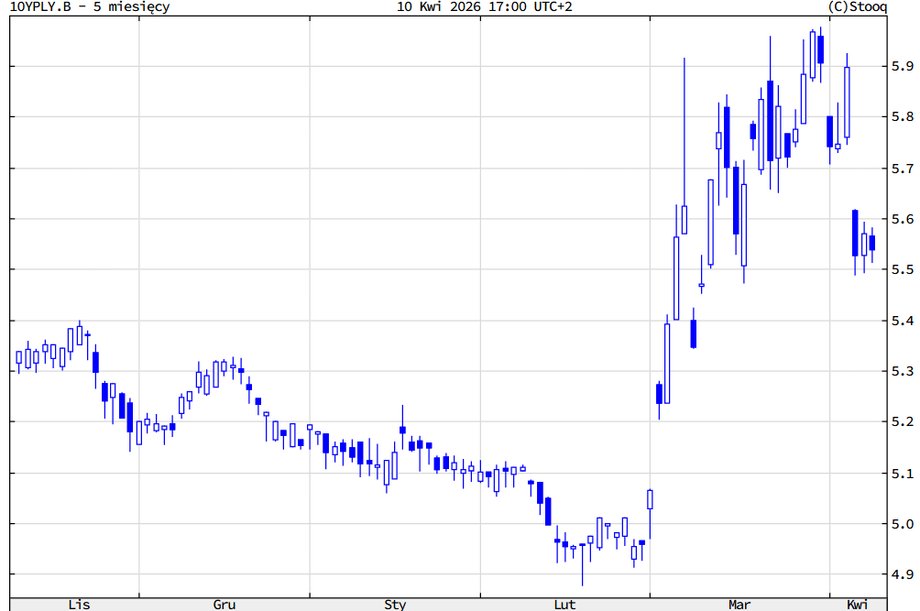
The yield on Poland's 10-year treasury bonds temporarily dropped to the lowest level in four years at the beginning of the year, but the attack on Iran quickly pushed it up to around 6 percent.
|
Stooq, own study
It reminds that in addition to the reduced demand for Polish treasury bonds, the increase in their yield is also the result of taking into account a slightly greater fiscal risk due to the cost of the CPN program to the state budget.
The futures interest rate contract (FRA) market significantly reduced the valuation of future rates in Poland after the ceasefire was announced. In the second half of March, FRA contracts indicated a total of almost 100 bp of increases, and now they practically do not price in an upward move. However, at the beginning of the year it was expected that about three cuts for a total of 75 bp would be possible.
Will the Monetary Policy Council be forced to increase rates?
For central banks, the situation is multidimensional and quite difficult. On the one hand, they usually do not respond to supply shocks, and in addition, there is more and more talk about the inhibiting impact of increased inflation on economic activity (which would work towards reducing inflation). However, on the other hand, they cannot increase inflation expectations and must ensure credibility.
After the 14-day truce was announced, crude oil fell from approximately $110-115. per barrel to $95-100. However, it is still much more than before the attack by the US and Israel. Can these levels and the uncertainty about the actual end of the war and supply disturbances force the Monetary Policy Council to react in this half-year? On Thursday, the Monetary Policy Council decided to maintain the reference rate at 3.75 percent, and President Adam Glapiński said at the conference that there was no question of increases now.
— Prices of energy raw materials have fallen. Central banks can breathe a sigh of relief and are unlikely to react, although in the case of the ECB this is not yet certain. However, we do not expect the Monetary Policy Council to respond by increasing interest rates. Nor did we expect this when the prospects for a truce were still dim. An energy shock is a type of supply shock that monetary policy cannot effectively mitigate. The truce, however, opens the way to talks about a return to price cuts. Perhaps they will take place in the fall, if the ceasefire continues and the prices of energy raw materials return to relatively low levels, i.e. USD 70-80. a barrel – says Karol Pogorzelski.
— The prolonged conflict and growing concerns about a permanent acceleration of inflation could potentially intensify the discussion on the need to increase interest rates in Poland. However, we believe that the likelihood of such a move is still lowand the announced two-week truce gives rise to hope that an early end to the conflict is possible. In our opinion, the implementation of this favorable scenario would cause the market to quickly abandon expectations of higher interest rates in Poland – adds Marcin Kujawski.
How has the bank coped with market pressure in the past?
Bank Pekao economists wrote in Friday's report that theoretically, the central bank may not care what markets think. However, they emphasized that in practice it is more complicated, because market expectations provide valuable feedback on the reality that the central bank wants to respond to and influence. In extreme situations, market valuation may become a self-fulfilling prophecy if it is accompanied by capital outflow from the country.
They checked how markets in the past coped with predicting future NBP movements, and how NBP coped with responding to market pressure. The framework is very simplified: changes in the WIBOR 3M rate estimated one year ahead (using a 12×15 FRA contract) were compared with the actual changes in WIBOR 3M over the next year. The conclusions are as follows
- Markets have previously priced in all the big swings in Polish monetary policy in advance,
- The change in valuations was not a perfect predictor of future NBP movements – a year is a long time and some shocks (a prime example is COVID) were not known so far in advance. So the markets had no chance of knowing about them,
- Markets tend to underestimate the scale of future interest rate changes. The cycles of interest rate cuts and increases have always turned out to be greater ex post than the markets estimated. Alternatively, the FRA market primarily valued the first steps of the NBP.
- Valuations of small interest rate adjustments. one way or the other, they often had no predictive properties at all. For example, in 2016-17 there were no rate cuts (although the market estimated 1-1.5 such a move) and in 2014-15 the Monetary Policy Council did not increase rates (instead, they lowered them).
“In terms of scale, last month's valuations were closest to the situation outlined in the last point: the market was pricing in a relatively small rate correction, which included a lot of the effects of a natural steepening of the curve. The NBP will be able to cope with such pressure calmly – it has just done so,” Pekao economists concluded.
Author: Maciej Rudke, journalist of Business Insider Polska