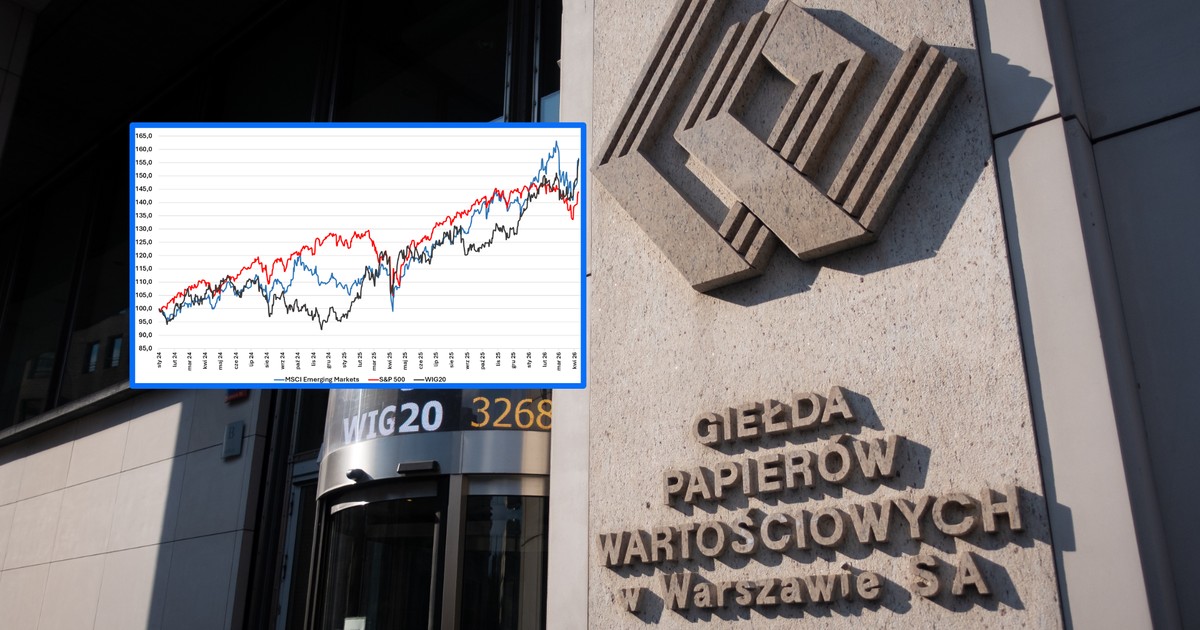
The year 2025 was phenomenal for our stock market – WIG gained 47.3% and WIG20 over 45%. — and it seemed that it would be difficult to maintain such a good streak in 2026. Especially since our stock indices in the previous decade unfortunately had the unpleasant habit of lagging behind the leading markets in terms of rates of return.
Growth trend at ul. However, Książęca in Warsaw is continued. On Friday, WIG, the broad market index, set a new all-time record during the session at 131,325 points. WIG20 reached 3,596.8 points, which is a new peak of the bull market that has been ongoing since the end of 2022 and the highest level since mid-December 2007. WIG20 Total Return, a variant of the index of the 20 most liquid companies from the WSE taking into account dividends, set a new historical peak of around 7,952 points.
mWIG40 and sWIG80, grouping medium and small-sized companies, are still slightly below their records at the turn of January and February, which may suggest that foreign investors – focusing their activity on the largest Polish companies – are responsible for the recent increases on the WSE.
Important: the calculations and information contained in the text are for information purposes only and do not constitute a recommendation or any other form of suggestion for the purchase or sale of financial products. Investment decisions should be preceded by your own analysis of risk and financial situation.
The WSE indices outperformed developed markets
Since the beginning of this year, WIG has already gained 12%. (the rate of return for the last 12 months is 43.2%), and WIG20 increased by 13%. (40.9%). MSCI Poland, on which foreign investors rely, gained 11.8%. (46%). The American S&P 500 and Nasdaq 100 indexes have been around zero since the beginning of the year, and their 12-month returns are 29.9%, respectively. and 37.4 percent The German DAX lost 2% and gained 16.1% in one year.
The WSE performed similarly to the MSCI Emerging Markets index, which groups other stock exchanges from emerging markets, which has gained 10.9% since the beginning of the year and 50% in the last 12 months. (although it is worth remembering that approximately 80% of the share in this index is held by emerging Asian countries).
The stimulus for the increase was the information on Wednesday that the US and Iran had agreed a two-week truce. This improved sentiment on global markets and restored investors' risk appetite. However, the WSE was already performing relatively better. On Tuesday, WIG20 reached the maximum in this bull market during the session and the highest level since the beginning of January 2008, which may seem surprising considering the external environment (war in Iran, high oil prices, concerns about rising inflation and its impact on interest rates and economic activity).
See also: OFEs record record profits for Polish retirees. The result may surprise you
— The strength of the Polish stock market results from the overall, very good economic situation of Poland compared to other countries. And not only against the background of Europe, but also against the background of emerging markets. The conflict in the Middle East confirmed investors' belief that despite the great confusion on the commodity markets, there are safer areas. Fortunately for us, our stock market shows quite well the scale of Poland's economic success and gives us the opportunity to build well-diversified stock portfolios – says Marek Kaźmierczak, fund manager at VIG/C-Quadrat TFI.
| Stooq, own study
He estimates that the problems of large developed markets are naturally related to the scale of these economies and the scale of the challenges they face (mainly the high level of business globalization). It reminds that we will see a significant increase in the prices of products derived from crude oil in the third quarter (July-September).
— That is why global investors tried to adjust their stock portfolios at the beginning of the conflict. It should be remembered that in addition to this, trade wars are ongoing, there is strong competition from Chinese producers on global markets and the AI revolution is still gaining momentum. As a result, we have new winners and losers among countries, sectors and companies, says Kaźmierczak.
It is also worth taking a look at the structure of the WIG20 index. There is an old saying that without banks there is no boom on the WSE. Now it is confirmed once again. WIG-banks has just climbed to new heights, having gained 19.4% since the beginning of the year, and as much as 54.4% in the last 12 months. This industry – taking into account its large share in WIG20 (35.8%, and together with PZU, which also performed well, 43.7%) – was the driving force behind the growth of the blue chip index.
To this must be added Orlenwhich has gained as much as 34% since the beginning of the year, and 115% within 12 months, and its capitalization exceeded PLN 150 billion, and another state giant – KGHM — which brought 12 percent respectively. and 181 percent rates of return. They were strong too Kęty (19.1 percent and 49.9 percent) and Budimex (18.1 percent and 37.8 percent) i LPP (12.6% and 54.4%). It is also worth mentioning the strong recovery of companies from the energy sector, i.e PGE (26.8 percent and 43.5 percent) and Tauron (23.8 percent and 118 percent).
Companies such as Żabka and Kruk fell below the benchmark. Allegro (- 10% from the beginning of the year and for 12 months), Dino (-16.8% and -26.5%) and Modivo (-23.9% and -59.4%) performed very poorly.
Will the WSE indices continue to grow?
— Central and Eastern Europe has been surprisingly strong since the outbreak of the war in Iran, and this also applies to the Warsaw Stock Exchange. This can be understood from the perspective that within emerging markets, Asia, which previously led the upward movement, was the hardest hit. At the same time, within developed markets, it is difficult not to notice that Europe, led by Germany, is behaving weaker than the rest of the world. This is the main reason why we are skeptical about the Polish market, says Kamil Cisowski, manager at Opoka TFI.
Dariusz Świniarski, fund manager at Eques Investment TFI, sees potential for growth – despite the relative strength of stock indices on the WSE since the beginning of the year. He emphasizes, however, that generating positive rates of return in the country in the coming quarters will require a more selective approach than before.
— The two main factors behind the positive prospective approach to WSE companies are a favorable macroeconomic environment and capital inflows to Europe and the basket countries. — says Świniarski.
He enumerates that the first set of factors are: the continuing positive momentum in the domestic economy, accelerating GDP dynamics, strong consumers due to the real growth in the wage bill, low unemployment and a positive monetary environment due to lower NBP interest rates, which translate into an increase in bank lending. In his opinion, such an environment should support companies from sectors whose performance is correlated with the business cycle in the economy.
He points out that the second of the factors mentioned at the beginning results from the specificity of European stock exchanges, where cyclical companies from the so-called the old economy, the weakening US dollar, which pushes capital out of the US, which is also dictated by the erosion of investors' trust in the US administration. — The region of Central and Eastern Europe, characterized by higher GDP dynamics than in the rest of the EU, attracts this capital more stronglyand its impact on the growth dynamics on the Warsaw Stock Exchange is more visible due to lower liquidity versus Western European markets – says the Eques Investment TFI expert.
— I think the market needs to rest a bit after such a strong move recently, but it will be a sideways trend rather than a noticeable correction. Any end to Russia's aggression against Ukraine may be a catalyst for further increases. Lasting peace would be a dream scenario, especially in the context of the problems of Russia's ally, Iran, but difficult to implement, Kaźmierczak believes.
He adds that the resumption of the conflict between the US, Israel and Iran will exert some inflationary pressure, which will probably be reflected in higher yields on long-term bonds (think 10-year bonds in the US or Poland). — This is negative for the stock. In such a scenario, equity markets may gradually decline. The US administration perfectly understands how financial markets work, and this conflict is neither popular nor sensible in the medium and long term, notes the VIG/C-Quadrat TFI expert.
Valuation indicators on the WSE. Is it already expensive?
The share prices of companies on the WSE have gone up significantly, but the company's profit forecasts have not been significantly raised yet. Could this suggest that the price-to-earnings ratio is slowly becoming unattractive to buyers?
— The expansion of multipliers that took place in 2025 did not cause valuations to become detached from reality. The forecast P/E ratio for 2026 for the broad WIG is over 7%. lower than the 10-year average, and the profits of companies listed there should increase by 12% this year. y/y. A return to disruptions in the flow of energy resources will negatively affect the quotations of companies around the world, including those listed on the WSE. If the scenario of ending the conflict in the Persian Gulf in the first half of this year is realized, corrections will constitute an opportunity to take long positions, says Dariusz Świniarski.
According to Kamil Cisowski, the valuation indicators on the WSE have not reached the level of overheating, they are quite high, but not in the area that has diagnostic significance. — Poland is not a market that seems attractive to us from the perspective of long positions (growth games), but this does not mean that it will not benefit along with the rest of the world if an armistice were a precursor to the end of the war. – says the manager of Opoki TFI.
— The domestic stock market achieved the minimum plan, i.e. approximately 10%. growth in 2026. This is at least a good, if not very good result, especially after a phenomenal 2025. Valuation ratios are above average, but still below developed markets, which we are gradually catching up with. Why is the valuation gap between the domestic stock market and foreign companies narrowing? Because domestic companies record higher dynamics of profit growth and have been doing so successively for many years. Higher valuations of domestic companies also mean that it will be easier for them to justify takeovers on foreign markets, says Marek Kaźmierczak.
Author: Maciej Rudke, journalist of Business Insider Polska
I’m Ashley Davis as an editor, I’m committed to upholding the highest standards of integrity and accuracy in every piece we publish. My work is driven by curiosity, a passion for truth, and a belief that journalism plays a crucial role in shaping public discourse. I strive to tell stories that not only inform but also inspire action and conversation.