INTERVIEW On Viktor Orbán's strengths: “A very hard-working politician. Both intellectually and physically. Plus very good at adapting”


Hungarian investigative journalist András Pethő explains for the HotNews audience why Hungary has reached the situation where “There is no clear separation between the state and the party. Basically, it is a party-state.”
“Orbán always needed an enemy. And the best enemies are those who don't fight back.” This is how András Pethő explains how the Hungarian Prime Minister has once again made Brussels a central issue in domestic politics in Hungary, ahead of parliamentary elections to be held in the neighboring country on Sunday, April 12.
Who are András Pethő and Direkt36
András Pethő is one of Hungary's best-known investigative journalists. He is the co-founder of Direkt36, an independent newsroom launched 11 years ago, when he left the publication Origo, meanwhile transformed into a government propaganda platform. “I could have stayed, I had a job, I was paid decently and everything was comfortable. But I didn't want to give up my freedom and independence,” says the journalist.
Direkt36 operates as a non-profit organization, and most of its funding comes from the public: in 2024, tax redirections and more than 19,000 micro-donations provided 84% of the newsroom's annual budget.
Direkt36's investigations and documentaries are watched by millions of people. The film “The Dynasty”, about the business of the Orbán family, was released by Direkt36 in February 2025 and in one year exceeded 4 million views. This year, the editorial office also released “The Trap”, a new documentary about the Orbán regime, with more than 1.5 million views.
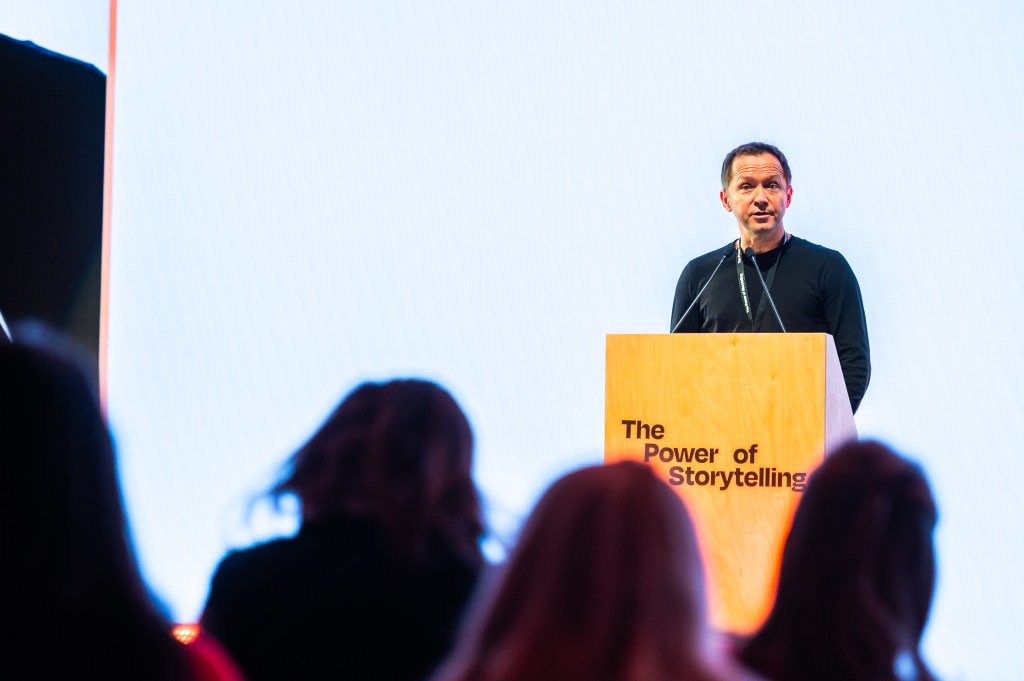
The interview was conducted at the Power of Storytelling conference, organized in Bucharest, where András Pethő spoke about investigative journalism in an unbalanced media landscape and about its role in society.
Why the Hungarian electoral system favors Viktor Orbán
HotNews: Hungary is preparing for important elections. Can you explain to the public in Romania why they are also important for our country?
András Pethő: In fact, I think that these elections attract a lot of attention not only from Romania, but also from many other countries. Because Viktor Orbán has become a symbol of a new type of populist politics with autocratic tendencies. And, for the first time in 16 years, the stakes are real. Orbán is, at least according to credible polls, trailing his opponents.
There is a new opposition political force, a party leading in the polls. This has not happened in the last 16 years. That's why I think this election is so important. Obviously, first of all for Hungarians, but also for the rest of the world and the region.
– What would the fall of Viktor Orbán mean for the region?
– The campaign of the two main candidates, Victor Orbán and Péter Magyar, focuses mainly on domestic politics. Sure, the government uses the Ukraine issue as a campaign topic, but mostly for domestic consumption.
I think that if Péter Magyar and his party, Tisza, win and can form the government – if they also have a majority in Parliament – then they will have a different approach to international politics. Mainly, I think the relationship with the European Union will be different. At least that's what they say.
I think they will be less confrontational. I think they will say that they will cooperate more with international partners. Including some countries in the region.
Even the relationship between Hungary and Poland, which was very strong, is now much weaker, because there are many conflicts between the Hungarian government, Viktor Orbán, and the political leadership in Poland. I think Péter Magyar would try to normalize these relations. Magyar says he will stand firm with Brussels on some issues, but will likely be more pro-Western and pro-EU.
“Orbán always needed some kind of enemy“
– But the Hungarians want to choose a European leader or rather a strong one? One that opposes Europe and imposes its positions?
– It is interesting how Viktor Orbán managed to turn the European Union and Brussels into a central topic of Hungarian domestic politics. I think the explanation is that Orbán always needed some kind of “enemy”. He is always in a fight. And the best enemies are those who don't fight back. The best enemies are the invisible ones. That's why when he attacks Brussels, most people don't understand exactly what he's talking about. They are mostly faceless bureaucrats or bureaucratic institutions.
However, I think that these messages have started to not resonate so well with the Hungarian public, because people are naturally preoccupied with everyday problems: high inflation, housing problems, lack of economic growth. And the opposition is campaigning on these issues.
In fact, the topic of how Péter Magyar will deal with Brussels is not a central one for them. They talk about stopping corruption, improving public services – health, education, transport. All this was neglected under Orbán. He failed to improve most of these services. We have data to prove it.
So I don't think Hungarian voters will decide on the promise that someone will be tougher on the EU or Brussels. It's not a major topic for most people.
“The opposition must win by a large margin to be able to form the government”
– TISZA is currently leading in the polls, but it is not certain that, if the numbers are confirmed, this will lead to the fall of the regime. Why?
– The electoral system in Hungary is built in such a way – and was built by the ruling party – that it favors Viktor Orbán and his party. In fact, it is not enough to win the election. The opposition must win by a large margin to form the government.
There is the English term “gerrymandering”, when constituencies are drawn to favor one party. For example, Fidesz has more support in the villages. So there are constituencies that include several villages.
“There is no clear separation between the state and the party. Basically, it is a party-state”
In large cities, where the opposition is stronger, these cities are fragmented and then “glued” to rural areas. It seems technical, but it is an important element of the electoral system. But it is not only about the electoral system.
In Hungary we have been living for years in a permanent political campaign, paid for by the government, but serving the messages of Viktor Orbán's ruling party. There is no clear separation between the state and the party. Basically, it is a party-state. The government and its allies control a huge media conglomerate. They have a much greater advantage in spreading their messages and campaigning. They have a lot more money, a lot more resources. The playing field is not level.
This is another reason why this election will not be fair, just as the last election was not fair. They may have been free – meaning there was no widespread electoral fraud, or at least no evidence – but it's not a fair competition.
Péter Magyar is banking on people's frustration in the face of economic stagnation
– How would you characterize Péter Magyar? What does he represent beyond the discourses of transparency and anti-corruption? Is he just the anti-Orbán candidate or does he have a plan of his own?
– Yes, part of his success comes from the fact that he managed to unite all these forces dissatisfied with the Orbán regime. It has a fairly broad and colorful coalition: liberals, former Fidesz supporters.
His vision is rather conservative, center-right, as an ideology. Not surprising – he comes from a conservative family and has spent most of his political life in Fidesz circles.
But his campaign is based on very concrete things. He understood that people are fed up not only with corruption, but also with propaganda and the lack of improvements in everyday life. There is frustration with economic stagnation.
But also public services, which have not only not improved in 16 years, but, in some cases, have gotten worse. This is the experience of people. His slogan is that he wants a Hungary that works, that serves the citizens. Obviously, that's easier said than done. We'll see if it comes to power and what it can deliver.
“Orban is very good at adapting”
– And how would you characterize Viktor Orbán, compared to Péter Magyar?
– He is, of course, a fascinating character. He has been in Hungarian politics for over 30 years. The problem is that he has gone through many stages: he was liberal, then center-right, now he is a populist leader. He was long pro-Western or at least anti-Russian, and now he is the most pro-Russian and pro-Putin leader in the EU. He changed his positions so many times and on such a wide spectrum that it is very difficult to define ideologically.
He is very good at adapting. It is open to new solutions. He is not at all lazy, either intellectually or physically. He is a very hardworking politician.
– In recent years, he seems more involved in international politics..
– I think he likes this role – he goes to Mar-a-Lago to meet with Donald Trump, then to Moscow with Vladimir Putin or Xi Jinping. If you watch his speeches, you see that he likes to talk about geopolitics – Ukraine, the EU, the great powers. But he avoids domestic topics: health, child protection, everyday life.
That's why they avoid real interviews. Don't talk to real journalists. That's a problem for him. In the past, he was very good at feeling the pulse of society. He spoke the language of the people. He was a “provincial” politician. But a lot has changed. And the opposition takes advantage of that.
“I think Orbán has made many opponents within the EU”
– Does the support of Donald Trump or Vladimir Putin for Viktor Orbán matter to the voters?
– Honestly, I don't think it matters much at the moment. If you look at polls about the Hungarian public's priorities, you won't find international politics among them.
Of course, when the full-scale invasion of Ukraine began in 2022, the war mattered enormously. But now it's been going on for four years and people have gotten used to it. It no longer plays such an important role in domestic politics.
It is unlikely that Donald Trump will personally come to Hungary. There are reports that JD Vance may come to the support of the Orbán government. I am quite skeptical about the political impact this would have for Orbán.
– How do you think the European partners see these elections?
– I think that Orbán has made many opponents within the EU. If you look at the recent dispute over the aid package for Ukraine – that big loan package – he is the one blocking it, even though he had previously agreed. It seems to break the unit.
Another important thing: Viktor Orbán is, I think we can safely say, Vladimir Putin's closest ally in the European Union. His government constantly promotes policies at the EU level that favor Putin. It blocked sanctions against certain organizations or individuals.
If there was a government that supported a common European response, then it would be easier for most countries in the region to support the EU's position. I know things change – Slovakia is different now, we have a new government in the Czech Republic – but it would make a big difference at EU level if there was a different government in Budapest.