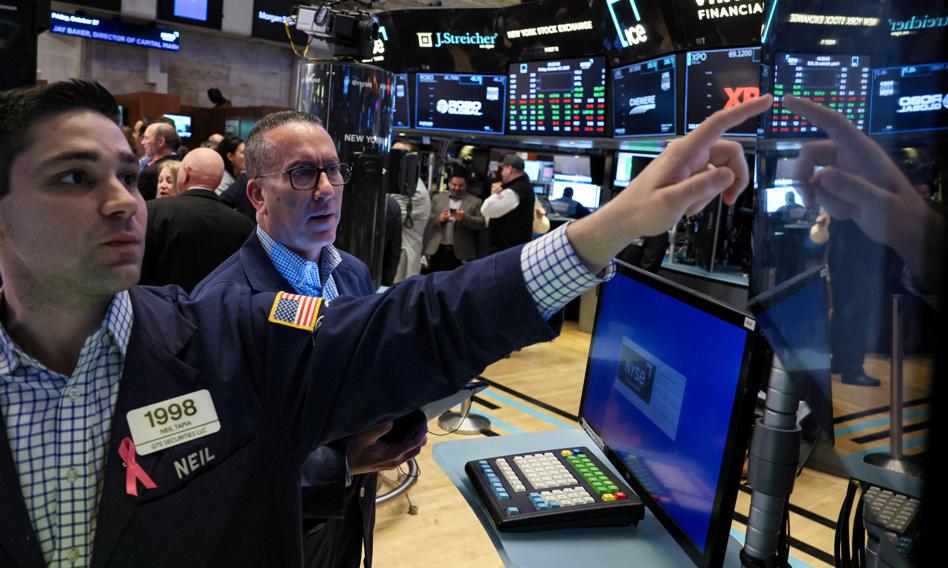
Stocks rose on Wall Street for a second straight day on Thursday, despite a rise in oil prices. Optimism has increased among investors who believe the fragile two-week ceasefire between the U.S. and Iran can be maintained.
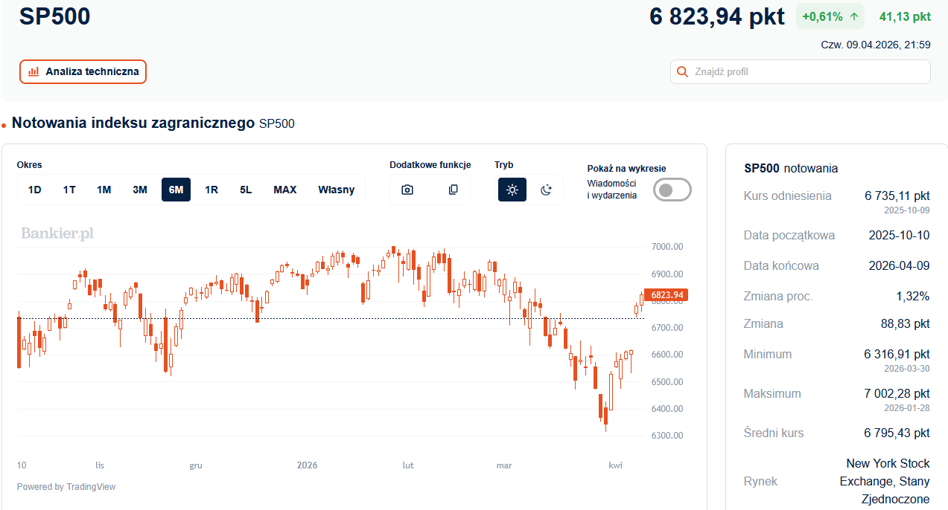
The Dow Jones Industrial was up 0.58% at the close. and amounted to 48,185.80 points. The S&P 500 increased by 0.62% at the end of the day. and amounted to 6,824.66 points. The Nasdaq Composite increased by 0.83%. up to 22,822.42 points The Russell 2000 index of mid-cap companies rose 0.64%. and amounts to 2,636.83 points. The VIX index loses 6.99%. up to 19.57 points
– Although the peak of the crisis is probably behind us, and markets seem to think so, it may still be too early to aggressively increase risk. Amid new information and changing rhetoric, flows from the Strait of Hormuz will determine whether any ceasefire actually works. Risk assets could continue to rise even if attacks continue, provided Hormuz shows credible signs of reopening, say analysts at BCA Research.
Advertisement
– There is considerable skepticism in the market regarding the ceasefire and the upcoming negotiations. The most important question is what condition the global economy will be in after the war, said Raphael Thuin, director of capital markets strategy at Tikehau Capital in Paris.
Information from the Persian Gulf is still in the center of investors' attention. Media reported that Israeli Prime Minister Benjamin Netanyahu announced that he had agreed to direct negotiations with Lebanon as soon as possible. Earlier, NBC reported that US President Donald Trump called Israeli Prime Minister Benjamin Netanyahu on Wednesday and asked him to limit Israeli attacks in Lebanon to ensure the success of negotiations with Iran.
Lebanese authorities said that more than 200 people were killed in Israeli attacks on Wednesday, including four Lebanese army soldiers. A day after the ceasefire between the US and Iran entered into force, the agreement is already in doubt. Iranian authorities said that Israel violated the ceasefire by attacking Lebanon, accusing the Israeli army of genocide. The US and Israeli administrations maintain that the ceasefire does not apply to Lebanon.
US-Iranian negotiations are scheduled to begin on Saturday in Pakistan to end the war that has been going on since February 28. The US delegation is to be headed by Vice President JD Vance.
Iran's Fars news agency reported that the flow of tankers through the Strait of Hormuz was suspended after the Israeli attacks. In turn, Vance reported that there are signs that the strait has begun to open.
On Tuesday evening, Trump agreed to halt attacks on Iran. The conflict in the Middle East has been going on for five weeks and has led to the closure of the key Strait of Hormuz.
However, the “bilateral” ceasefire was contingent on Iran agreeing to reopen the strait. Tehran agreed to reopen the waterway for another two weeks provided it halts all attacks, according to a statement by Iran's foreign minister. Media reports say Israel has also agreed to a ceasefire.
However, overall traffic through the strait has not improved since the ceasefire was announced, with only some bulk carriers, carrying dry cargo rather than oil, passing through the key waterway.
U.S. military forces will remain deployed in and around Iran until Tehran fully complies with a “real deal,” Trump said Wednesday, warning that any violation would trigger a military response on a larger scale than ever seen before.
“The mere fact that there is a ceasefire and that both sides are agreeing to it gives investors confidence that this situation will resolve itself in the long term,” said Rick Wedell, chief investment officer at RFG Advisory.
He added that the longer the strait remains closed, “the harder it will be to open everything and the longer these types of supply shocks will last.”
The number of people applying for unemployment benefits for the first time last week in the US was 219,000. Economists expected the number of new unemployed to be 210,000. compared to 203 thousand previously, after correction.
The number of unemployed people continuing to receive benefits amounted to 1.794 million in the week that ended on March 28. Analysts expected 1.828 million compared to the previously recorded 1.832 million, after correction from 1.841 million.
The PCE deflator in the US in February was 2.8%. y/y, compared to the consensus of 2.8%. and 2.8 percent in the previous month. The base rate was 3.0 percent. y/y vs. expectations at 3.0%. rdr. 3.1 percent each a month earlier.
On a month-to-month basis, the PCE deflator was +0.4%. Expected +0.4%. 0.3 percent each a month earlier. Excluding food and energy prices, the PCE deflator was +0.4%. mdm. Expected +0.4%. 0.4 percent each a month ago.
The PCE deflator (personal consumption expenditure deflator) is a measure of changes in prices of goods and services purchased by consumers. In the base approach, it does not take into account food and energy prices.
The PCE deflator is the Fed's preferred measure of price growth. The Federal Reserve's average inflation target is 2.0 percent.
The US Gross Domestic Product increased by 0.5% in the fourth quarter of 2025. on an annualized basis (SAAR) quarter to quarter – the Department of Commerce reported in the third calculation. In the second calculation it was estimated +0.7%. In Q3, US GDP increased by 4.4%, and in Q2, US GDP increased by 3.8%.
Private consumption increased by 1.9% in the fourth quarter, compared to 3.5%. in the previous quarter. In the second calculation, it was estimated at 2.0%.
The core PCE deflator amounted to 2.7% in the fourth quarter on an annualized Q4 basis, compared to the second reading of 2.7%. and 2.9 percent in the previous quarter. The PCE deflator is the US Federal Reserve's preferred measure of inflation.
On the oil market, WTI contracts for April are up by 5.20%. to USD 99.32 per barrel, and May Brent futures are gaining 2.70%. and are USD 97.31/b. (PAP Business)
pr/
The publication contains affiliate links.