Packs of wolves roam the bike path of a deserted village inaccessible to cars, hidden in the brains of the mountains

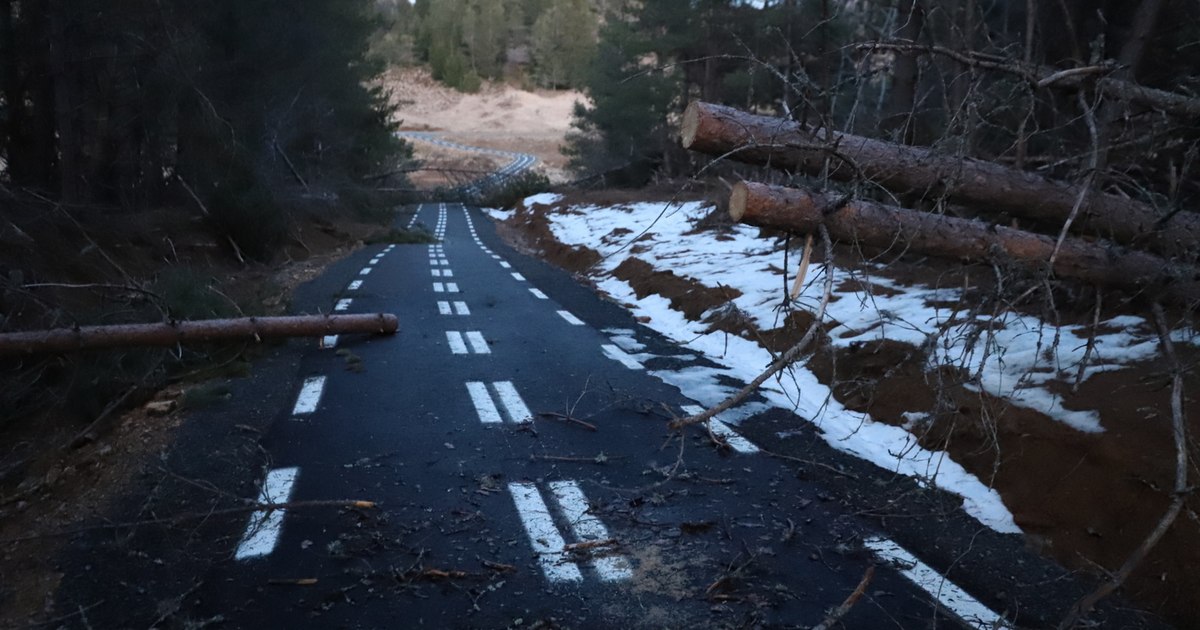
A bicycle path built in 2025, at over 1,000 meters above sea level, in the vicinity of an almost deserted village in the Poiana Ruscă Mountains, is causing controversy. So far, only wolf packs, bears, a few tourists and logging equipment have passed through its vicinity.
Bike lane. Photo: Daniel Guță. TRUTH
Four to five families still live in the village of Vadu Dobrii in the Forest County (Hunedoara county), one of the most isolated localities in Romania, where a bicycle path was built in 2025.
Asphalt arrived after two centuries in the village, on the bike path
Vadu Dobrii, located at over 1,000 meters in the Poiana Ruscă Mountains, developed in the 19th century, thanks to the extensive forests around it, used by the locals to produce barbecue, the charcoal needed for the smelters and iron plants of Hunedoara.
At that time, the forests of Vadu Dobrii were secular, and their exploitation brought together the archaic community of “foresters”, the inhabitants of isolated villages in the Poiana Ruscă Mountains. Since the end of the 19th century, a funicular connected Vadu Dobrii to Hunedoara, on a route of more than 40 kilometers, which crossed more than 60 ridges and their deep valleys in the Forest Land. In the 20th century, an iron mine and a military anti-aircraft unit kept alive the mountain village, difficult to reach, but attractive with its picturesque appearance.
Mining operated until the 80s, and the military missile unit was decommissioned in the 2000s. The village gradually depopulated, although in recent years, among the old wooden houses typical of peasant architecture, several one-story buildings were erected, which now dominate the settlement's scenery. The latest investment here has brought the forest village back into focus.
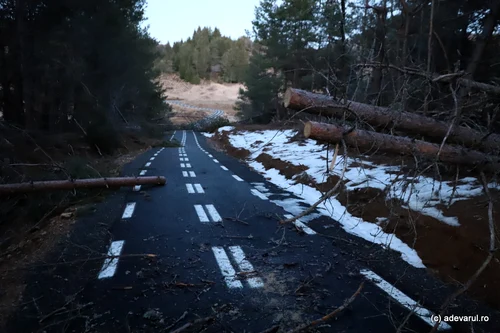
Image 1/13:
Bicycle track from Vadu Dobrii Photo Daniel Guță THE TRUTH (4) JPG
In 2025, on the outskirts of the town, in the meadow of the Dobra river, outlined by numerous sinkholes “drawn” by the waters, a bicycle path of about 2.5 kilometers was built, with funds accessed by the Town Hall of the Bunila commune, through the National Plan for Rehabilitation and Resilience (PNRR).
Its route descends from the isolated village at over 1,000 meters in the Poiana Ruscă Mountains, makes a loop going up into the forest and continues towards the Dobra valley.
Village with bicycle path, inaccessible to cars
In the valley, the track is continued by a forest road of over 30 kilometers, until the next village, Roșcani, where the asphalt starts again.
At the upper end, the track stops at the intersection of dirt roads that connect Vadu Dobrii with the villages of Runcu Mare, Bătrâna, Poiana Răchițele, Bunila, Cernișoara – Florese, Meria, Lunca Cernii de Jos, Hășdau, Gura Bordului and other localities, located in different directions, but none accessible by car in winter, due to the steep slopes, clearings and forest exploitations.
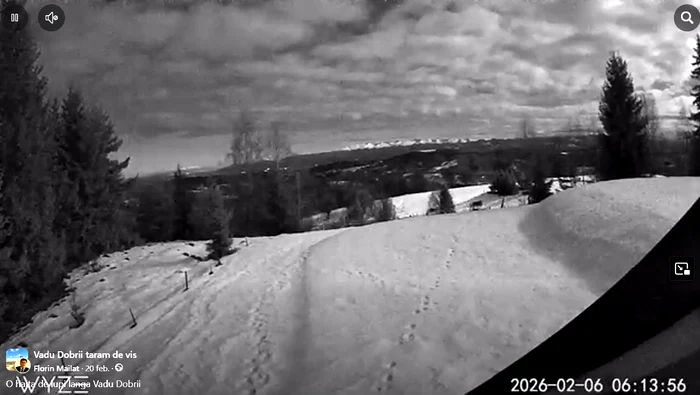
Pack of wolves at Vadu Dobrii. Photo: Florin Mailat.
Transalpina for cyclists, the ghost track turned into a strange tourist attraction, without cyclists
A few months after the installation of the bike path, winter left traces on its route. Several trees have fallen on it, and the frozen slush in other places makes it impassable. However, locals claim, no one has complained about the condition of the track so far, as no cyclists have tried it yet.
“The problem of the village of Vadu Dobrii is that, for several months of the year, you can hardly get here with a 4×4 car. All the roads to the village are affected by forestry works. Where there are parquet floors and the forest is cut, cars cannot pass, and wood is cut and carried from everywhere. Even if the roads to Runcu Mare and Cernișoara – Florese have been repaired, you still risk getting stuck on them. There are areas with flumes, with ditches made by streams and TAFs”, complains a local woman.
Wolves have taken over the land
In Vadu Dobrii, the hard-to-reach roads are not the only problem of the few locals. Several wolves have been seen in recent months roaming around the village, and the tracks left by bears have also been observed in the snow, which melts completely only towards the end of spring.
In February, a local resident published surveillance footage of a pack of wolves passing by the outskirts of the village (video source: Florin Mailat, Vadu Dobrii Tărâm de Vis / Facebook).
The hidden history of the village of Ioan de Hunedoara, swallowed by Lake Cinciș. “It was a kind of San Marino of Transylvania”
“They also came to see the new bike lane,” joked a netizen, at the images that circulated on social networks.
The villages of Poiana Ruscă Mountains, in steep demographic decline
At the beginning of the last century, the Poiana Ruscă Mountains were inhabited by almost 30,000 people and were even considered overpopulated in relation to the relief conditions. They included over 100 localities from Hunedoara, Timiș and Caraș-Severin, some established around iron, lead and silver mines, others near stone, talc and marble quarries or factories and smelters.
In the middle of the 20th century, during the period of communist industrialization, municipalities such as Nădrag, Ghelari, Teliuc, Rusca Montană and Tomești turned into workers' centers, with thousands of inhabitants, and the total population of the region would exceed 30,000 people.
Since the 60s, many settlements have entered the trend of depopulation, along with the migration of local residents to the cities. Some, considered unviable, were condemned to extinction by the communist regime, which blocked investment in infrastructure, utilities and construction. The phenomenon of depopulation intensified after 1990, and led to the complete disappearance of many villages.
Currently, the more than 50 localities in the Poiana Ruscă Mountains together have approximately 15,000 inhabitants, the population density in the area being 5 – 6 inhabitants per square kilometer. Bunila communes (to which Vadu Dobrii, Bătrâna and Cerbăl also belong) have a population of about three inhabitants per square kilometer and together count less than 800 inhabitants.