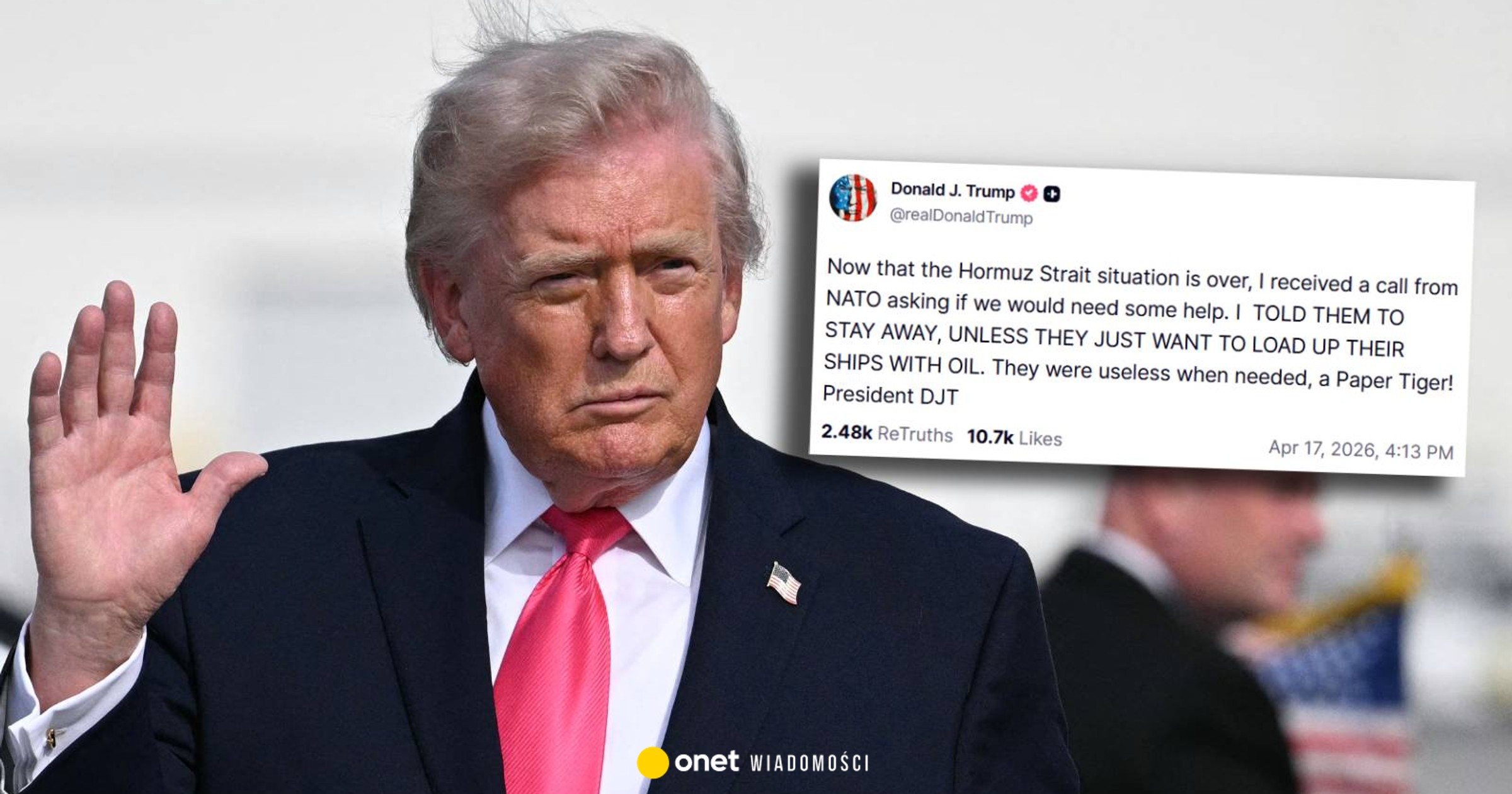
Donald Trump is making a mess. Europe is being called upon to clean it up, or at least pay the high bill to clean it up — such a pattern, as EU diplomats and officials fear, may be repeated in the Strait of Hormuz after the US president announced a ceasefire agreement with Iran. European leaders have already pledged to help clear the disputed sea lane once the fighting subsides.
Not only France, Germany and Great Britain may now be burdened with the costs of the costly operation of escorting ships and clearing mines in the strait. Their merchant ships will likely have to pay high fees that did not exist before the war just to be able to sail through it. Trump said Wednesday he was considering a “joint venture” with Iran and Oman to collect tolls for the crossing.
Add to this the fact that Europe's energy bills are likely to remain high for weeks or even months if the ceasefire holds, and a trend becomes clear: Europe is having to pay more and more just to remain part of a transatlantic alliance that has become extremely unpredictable.
“It's a pattern,” says Nacho Sanchez Amor, a Spanish socialist MP on the European Parliament's Foreign Affairs Committee. — In Gaza we will pay for reconstruction. In Ukraine, we are paying for the war – essentially ourselves at this stage. Now we may have to pay to clean up the Strait of Hormuz.
— NATO was supposed to be based on mutual loyalty. But that's not how it works, he adds.
Nacho Sanchez Amor at a press conference in Colombo, Sri Lanka, August 30, 2024.PAP/EPA
Another great challenge
In the hours after Trump announced a ceasefire agreement on Tuesday evening Washington time, when he backed down from threats to completely destroy Iran, EU leaders breathed a sigh of relief, calling it a diplomatic success. The last-minute agreement brought a “much-needed” de-escalation, European Commission President Ursula von der Leyen wrote on social media.
But even as they took a breather, leaders were already preparing for the next big challenge — how to reopen the strait. French President Emmanuel Macron, who has repeatedly clashed with Trump over the war, said Wednesday that the Group of 15 countries, including France, “will facilitate the resumption of maritime traffic” through the strait “when the conditions are right.”
Easier said than done. Even if the operation were spread among the navies of several powers, including those from outside the EU – Australia and the UK – the costs of such an operation would be enormous. The U.S.-led Operation Earnest Will, which involved protecting Kuwaiti tankers from Iranian attacks in 1987-1988, cost allied countries several hundred million dollars, and when adjusted for inflation, probably over a billion dollars.
In a statement on Wednesday, British Foreign Secretary Yvette Cooper also referred to the need to reopen the strait. Her statement, however, indicated the need for a “quick end to the conflict” rather than military escort and mine clearance activities.
Indeed, almost immediately after Trump announced the ceasefire, British Prime Minister Keir Starmer and EU foreign policy chief Kaja Kallas rushed to the Middle East to try to achieve lasting peace (the ceasefire is currently scheduled to last for two weeks).
Starmer's office said the prime minister would hold “further discussions on practical steps to restore freedom of navigation in the Strait of Hormuz” with a number of Gulf leaders, while Kallas was scheduled to meet with Saudi Arabia's foreign minister and the head of the Gulf Cooperation Council, Jasem Al Budaiwi.
“It is crucial that this ceasefire is maintained,” says an EU diplomat. The announcement by France, Germany, Britain and other countries to clear the strait “is not a blank check,” he added. — We are ready to help, but under appropriate conditions.
If it is not necessary to carry out demining operations, Europe will probably continue to feel the effects of the war for a long time in the form of energy supply problems and market turmoil.
Asked how quickly fuel prices at gas stations would fall after the ceasefire, a French government spokesman replied: – I approach this with caution. We have already heard announcements of price cuts that were not passed on [na konsumentów].
The article continues below the video
“We do not have the strength to impose our will on the world”
This attitude of vigilant caution will certainly carry over to the informal meeting of European leaders later this month in Nicosia, Cyprus. In addition to the effects of the war with Iran, they will also discuss ways of financing aid for Ukraine.
In practice, as an EU diplomat notes, Europe still feels the effects of its relative weakness in the international arena.
“We do not have the power, in the traditional sense of the word, to impose our will on the world,” said the diplomat. — We are stuck trying to negotiate and minimize the effects of various crises.
I’m Ashley Davis as an editor, I’m committed to upholding the highest standards of integrity and accuracy in every piece we publish. My work is driven by curiosity, a passion for truth, and a belief that journalism plays a crucial role in shaping public discourse. I strive to tell stories that not only inform but also inspire action and conversation.