The “Fuel Prices Lower” package has been in force in Poland for several days, thanks to which VAT and excise duty on petrol and diesel have been reduced, and their maximum retail prices will be announced every day, calculated, among others, on the basis of the average wholesale price from the previous day. The announced actions lack instruments to reduce demand, including the most serious one, i.e. fuel rationing. Although there is no official talk of such radical steps yet, the government and representatives of the Ministry of Energy do not rule out restrictions on the purchase of fuel by foreigners.
The rest of the article is below the video:
Read also: New fuel prices on Good Friday. The minister announced the maximum rates
Fuel tourism. Will there be restrictions?
It's about preventing the so-called fuel tourism, i.e. a situation in which drivers from neighboring countries would come to Polish stations to take advantage of prices lower than at home. Answering media questions during a press conference on April 1, Minister of Energy Miłosz Motyka stated that the ministry does not see a large scale of this phenomenon, but added that it may still be too early to draw final conclusions.
If visits to our stations increase and we face the risk of physical fuel shortages, the ministry is to resort to “a possible range of restriction measures.” It also monitors traffic, and potential arrangements will be made together not only with Orlen, but also with private companies.
– Such decisions (regarding refueling restrictions for foreigners – editor's note) are made by other countries, or they go further by introducing different prices – added Minister Motyka, noting that differentiating prices for customers from Poland and abroad would be more difficult, and the ministry does not want to add more work to sellers.
Minister of Energy Miłosz Motyka and Minister of State Assets Wojciech Balczun, March 31
|
Marysia Zawada/REPORTER / East News
As Grzegorz Łaguna, spokesman for the Ministry of Energy, confirmed to Business Insider on April 2, all yesterday's words of Minister Motyka regarding restrictions for foreigners remain valid.
Restrictions for foreigners. Is Slovakia going crazy?
As for the other countries mentioned by the minister, the most famous example of restrictions on fuel sales is Slovakia. We wrote about this last week in our review of the different responses of EU member states to the crisis; the government in Bratislava decided to allow stations to introduce higher diesel prices for foreign customers.
Read also: Europe is struggling with high fuel prices. These ways dominate
Such differentiation is, of course, at least controversial from the point of view of EU law, and the European Commission officially expressed its protest regarding non-compliance with Community regulations. Robert Fico's cabinet, however, does little about it, although not everyone on the other side of the Tatra Mountains likes the decision. Julius Jakab, a member of the Slovak Parliament from the opposition Hnutie Slovensko party, even went to visit the Orlen station in Cieszyn, Poland, pointing out that not only does he not have to pay more as a foreigner, but petrol in Poland is 20 eurocents cheaper than in Slovakia.
A hidden form of combating fuel tourism is Slovenia's decision to introduce restrictions on refueling to 50 liters of fuel per day. The limit applies to all private drivers (currently 200 for companies and farmers), although it was introduced primarily to discourage further visits by guests from Austria. In Central Europe, Hungary has also introduced restrictions for foreigners, where only drivers of cars with Hungarian registration plates can benefit from the maximum retail fuel prices. This is not the first time for Budapest, as similar regulations were already in force during the crisis of 2022–2023.
“Government policy is aimed at maintaining consumption”
Aleksander Kieroński, an economic analyst at Polityka Insight, estimates in a commentary for Business Insider that introducing restrictions on refueling for foreigners – either limits or higher prices – would only be possible in an extremely crisis situation.
– I mean physical fuel shortages, which fortunately have not happened yet. However, government policy in its current shape is aimed at maintaining their consumption at a relatively unchanged level, which, according to economic theory, must at some point lead to market shortages. Of course, we do not know whether this will actually happen, but such a threat must be taken into account, says the expert.
As in the case of Slovakia, any restrictions would be met with protest from the European Commission, but Kieroński assumes that under an emergency scenario, Brussels would de facto turn a blind eye to Poland's decision.
— EU bodies can sometimes act somewhat arbitrarily, the specialist admits. At the conference on April 1, Miłosz Motyka and Secretary of State Wojciech Wrochna emphasized that all decisions in the area of fuel prices and rationing will be made independently by the government in Warsaw.
Fuel crisis. Time to reduce demand?
Politicians were also rather skeptical about proposals to reduce fuel demand; They were already submitted by the International Energy Agency in the earlier phase of the crisis, and the Commission is also expected to present its own proposals. However, Aleksander Kieroński believes that such solutions make the most sense today.
— A good example should come from above. Some public sector and offices may start to use remote work to a greater extent. We also need to focus more on public transport, he says.
The expert also adds that instead of universal price controls for all drivers, targeted interventions should be introduced for selected groups.
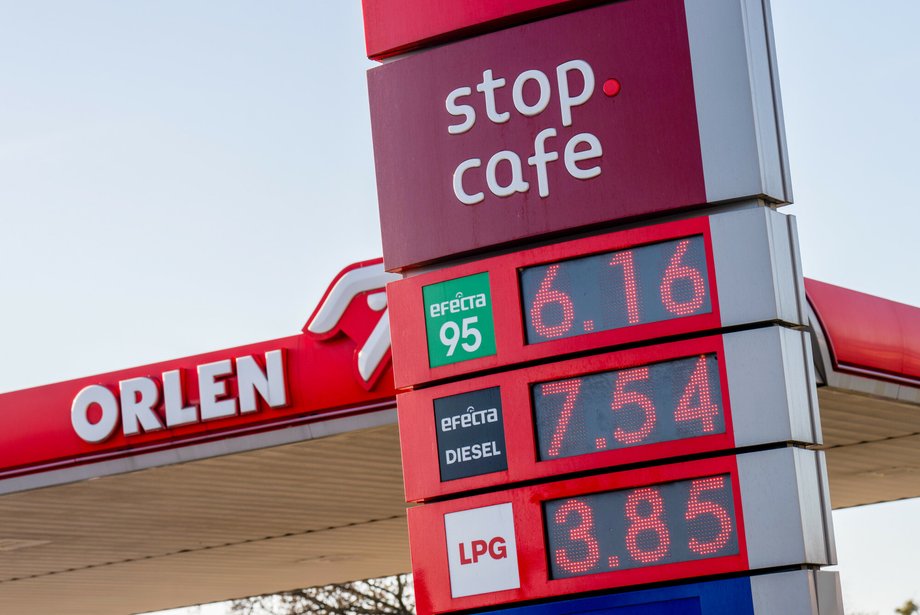
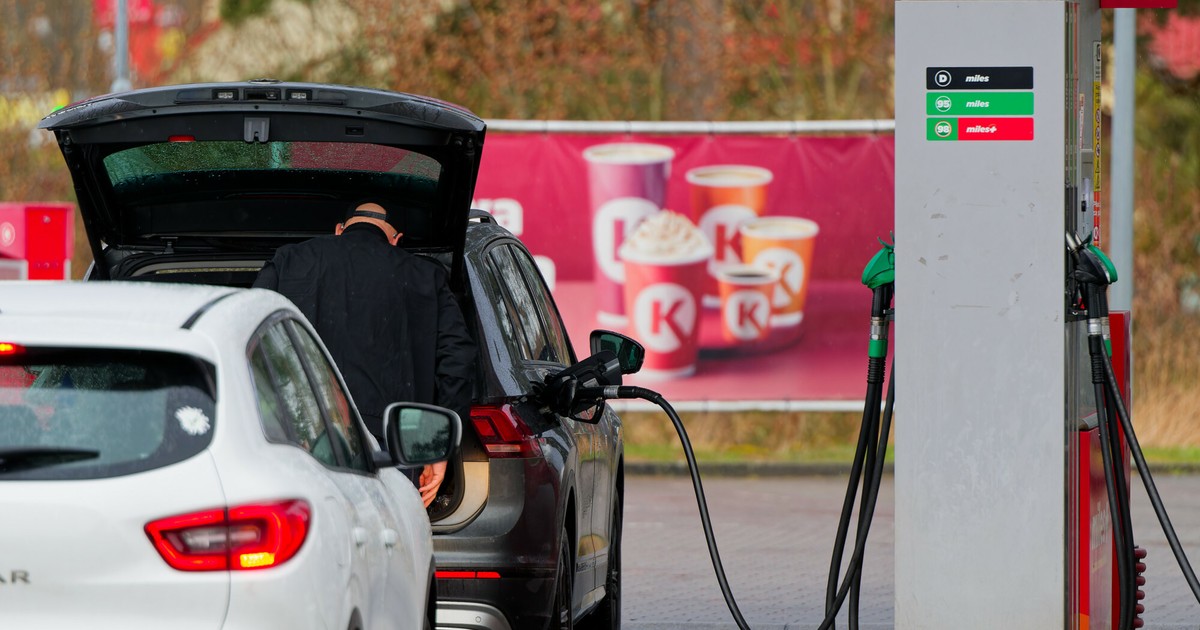
Fuel prices at the Orlen station in Gdańsk, March 31
|
Oliwia Domanska/East News / East News
— It is worth focusing on the transport industry, because it is through this that the price shock may spill over to the rest of the economy. It's not so visible today, but the increase in transport costs can most easily translate into higher prices in stores, he points out.
Read also: Germany raises alarm after Poland's decision. Companies are facing a wave of bankruptcies
The second group are people living in areas affected by transport exclusion. – From the perspective of a big city, it is easy to talk about limiting the use of a car, but there are entire areas where life without it is de facto impossible. The ideal solution would be targeted fuel allowances for people with such a problem, although politically and organizationally it is of course difficult to implement – says Aleksander Kieroński.
Orlen: growth was lower at the border
We also asked Orlen about the impact of the government's “Fuel Prices Lower” program. Mateusz Witczyński, the Group's spokesman, tells us that prices at Polish stations are among the lowest in the EU, and on the first day of the program (March 31) “customers made a record volume of purchases.”
“This was a consequence of the previously observed postponement of purchasing decisions while waiting for the announced intervention to alleviate the effects of the conflict in the Middle East,” he explains.
He also adds that fuel sales to foreign drivers increased on the same day, although the increase at stations located near the border with Germany was lower than the average for the whole of Poland. “In the following days, we observe a decline in sales dynamics compared to the beginning of the CPN program, both nationally and at border stations that are subject to additional monitoring.” – summarizes the spokesman of the Płock giant.