Meat and bread become luxury products. Expert Dumitru Chisăliță: “We are talking about a degradation of the standard of living”


Romania will be marked in the next period by price increases in the chain, in all branches of products and services, despite the measures to cap the commercial addition for basic foods and the regulation of gas and fuel prices.
Romania will be marked by price increases difficult to bear in the next period. Photo 123 RF
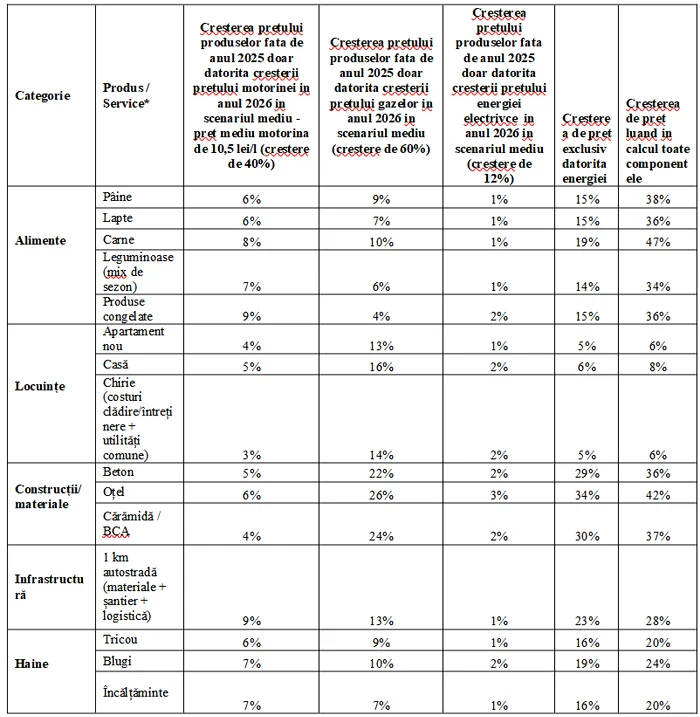
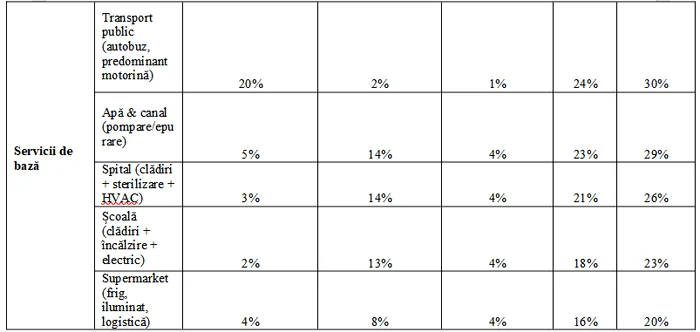
The price increases that await us in 2026 can no longer be called simply “expensive”, they touch every aspect of everyday life and turn ordinary costs into constant challenges. “Diesel, at 10.5 lei per liter, does not just mean a higher bill at the gas station: every journey becomes more expensive, and the transport of goods increases along with it. Gas, with a 60% jump, is felt not only in household bills, but also in production costs and the price of food on the shelf. Electricity, although it appears to be “only” up 12%, is the invisible fuel of the entire economy, affecting every industry, service and production“, points out the energy expert, Dumitru Chisăliță.
He estimated that the price of basic food is becoming a test of the daily budget: bread can become more expensive between 15 and 38%, and meat between 19 and 47%, turning access to protein and quality food into a real challenge. Rents and housing prices are increasing between 5 and 8%, and for many Romanians, the idea of owning your own home is becoming less and less feasible, and renting is turning from a phase of life into a permanent condition.
Food prices stagnate, detergents rise
The price increases estimated by the energy expert may come despite the fact that the Government has announced the capping of basic food prices for another three months and has regulated the phased reduction of diesel excise duty and the price of gas for the population, but not for companies, which means that all these costs will be reflected in prices.
Such price increases have also occurred during and after the pandemic, when capping commercial food additives kept the price of bread and meat or other food products under control, but increased the price of detergents by 23-25% and services by 7-11% or more, depending on the category.
And then, as now, the capping of the commercial addition targeted plain white bread, consumer cow's milk, telemea cow's cheese, plain cow's milk yogurt, white wheat flour, sorghum, chicken eggs, sunflower oil, fresh chicken and pork meat, fresh vegetables and fruits, white potatoes, cast white sugar, cream, butter and marjoram.
“A food basket that jumps in 2026, towards 1,800 – 2,000 lei is not just a figure. It's proof that food is becoming a problem again. Gas more expensive by 60% for non-households means higher costs everywhere: industry, agriculture, services. Diesel at 10.5 lei doesn't just affect transport — it affects every product on the shelf. Energy is no longer a sector. It becomes the infrastructure of the general increase. And this is where the biggest fallacy falls: that the economy will adjust. It will not adjust. Or if it does adjust, it will be many months from now. Because there is nowhere else to go. Revenues grow slowly or most likely stop growing. Expenses are skyrocketing. The poverty line does not keep pace with reality. The result is simple and brutal, people who yesterday were “ok” become poor without having changed their lives. Just the prices they have to pay“, said the energy expert.
The middle class is tightening its belt
According to him, the lower middle class is hit head on. Those who have kept the economy afloat – employees, families, taxpayers – are forced to make real sacrifices: less food, less travel, less essential services. The daily basket becomes a test of endurance, and every choice turns into a compromise between the necessary and the impossible. The state, caught between rising costs and revenues that do not keep pace, can no longer absorb the shock: taxes and duties are increasing, and public services are at risk of declining in quality.
At the same time, the economy enters a tacit defensive mode, the expert points out, stating that companies are no longer thinking in terms of expansion, but survival and optimization, against the background of the steep drop in consumption, which only in January 2026, compared to January 2025, recorded a 10% reduction.
The apparent stability, with supermarket shelves full, cities functioning, is just a delay, Chisăliță claims, adding that in reality, consumption is falling, business is slowing, and the cost of living is becoming a real barrier.
Poverty is spreading rapidly
Poverty in Romania is expanding rapidly. Relative poverty, which measures who lives with income below 60% of the national average, can reach 23–25%, affecting up to 5.5 million Romanians. The AROPE indicator, which captures social vulnerability through poverty, exclusion and material deprivation, could increase from 27.9% to 32–35%. Severe material and social deprivation, i.e. real deprivation – the inability to pay bills, heat the home or have access to basic goods – can reach 20–26% of the population.
“We are used to inflation, but what awaits us in 2026 is no longer inflation. It is social relegation. People who were “ok” yesterday become poor only because of the prices they have to pay.” claims Dumitru Chisăliță.
Thus, what begins as an increase in prices turns into a real degradation of living standards. Romania risks returning to the poverty thresholds of 1996–2000, and the effects will not only be seen in statistics, but in people's daily lives: poorer food baskets, impossible bills, increasingly unaffordable housing and a deepening sense of economic insecurity.
Grindeanu, after visiting 4 branches: Nobody wants to stay in the same form, with Bolojan premier. The 3 scenarios of PSD
Commodities are rising in price around the world
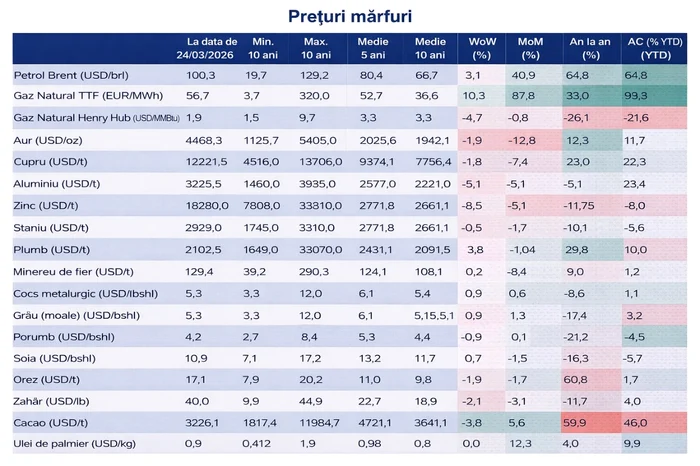
On the other hand, the crisis is deepened by disruptions in the supply of raw materials through the Strait of Hormuz, which continue to fuel price volatility. For now, oil and gas, fertilizers, petrochemicals and aluminum are particularly affected.
“The current escalation of the conflict in the Middle East is strongly affecting commodity markets. Whether or not this conflict comes to a standstill will determine the extent of the current shock to the downstream part of the value chain“, says Simon Lacoume, sector economist at Coface.
Oil prices, a long-lasting shock
The recent attacks on the Ras Laffan gas complex in Qatar have triggered a new rise in the price of energy raw materials. Brent crude, which recently hit a high of $119, is up 50% in a month.
This growth is not uniform. Oman DME crude topped $160 a barrel, while US WTI hovered around $100 a barrel, reflecting a highly uneven impact on prices by region and product.
As the conflict drags on, this growth is already beginning to spread along the value chain. In the United States, retail prices for regular gasoline hit a record high ($3.96/gallon, up 35% from the previous month). In Asia (Singapore), diesel prices have almost tripled since the start of the conflict to $256/barrel, while global jet fuel prices have doubled, according to the International Air Transport Association (IATA).
Natural gas at the center of supply disruptions
The increase is also evident in the case of natural gas. In Europe, gas futures (Dutch TTF index) rose 85% in one month to €55/MWh, while the Asian benchmark (LNG Japan/Korea Marker) doubled over the same period, reflecting the persistent vulnerability of import markets.
In comparison, the US market appears less exposed to supply disruptions. However, the US Henry Hub is under strong upward pressure (+36% month-on-month), a sign that energy tensions have already spread globally.
Prices for many petrochemicals are rising exponentially
The Gulf States are the main Asian suppliers of petrochemicals1, essential for the entire plastics industry. A tonne of oil has reached $1,000 in Singapore, an increase of more than 60% since the start of the conflict. The combination of tensions in the Strait of Hormuz and Asian stocks at a historically low level (2-3 weeks) has already driven polymer prices (polypropylene, polyethylene, polystyrene, PVC) higher. This now poses a risk of propagation throughout the value chain.
This trend also affects sulphur, a key factor for the copper and nickel ore leaching process. The 25% increase in the price in a single month threatens major mining producers heavily dependent on the commodity, such as Chile, the Democratic Republic of Congo and Indonesia.
Fertilizer prices rise despite 'favorable' agricultural calendar
Due to cheap domestic energy supplies, the Gulf states occupy a central position in these markets, accounting for almost 19% of global nitrogen fertilizer exports and 36% of global urea volume, while Saudi Arabia is the fourth largest phosphate exporter (Map 1).
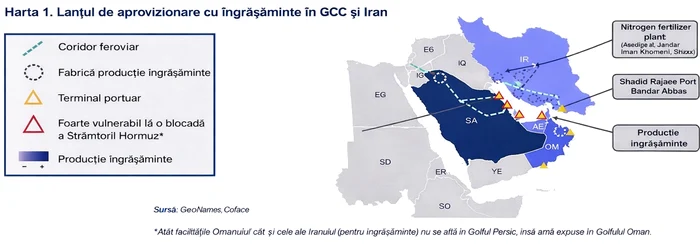
However, natural gas accounts for up to 80% of nitrogen fertilizer production costs. The sharp increase in gas prices therefore automatically leads to an increase in fertilizer prices: the price of a tonne of granular urea (FOB Middle East) has risen by 37% to $665 since the start of the conflict.
Basic food prices remain capped for another three months
However, the impact remains limited, given the favorable timing. For now, only US grain producers seem to be affected, but if disruptions persist, then Brazil, India or even Europe would be more exposed.
The negative effects could even extend beyond direct fertilizer flows – to India, Brazil or the United States, for which the Gulf states account for 63%, 24% and 21% of nitrogen fertilizer imports, respectively – by affecting third countries such as Morocco, the world's largest producer of phosphate rock, which depends heavily on sulfur exported by the Gulf states.
Aluminum: the metal most at risk
With the Strait of Hormuz blocked, the Gulf states – which account for 8% of world aluminum production – can no longer export domestic production or import the raw materials (bauxite and alumina) needed for their smelters. On Monday, March 16, Aluminum Bahrain (Alba), which produces 25 percent of the region's aluminum, announced the suspension of 19 percent of its production as a result, representing 5 percent of the region's aluminum output. Away from the turmoil in the Middle East, Mosal announced the suspension of its operations in Mozambique, citing excessive energy costs. Amidst this worsening situation, aluminum prices continue to follow an upward trend (+11.5% from the previous month), reaching a high of USD 3,500/ton (March 12), after an increase of almost 25% over the past year.