Dispute over the “Piłsudski bench” in Lithuania. For a moment I think I've got the wrong places


The city is the oldest Lithuanian health resort, which has been attracting visitors from all over Europe for 230 years. Tourists from Poland also come here to the largest water park in Lithuania. Druskininkai was visited by Józef Piłsudski. He rested here in a modest wooden house without electricity. He finished writing the book 1920 by a kerosene lamp, and when he needed a break, he went for long walks in the forests and along the Neman River. It was in Druskininkai that the Marshal met Eugenia Lewicka, with whom he began an affair. It was his last love. (…)
The Polish House at 9 Klonio Street. Teresa, the president of the Druskininkai branch of the Association of Poles in Lithuania in Druskininkai, is waiting there. He greets me with a broad smile and pistachio cake and invites me to the main room. Here, Polishness hits you from everywhere.
Immediately after entering, my eyes fall on a reproduction of the portrait of Józef Piłsudski in a blue-gray uniform decorated with medals and a sash. The marshal holds a mace in his hand and a saber at his side. Maybe the same as the one hanging on the wall – another element of the exhibition. Next to the image of the Marshal there are three flags: Polish, Lithuanian and European Union. There is also a Polish emblem. I also see a sketch on the wall, and below it the text of the military oath.
Reproduction of Józef Piłsudski's painting in DruskininkaiDiana Wawrzusiszyn / Onet
On one of the wardrobes there is a collection of dolls in Krakow folk costumes. A collection of books: of course, a collection of works by Piłsudski, but also by Jerzy Klich, Czesław Miłosz, Stanisław Lem, Sienkiewicz's trilogy, a recording of the radio play Matysiakowie.
With a view of Poland. Neighbors, Stalin's thumb, Czech debt and the KGBOnet
On the shelf under the TV I notice some press – mainly “Kurier Wileński” and “Do Rzeczy”. On the wall next to the black piano there is a painting depicting Father Jerzy Popiełuszko and old engravings with a view of the city. Another striking thing is a gold plaque with information that the renovation of the Polish House was financed by the Senate of the Republic of Poland.
“I always felt Polish”
Mrs. Teresa comes back from the kitchen with brewed coffee, puts the tray on the table next to the thick red and white candles. He is 54 years old, has deep eyes and a wide smile. She puts her hair in a tight bun on top of her head.
We talk for a while about Druskininkai and old villas with wooden lace.
— It used to be different, people were different. In the evenings, they gathered in the gardens of sanatoriums, played guitars and harmoniums, sang and danced. Until late hours. On warm summer evenings, singing could be heard throughout the city. Everyone is so closed now, sometimes even friends won't say hello on the street. I also remember the cinema from the old days. But what a movie it was! Queues every day. My mother worked there and said that the director was a nice, very human person. He had friends in Moscow and always arranged the best films for us. When they came to us from Moscow or Leningrad to rest, they said: “Oh, they don't show this film here.” Sometimes the premiere was here earlier than in Moscow.
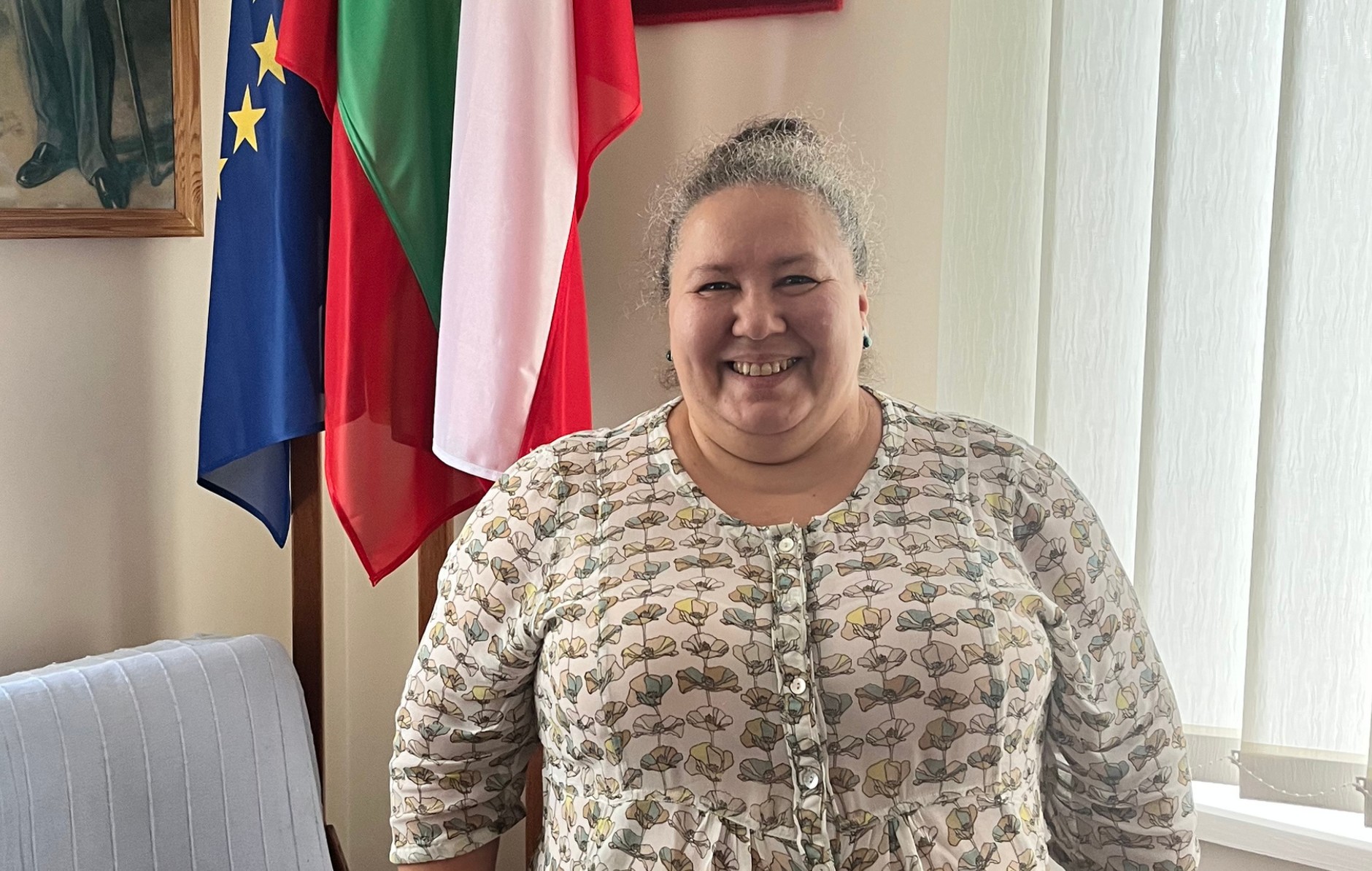
Teresa, president of the Polish House in DruskininkaiDiana Wawrzusiszyn / Onet
Teresa's mother was Polish, but her grandmother and grandfather were born in Belarus. Then they moved to Druskininkai. Teresa spoke three languages from childhood: Polish, Lithuanian and Russian. In the latter, she talked mainly with her father, a Russian. She knew Lithuanian well from an early age thanks to her godmother, a Lithuanian woman.
— I've always felt Polish. At home, we put Polish traditions first, he emphasizes. — Druskininkai truly became Lithuanian after 1991. Before the war, mostly Poles and Jews lived here. There were very few Lithuanians. Until 1958, we even had a Polish school, but many people were repatriated. The teachers almost all left. Grandma and grandpa were also supposed to leave because they received the documents, but grandpa injured his leg and that's why they stayed.
“You don't like Poles very much”
When Teresa was a teenager, the Polish House in Druskininkai was bustling with life. Several hundred Poles belonged to the union, and they had to rent additional rooms in the sanatorium to accommodate everyone. The then president invited Polish bands from Vilnius, and there were posters hanging on the fences. The children went on trips to Poland several times a year. Teresa went to Krakow for the first time in 1997, together with thirty other children.
— Now a few people come here on Sunday after mass for coffee. Mainly Belarusians. Children are not taught Polish, only in some places Polish is spoken at home. It will no longer be the same as it was. Older people are leaving. We also recently buried one of our grandmothers. And it's kind of sad that it's all disappearing.
According to the 2011 census, 612 people who declared Polish nationality live in Druskininkai (4.15 percent of all residents). You can still go to a Polish mass in the neo-Gothic church dedicated to Our Lady of the Scapular. The service takes place on Sundays at 10.30.
— We used to have all Christmas masses in two languages: Polish and Lithuanian. And recently there was one mass left on Sunday. And thank God that there is at least that much. We also had a choir, but we don't sing anymore. You don't like Poles very much. I quarreled with him because he called our community a mafia.
Dispute over the “Piłsudski bench”
Teresa prefers to omit details, but says that apart from that she lives well with Lithuanians, and even when someone says something bad, she doesn't pay attention.
— Not everyone knows that I am Polish, because I speak Lithuanian very well. And these Lithuanians know it… They say that for a Lithuanian there is no better celebration than when a neighbor's house is burning down. A few years ago, there was a heated discussion in Druskininkai about commemorative benches that were to be placed in various parts of the city.
— There was a plebiscite, people voted. Józef Piłsudski was on the list. And the voices started: “What did he do for Druskininkai?”, “Why build this bench for him?” The list also included the sculptor Jacques Lipchitz, who was born in Druskininkai. He never came here, he lived abroad. And they gave him a bench. All the benches were financed with public money, and the Piłsudski one with private money, from local activists.
– And why “supposedly” Piłsudski?
– And you'll see for yourself.
The next day, instructed by Teresa, I go to the bank of the Neman, to the place where Piłsudski's house on Poganka Street once stood. Now there is a modern hotel here. In the distance you can see a small bench on a slope: wooden, with a metal triangular backrest. There are no traces of Piłsudski, for a moment I think I've got the wrong place. In the central part there is an engraved date of 1863 and the coat of arms of the January insurgents, consisting of three other coats of arms: the Crown (White Eagle), Lithuania (Pogoń) and Rus' (Archangel Michael).
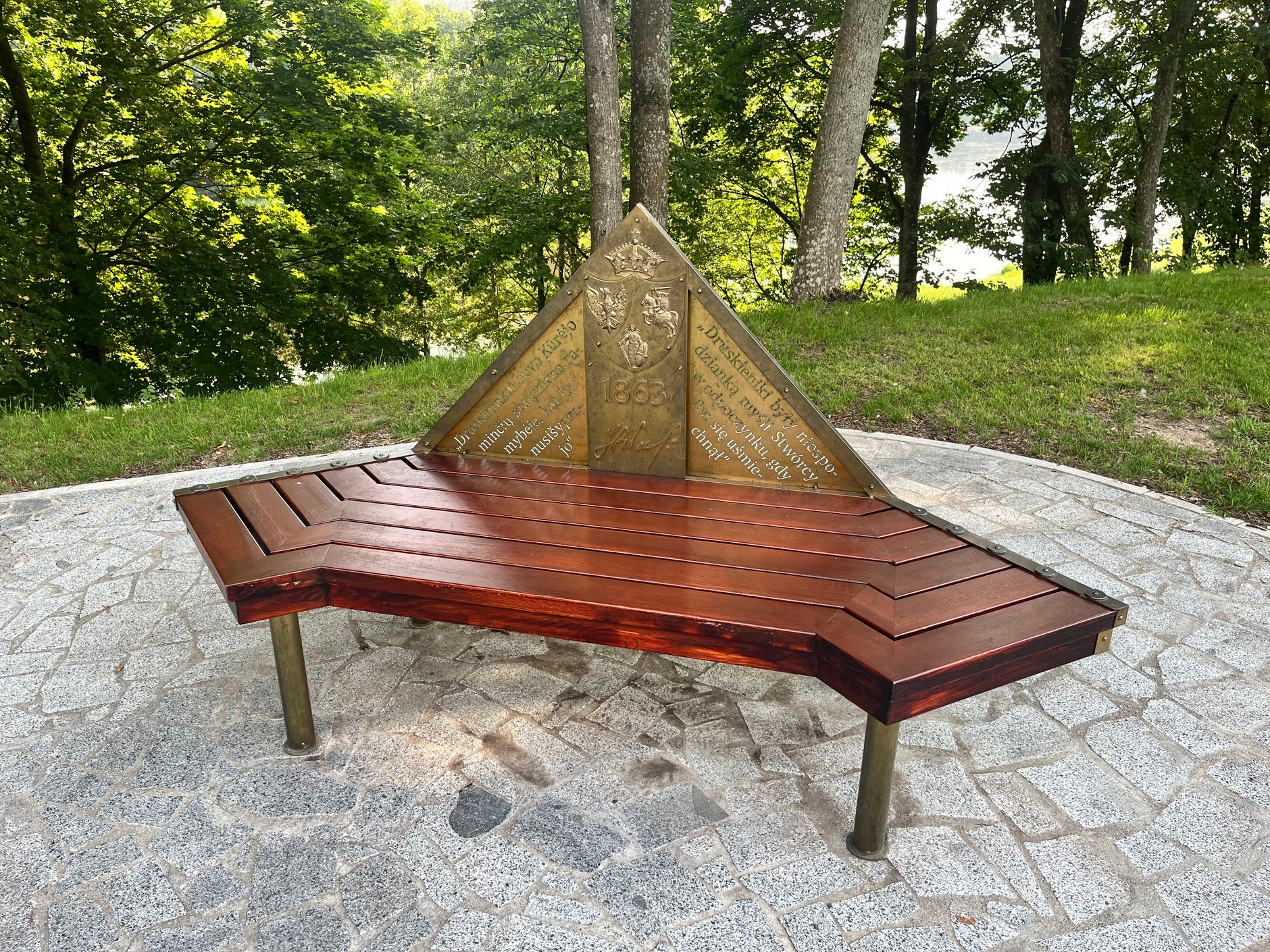
Bench of the January Uprising in Druskininkai, also known as Piłsudski's BenchDiana Wawrzusiszyn / Onet
I also see a quote in Polish and Lithuanian: “Druskininkai was a surprise of the Creator's thoughts in rest when He smiled” and the signature of the author of the words, Józef Piłsudski. The only element referring to the Marshal. When the January Uprising began, Piłsudski was not yet born; he was born four years later.