As thousands of US troops are deployed to the Middle East, attention is increasingly focused on Iran's network of strategic islands in the Persian Gulf, sites that analysts see as having a decisive role in a possible military operation to open the Strait of Hormuz, reports CNN.
Strait of Hormuz, satellite image PHOTO shutterstock
Much of the initial speculation about a possible US ground intervention focused on Kharg Island, a vital oil hub in the northern Persian Gulf that handles about 90 percent of Iran's exports. However, experts note that another group of islands could be even more important in terms of securing the sea route, particularly those that form what researchers call Iran's “defense arc” along the Strait of Hormuz.
Seven islands—Abu Musa, Great Tunb, Little Tunb, Hengam, Qeshm, Larak, and Hormuz—form a defensive arc that gives Iran a geographic advantage over one of the world's most important shipping lanes. “A hypothetical curve connecting these islands would help understand Iran's strategic superiority in controlling the security” of the straits, Iranian researcher Enayatollah Yazdani and Chinese researcher Ma Yanzhe wrote in a 2022 study.
At the western end of this arc, Abu Musa, Greater Tunb and Lesser Tunb, the smallest of the group, are considered key to controlling the strait. Due to narrow sea lanes and shallow waters, “large warships and oil tankers are forced to pass” past these islands, the researchers noted, making them vulnerable to attacks by the Islamic Revolution Guards Corps (IRGC) with speedboats, mines and drones.
Iran has long emphasized the military value of these positions. Officials described them as “stationary and unsinkable aircraft carriers,” according to Yazdani and Ma. The IRGC reinforced this position last year when naval commander Rear Admiral Alireza Tangsiri, recently killed in an Israeli attack, said: “Our tactical approach dictates that we must arm and operationalize this group of islands. We have the capability to strike enemy bases, warships and assets in the region.”
Military analysts note that any US effort to ensure the safe passage through the Gulf of US warships, possibly with Marines on board, headed for Kharg Island would likely first require the neutralization of these defensive positions. “The islands are strategically positioned to control any shipping” entering or leaving the Gulf, explained Carl Schuster, former director of the US Pacific Command's Joint Intelligence Center.
There is no timetable for possible US amphibious assaults on some of Iran's islands.
US President Donald Trump said on Thursday he was extending the deadline for launching attacks on Iran's energy infrastructure by 10 days, until April 6, to see if a deal can be reached with Tehran to end the conflict. A previous deadline expired on Friday evening.
US Secretary of State Marco Rubio told reporters that “progress has been made” in negotiations with Iran.
But no pause in the general military campaign was announced. Defense Secretary Pete Hegseth said on Thursday that the US would continue to “negotiate bombs”.
According to CNN, elements of two US Marine Expeditionary Units (MEU) – about 4,000 troops – are heading to the region, along with about 1,000 soldiers from the 82nd Airborne Division. Schuster suggested that a large-scale operation might be necessary, stating, “I would use two MEUs to provide an overwhelming force.”
Such an operation could involve amphibious landings with the help of naval vessels or insertions of paratroopers. However, each option carries risks. Ships would have to pass other Iranian defensive positions on islands such as Larak and Qeshm, while aircraft could be vulnerable to air defense systems.
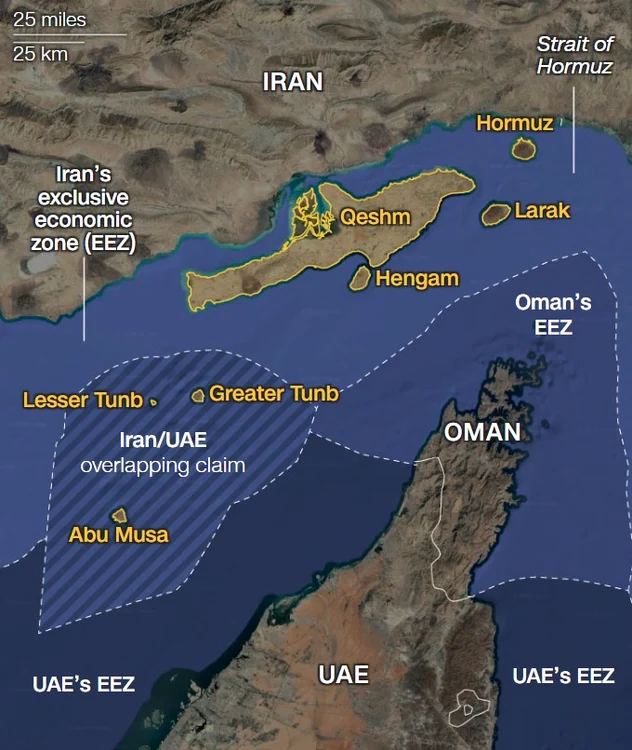
Map of the strategic islands of Hormuz PHOTO Lou Robinson CNN
CNN military analyst Cedric Leighton explained Thursday that Larak, located at the eastern entrance to the strait, poses a problem for military ships trying to enter the gulf.
US options in Iran: “A full ground operation is not possible. You need 150 to 300,000 people in the area”
With attacks launched from Latrak Island, (Iran) “could stop anything coming through the strait. This is a critical military target,” he stressed.
Even if successful, capturing the islands would be only part of the problem. Analysts estimate that between 1,800 and 2,000 troops would be needed to keep them under control, exposing US forces to counterattacks. “If (Iran) has the drones and ballistic missiles available, it will strike any hostile force on those islands,” Schuster warned.
A recent report by the Institute for the Study of War indicates that US or Israeli aircraft have already begun striking Iranian infrastructure on some of these islands – hangars, ports and warehouses – possibly a precursor to an amphibious operation.
However, the strategic calculations outweigh the immediate military gains. Schuster noted that targeting the lower Gulf islands of Abu Musa, Greater Tunb and Lesser Tunb instead of Kharg could reduce long-term economic damage. “There is less risk of harming the economy of a future Iranian government,” he said, pointing to Kharg Island's central role in oil exports.
However, capturing the islands could create diplomatic complications. The United Arab Emirates has long disputed Iran's control of the Abu Musa and Tunb islands, which Tehran seized in 1971. A US intervention could create what Schuster called a “political dilemma” for Washington.
Returning the islands to Iran could strain relations with the UAE, while their transfer to the UAE could undermine the legitimacy of a future Iranian government.
“That's why modern military planning is so complex,” Schuster said. “Each option has a negative impact. There are no perfect plans or solutions. There is only a balance between costs, risks and impacts, both intended and unintended.”
Axios: The US is considering military options for a decisive strike on Iran
These include ground operations and bombing of islands in the vicinity of the Strait of Hormuz, several officials and sources familiar with the situation told Axios.
Iranians say Trump lied about Strait of Hormuz open, three ships turned away
For example, capturing Larak Island could limit Iran's ability to harass ships in the strait and lay mines, but the island is heavily fortified and would be a difficult target.
Abu Musa and Tunb Islands lie near the western entrance to the Strait of Hormuz, between Iran and the United Arab Emirates, and serve as Iranian outposts, equipped with missiles, drones and mining capabilities.
The Pentagon suggested capturing Abu Musa Island, sources told Axios.
In fact, the speaker of the parliament, Mohammad Bagher Ghalibaf, wrote on Wednesday on X that the Iranian intelligence services estimate that “the enemies of Iran, with the support of a country in the region, are preparing an operation to occupy one of Iran's islands.” Ghalibaf was probably alluding to the United Arab Emirates and the country's claims to Abu Musa Island.
“If they take any action, all of that country's vital infrastructure in the region will be the target of unrelenting, unrestricted attacks,” he threatened.
Qeshm Island, the largest island in the Persian Gulf, is located off the southern coast of Iran and houses anti-ship missiles, mines, drones and other attack equipment in underground tunnels
Iran accused the US of attacking a desalination plant on the island in the early days of the war, cutting off water supplies to local villages. Washington has denied the allegation. With an area of about 558 square miles, Qeshm would be a huge target, however, and there were no signs that the US was planning an operation to take over the island.