“American assault ships will clear everything.” Expert: Trump's ultimatum, a strategic window before the assault on Iran

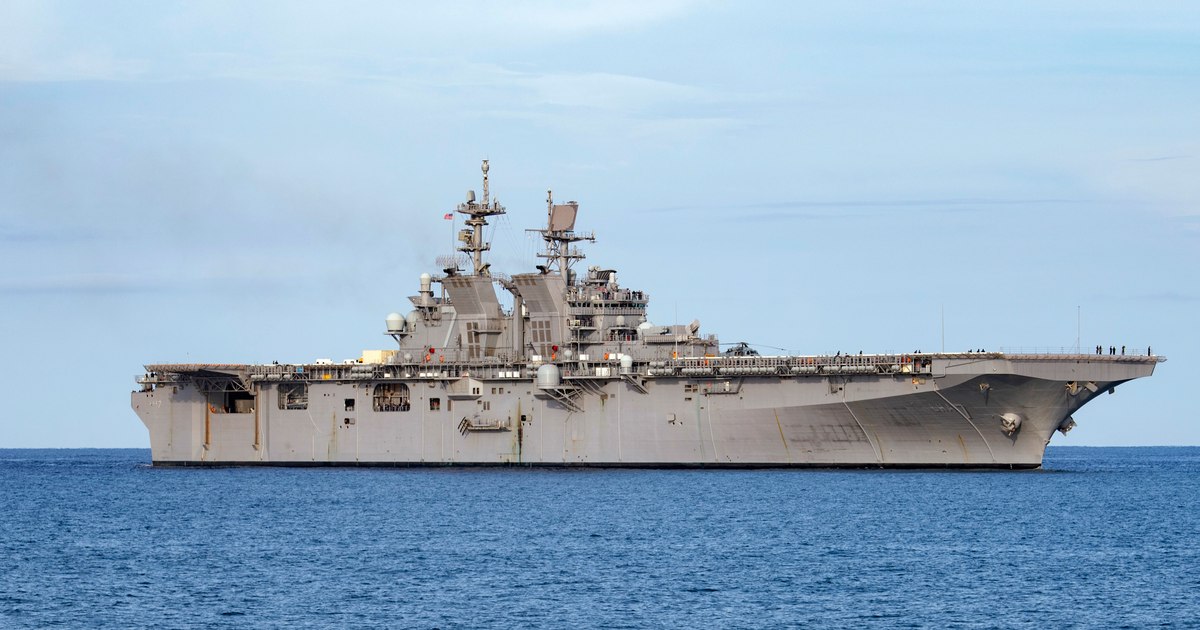
Playing with the ultimatums – 48 hours and then 5 days – given to the regime in Tehran by President Trump hides a destructive strategy, says security expert Hari Bucur-Marcu. A US amphibious destroyer group is heading to the Strait of Hormuz to “clean up” the area.
The assault ship USS Tripoli is heading for the Strait of Hormuz. PHOTO: Profimedia
US President Donald Trump sent Iran, on Friday, a 48-hour ultimatum, conditioning the avoidance of attacks on Iranian energy infrastructure on the resumption of traffic in the Strait of Hormuz.
“If Iran does not fully reopen the Strait of Hormuz without threat within 48 hours, the United States will strike and destroy its power plants, starting with the largest”Trump said on a social network.
In a statement issued on Sunday, Iran's Khatam al-Anbiya joint command said that if these US threats are implemented, the Strait of Hormuz “will be completely closed and will not reopen until we have rebuilt the destroyed power plants.”
Companies with American shareholders in the region will also be targeted, as well as energy installations in the countries that host American bases, the same press release states.
On Monday, March 23, hours before the ultimatum expired, Trump said that the United States and Iran had held “very constructive and productive” talks over the past two days regarding a possible resolution of conflicts in the Middle East.
Following these negotiations, the leader in Washington announced the postponement, for a period of five days, of any military attacks targeting Iranian power plants and energy infrastructure.
“I am pleased to inform you that the United States of America and Iran have, over the past two days, engaged in very constructive and productive discussions regarding a full and final resolution of our conflicts in the Middle East. Given the tone and character of these in-depth, detailed, and constructive discussions, which will continue throughout the week, I have instructed the War Department to postpone all military strikes against Iranian power plants and energy infrastructure for a period of five days, subject to the success of the ongoing meetings and discussions, thank you for your attention to this matter!”Donald Trump sent on his platform.
Iran's Fars news agency said on Monday, March 23, that there are no direct or indirect communications with the US, after President Donald Trump said he had “very constructive and productive” talks with Iran over the past two days.
Fars claims that Trump gave up on attacking Iranian power plants after Iran warned that it would attack power plants in West Asia in response.
Later, two other Iranian news agencies published their own reports on the subject.
Tasnim, an agency considered close to the Iranian Revolutionary Guards, confirms that there are no ongoing negotiations with the US and that the Strait of Hormuz will not return to pre-war conditions. The agency also claims, citing an Iranian official, that Trump has backed away from attacking critical infrastructure under market pressure, while Iran will continue to defend itself.
Instead, the Mehr agency says there are de-escalation initiatives, but accuses Washington of aiming to lower energy prices and buy time for military plans.
Analysis of the situation in the Gulf after Trump's new 5-day ultimatum: A controlled de-escalation perspective
The arrival of American forces and the changing equation of war
In a tense geopolitical context, US President Donald Trump's decision to replace the initial 48-hour ultimatum with a five-day deadline for Iran has generated a wave of speculation regarding the evolution of the situation in the Strait of Hormuz and in the region.
Security analyst Hari Bucur-Marcu, in an interview for “Adevărul”, provided a detailed perspective on the expected events, stressing that this deadline extension does not cancel the pressure, but strategically reconfigures it.
According to Bucur Marcu, the five-day waiting period is closely related to the imminent arrival of significant American naval forces in the Gulf. “For now we are in a waiting phase. In about a week, all those forces will arrive which are terrible, I'm talking about American assault ships. With a lot of marines on them and dozens of planes and helicopters and so on.” The importance of these ships is crucial: “And if these ships come, they will clean everything there. And on the islands, and on the shore and so on.”
It is the Amphibious Training Group Tripoli which includes the assault ship USS Tripoli, the amphibious transport ships USS New Orleans and USS San Diego and the Marine Expeditionary Unit 31 on board. The 31st Expeditionary Unit includes a ground combat element, which includes a battalion landing team – an infantry battalion and combat support elements – consisting of approximately 1,100 Marines and sailors – the US military press reported.
China calls for an end to the conflict in the Strait of Hormuz: “If hostilities continue, the entire region will be plunged into chaos”
Also included in this group is the air combat element, which includes tilt-rotor and fixed-wing aircraft, transport and attack helicopters, ground support resources, and air defense teams.
A combat logistics battalion with equipment and personnel capable of sustaining a multi-role unit in austere environments for up to 15 days will also join the effort. This group includes medical, supply, and explosive ordnance personnel, among others.
The analyst believes that the expectation of the Trump administration is that Iran will give in before the arrival of these forces, whose presence changes the war equation in Iran, each of these ships being “more powerful than everything Romania has.”
Bucur-Marcu claims that waiving the 48-hour ultimatum originally given by Trump has no relevance in the theater of war, but was rather a way to give “a bit of prestige” to the Iranian side.
All sides can claim victory
A fundamental aspect emphasized by Hari Bucur-Marcu is that the American-Israeli military action is not aimed at regime change in Tehran. “From the beginning, the purpose of the operation was not regime change”. Both Trump and Netanyahu, in their official statements, “I'm talking about giving the Iranian people a chance to decide their own path.”
The United States' goals are clear and have been “already 90 percent met.” These are: “Iran, never again be able to get nuclear weapons” and stop sponsoring terrorist organizations.
The analyst insisted that, “if after the negotiations and with the consent of the Iranians it will be reached 100%, America has no reason to continue the war.” This is what the victory of the American-Israeli operation would look like.
In this context, the current regime can also claim a victory: the ayatollahs' regime remains in office, the expert says. Thus, he says, a natural de-escalation will be reached by reaching the objectives.
The Role of NATO and Allies: Freedom of Navigation and Demining
Even if the alliance between the US and Israel is considered “sufficient” to achieve American goals, NATO and 22 other states (including Romania) have a distinct and important role. “The Europeans can come, as Trump said, to achieve their goals, such as freedom of navigation in the Strait of Hormuz,” explained Bucur-Marcu.
According to him, NATO's involvement has already been confirmed by the Secretary General, who announced the start of a process of “anticipatory planning. Prospective.” In this context, NATO excels at “planning multinational operations” and will provide “the elements that no coalition of the will can afford.” The main role of NATO and allies will be “to make sure things are going well there” especially in demining, interdiction and remining operations and securing the Strait of Hormuz.
A first phase of the operation is to ensure the security of the military who will carry out the demining, and this will be the main role of the American landing ships heading towards the Strait of Hormuz.
Unexpected decision in Washington: Trump extends the ultimatum given to Tehran by five days. Attacks on Iranian infrastructure are suspended
Mines are a real threat: “It's definitely me. But no one can correctly identify them because demining operations are complex, involving underwater robots and drones” and requires robust military protection provided by US assault ships. “The Americans will be able to mine to ensure the free passage of the Strait, that's the whole problem.“
The expert claims that allied troops will probably also participate in demining. Romania could also contribute to this operation, depending on “force establishment conference“where each state will provide its resources. However, Bucur-Marcu is skeptical about Romania's contribution.
Post-conflict de-escalation and normalization
In the short term, the analyst anticipates a “natural de-escalation by achieving the goals of the United States and Israel.” Once the precise objectives of the air military intervention are achieved and recognized by Iran, “end of discussion.”
However, this does not mean an immediate normalization of relations. Iran must comply with international law, including the UN resolution that indicts Iran and demands compliance with US and international demands. It must also stop the violation of human rights.
In addition to the military and political aspects, there are also financial consequences. Iran could be forced to pay reparations to neighboring countries. Qatar alone announced $20 billion in damage. Iran's threats to attack Qatar's desalination facilities are considered a “terrorist threat”.
In conclusion, Trump's five-day grace period to Iran is not a relaxation, but a strategic window to build up forces and allow Iran to accept the terms of de-escalation under the pressure of a determined military presence and extensive international coordination. The main objective remains regional stability, without forced regime change, but with a redefinition of Iran's role in accordance with international norms.