Diesel prices will remain high until the end of the year, even if the war in Iran ends, because the state does not intervene, and this is a big economic mistake, because it could prevent market distortions, an energy expert says.
Diesel prices will remain high until the end of the year. Archive photo
“The diesel market in Romania is in exactly such a moment, and the current strategy of the authorities – passively waiting for the market to self-regulate – risks producing emore expensive economic effects than the fiscal benefits obtained in the short term”, explained Dumitru Chisăliță, president of the Intelligent Energy Association.
According to him, currently oil is trading around USD 110-112/barrel and diesel in international markets is around USD 1,150-1,180 per tonne. Assuming an entirely theoretical and highly unlikely scenario where the geopolitical conflict that has disrupted energy markets ends tomorrow, forecasts for 2026 indicated pre-war price forecasts of late 2026 values of around $87/barrel for oil and $850/tonne for diesel.
Based on the estimated trends (Brent crude oil, ARA diesel) starting from the above hypothesis, the super optimistic estimated diesel price at the pumps in Romania, in the theoretical situation, in which starting tomorrow the war would stop and the price of petroleum products would fall to the level of the predicted price for crude oil and diesel to be reached in 2026 before the war in Iran remains high throughout 2026.
“Even if the war would stop and the price of crude oil would decrease, the pump price increase would not stop. The price of diesel would continue to rise for at least 3 more weeks, exceeding the psychological price of 10 lei per liter. The drop in the price of oil would cause a possible gradual reduction of the pump price of diesel, until the end of 2026, but without falling below a level of 9 lei/l”. says the energy expert.
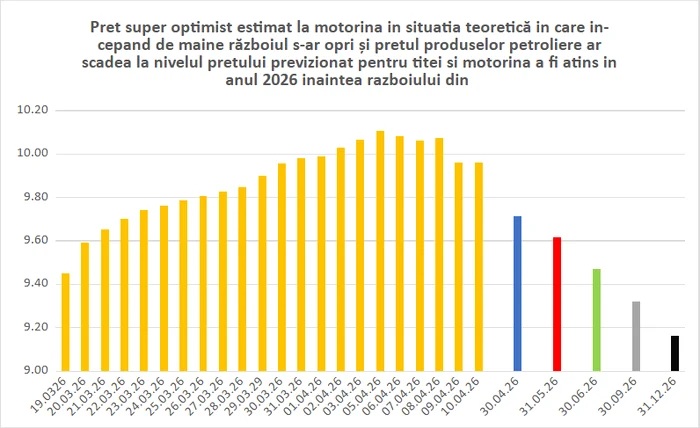
This would theoretically mean that in the next 290 days or so, we would have a drop of around 20% in the price of oil and almost 26% in the price of diesel on international markets. In other words, we would reach lower prices than the current ones but much higher than the ones in 2025, respectively we estimate that the price:
• crude oil would be 42% higher in December 2026 compared to December 2025.
• imported diesel would be 45% higher in December 2026 compared to December 2025.
If the state does not intervene, prices do not fall
The simulations show that in the absence of any intervention by the Romanian state, assuming the stoppage of the increase in the price of crude oil/diesel on the international stock exchanges, the price of diesel at the pump could still reach the psychological threshold of 10 lei/liter in April 2026, and by the end of 2026 it will remain around the value of 9 lei/liter, argues Dumitru Chisăliță, adding that this paradox is not the result of a simple market dysfunction, but of the fiscal and commercial structure of the fuel price.
In Romania, the price of a liter of diesel is roughly made up of four major components. Only 32–38% is the actual cost of oil and refining, while around 30% is excise duty and VAT is another 19% of the final price. The rest is made up of distribution costs, logistics and commercial margins. In practice, this means that more than half of the price of diesel is directly determined by taxation at sight.
Demand is very high in April, especially in agriculture
The month of April is when the demand for diesel in agriculture increases sharply. Sowing, soil preparation and fertilizer application cause an increase in agricultural diesel consumption by 20-40% compared to the annual average, the expert explains. In parallel, the transport sector enters a period of intense activity, and construction accelerates as the weather warms. The result is additional pressure on the diesel market just when farmers need fuel the most.
Where does Romania import diesel and how the Russian oil route was reconfigured
“Herein lies the fundamental problem with the current strategy of the authorities. Agriculture is one of the few economic sectors with very little elasticity to the price of fuel. A farmer cannot postpone agricultural work until diesel becomes cheaper. If the work is not carried out in time, the agricultural season is compromised.”stated Chisăliță.
According to him, in Romania, agriculture uses approximately 1.5–2 billion liters of diesel annually. At a price of 9.5 lei/liter, the cost of fuel for the agricultural sector can exceed 15–18 billion lei annually, a huge amount for an industry with relatively low profit margins and high risk due to weather conditions. Under these conditions, there are two likely scenarios for Romania: the reduction of cultivated areas or the reduction of agricultural works. Both inevitably lead to a decline in agricultural production.
Diesel makes all products and services more expensive
The impact does not stop at farmers, however. Diesel fuel is the dominant fuel for transport, logistics and industrial machinery. In road transport, fuel accounts for 30–40% of the total operating cost. In agriculture, the share of diesel in production costs can reach 15–25%, and in construction 10–20%.
Therefore, the sharp increase in the price of diesel has a multiplier effect on the entire economy. Logistics costs are rising, food prices are rising, and construction projects are becoming more expensive. In an economy already vulnerable to inflation, this mechanism can add increases of between 5% and 10% to the final prices of some goods and services.
The state is the biggest beneficiary of the price increases
Paradoxically, says Chisăliță, the state is one of the few direct beneficiaries of this situation. As the price of diesel increases, so does the VAT revenue automatically. For example, at a price of 8 lei/liter, the VAT collected by the state is approximately 1.38 lei/liter. If the average price in 2026 is about 9.5 lei/liter, the VAT increases to about 1.64 lei/liter. The difference of almost 0.3 lei for each liter means substantial additional tax revenues.
Energy expert Dumitru Chisăliță: Diesel will be more and more expensive, but capping it would be a big mistake
Considering the annual consumption of about 8–9 billion liters of diesel in Romania, this difference can bring about 500 million euros more to the budget in 2026. From an accounting point of view, this seems like good news for public finances.
From an economic point of view, however, it is an illusion. The short-term fiscal benefit is outweighed by the medium-term economic losses. If agricultural production falls due to high fuel costs, losses can exceed €1–1.5 billion. To these are added the indirect costs generated by inflation and the general increase in production costs in the economy, by the impoverishment of the population.
Thus, the state could gain several hundred million euros from taxes, but the economy could lose several times more.
“The problem is not an ideological one, but a pragmatic one. Diesel is not an ordinary consumer product, but a strategic fuel for the economy. In many European states, governments recognized this and intervened temporarily when the market became excessively volatile. Temporary reductions in excise duty, compensation schemes for farmers or temporary capping of margins were frequently used tools.
The strategy of waiting for the market to self-regulate can work for common products. For a fuel that directly impacts agriculture, transportation and inflation, this approach is risky, however.
If this situation persists, the consequences will be visible not only at the pump, but also in the field, in supply chains and ultimately in the prices consumers pay for food and services. And when the real costs of this inaction become apparent, the apparent fiscal gain of a few hundred million euros will, in retrospect, seem like a false economy“explained Dumitru Chisăliță.