The story of the Fundulea ship, attack by Iranians with napalm in the Strait of Hormuz. “They fired two rockets on each level of the ship. The cabin was gone. There was a big hole”

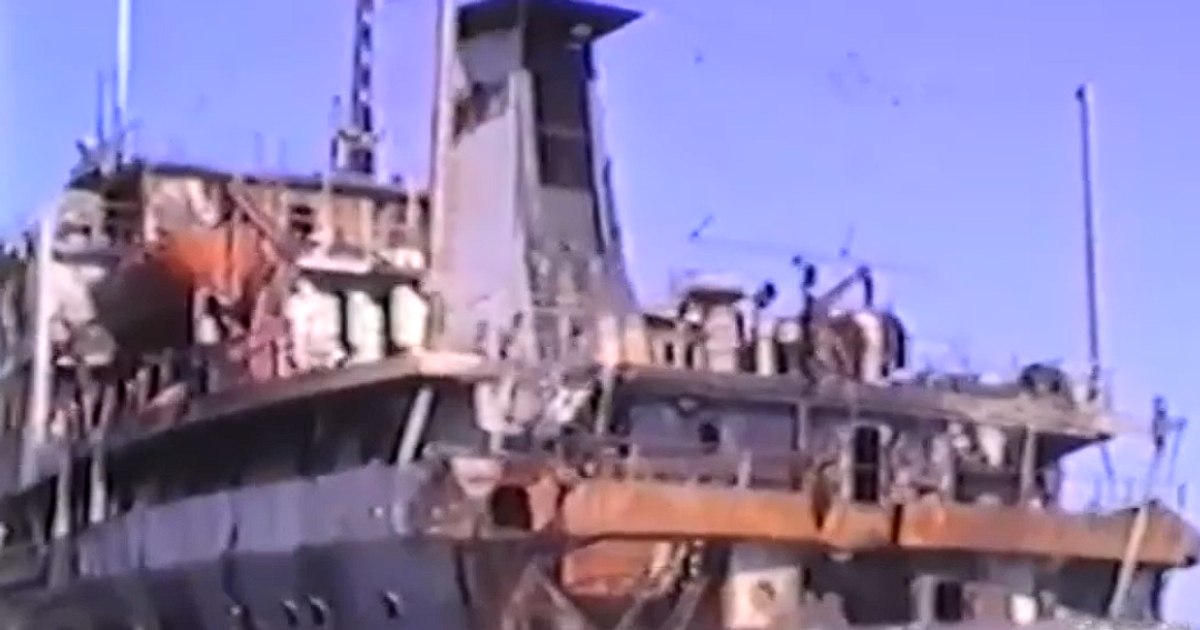
Almost four decades after the attack that turned the Romanian freighter “Fundulea” into a floating torch in the Strait of Hormuz, history seems to be knocking at the door again. The maritime area that then swallowed lives, secrets and an episode that the Ceaușescu regime buried in silence, is today again at the center of international tensions.
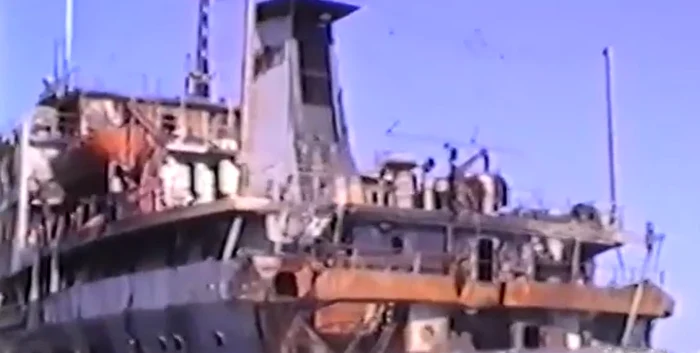
The Fundulea ship was attacked by Iran in 1987. PHOTO Video capture Constanța Info
The tragedy of November 23, 1987, when the Iranians hit the Romanian ship with napalm missiles, takes on a new charge in light of the current confrontations and the growing risk that the Strait of Hormuz will once again become a hotbed of global conflict.
“Adevărul” reported extensively, in 2017, 10 years after the tragedy, about the terrible incident in which Radu Lupu, the commander of the Romanian ship “Fundulea”, died, an incident kept quiet by the communist regime, later interpreted as a warning addressed to Nicolae Ceaușescu, in the context in which Romania would have indirectly supported Iraq during the war with Iran.
An ordinary trip turned into tragedy
The cargo “Fundulea”, of 7,800 tdw, built in Galati, had left Romania on October 3, 1987, with 30 crew members on board and being commanded by Radu Lupu. The ship was carrying marble to Kuwait and was preparing to enter the Strait of Hormuz.
“We were in the midst of a war between Iran and Iraq. Before entering the gulf, we were prepared to deal with situations such as fire or bombing”the story of Dumitrache Delicote, who was chief mechanic.
Upon entering the strait, the crew was questioned by the Iranians, then continued on their way. Around 10:00 AM, the ship was intercepted by an Iranian military unit.
“They asked us to stop the engine and started asking a lot of questions about the goods we were carrying. They kept citing the fact that they don't understand English and the conversation lasted about 45 minutes,” recalled Delicote, quoted in 2017 by Adevărul.
Seven missiles hit the superstructure
The crew retreated to the cabins so as not to disturb the command. The attack came suddenly.
“It wasn't long before we heard the first bang. I realized that while some of them were talking to us, the Iranian military was adjusting their missile launch systems. And they fired two missiles on each level of the ship. Seven hit the ship, on the castle level, where the crew had their cabins“, said Delicote
The fire started instantly. Delicote tried to reach his cabin to get a fire extinguisher.
“The cabin was gone. There was a big hole. A missile had gone through there”he said.
The crew regrouped in front of the superstructure and began searching for the injured.
“Three of us were seriously wounded: the commander, who had several shrapnel in his abdomen, the 2nd officer and the cook”Delicote said.
Help was late
Helicopters flew over the area, but not to intervene.
“Initially I thought they were helpers, but later I found out that they had come to reconnoitre, to photograph and film the tragedy”the sailor told, quoted by Adevărul.
An Omani ship tried to help but had to withdraw due to the risk of an explosion:
“He treated a few wounded, including me, and left.”
Finally, a helicopter picked up the injured and a specialized tug intervened to put out the fire. The Romanian crew and the tugboat crew fought the flames for 16 hours.
The hypothesis of a political warning: “To warn Nicolae Ceauşescu”
After the attack, the sailors tried to understand the reason.
“We were the first Romanian ship to pass through the area, and the Iranians wanted to take revenge on us and warn Nicolae Ceaușescu, who was in Egypt in those days, a country that had received a large loan from us, but which he used to arm Iraq“, Delicote said, adding:
The tragedy on the Fundulea ship: attacked by the Iranians with napalm because our country was indirectly arming Iraq
“Only we, the Romanians, were kept in the dark. The rest of the world knew these things.”
Wounds, losses and enforced silence
Delicote himself was wounded.
“From head to toe, under my skin, little shrapnel had gone in. They slowly came out of my skin over many years. My wife would pull them out one at a time“, he said.
Commander Radu Lupu died in hospital from his injuries. The cook, with burns on 40% of his body, survived.
The ship was towed to Dubai, then brought to the country after eight months for repairs.
The communist regime kept the incident secret.
“We were also told that we are not allowed to say a word about what happened, so as not to damage the relationship between the countries, between Romania and Iran. People did not matter for the communist regime“, said the sailor.
On December 10, 1987, Delicote arrived home.
Testimonies overtime: “Without any warning, they started shooting at the ship”
In an interview distributed on the YouTube channel of the Constanța INFO publication, other survivors of the terrible tragedy recalled the terrible incident:
“We entered the Strait of Hormuz, we were greeted by an Iranian ship that had a battery of 12 missiles on board. It told us to declare the cargo and the destination. They pretended not to understand, I repeated to them at least 10 times the destination: Kuwait. They left, only to return after about 10-15 minutes and, without any notice, started firing at ship”.
Why the Strait of Hormuz crisis does not automatically mean a global economic crisis. Director of IREF Paris: “We have faced such situations before”
“I didn't see the rockets, I felt them. I was sitting in the bed, to choose in the ship that it unbalanced the bed, I fell on my head, I hit my head on… Then I got out. So this part of providence was, because I had to get up to go to the sink to wash and go down to the car. That was the time. If I got up like they got me up, I was the headless sailor”, recalls Gheorghe Foriș, former 2nd deck officer of the Fundulea Ship, according to the recording.
“A bright light in the window… Simply out of fear, out of instinct, I retreated back. I tried to go out into the corridor. It was already impossible to breathe, there was a suffocating, sulphurous smoke. And I went out into the hall groping again, eyes closed of course, because I knew how many meters I had until the exit. I walked with my eyes closed and groped the wall to the exit”, says Dacian Bota, ex-mechanic II officer of the Fundulea Ship.
“A shrapnel went through the partition between the station and command, stopped in my station clock, which he dropped right on the desk in front of me. If it had penetrated, it was also sharp, it would have hit me directly in the head”Dacian Bota also reported, in an archive recording.