
One ingredient, one biological pathway — that's what makes the topical gel that millions of people use every day. Science has long identified that joint discomfort has four distinct mechanisms. Now there is a topical product that covers them all.

When the morning becomes the hardest part of the day
You don't need a diagnosis to recognize the feeling. A few seconds after you wake up, your body sends you a clear signal: something is wrong. The knees are hard to move, the shoulder refuses to lift completely, the lower back seems stuck. It's only after a few minutes of exercise — or an anti-inflammatory — that things start to loosen up.
This morning stiffness is not uncommon. European studies show that musculoskeletal disorders affect over 30% of adults in the European Union. Half of them report persistent lower back pain, and nearly half of employees report back discomfort during work hours. In Romania, lumbar pain is the second cause of discomfort after headache.
Typical reaction: the medicine drawer opens and the gel appears. Fast, accessible, familiar. But how many users know exactly how that gel works—and especially what it can't do?
Diclofenac gel: effective, but with an important limitation
Topical preparations based on diclofenac — Voltaren gel, Diclac gel or generic equivalents — are among the most studied products in this category. Their mechanism: inhibition of the COX-2 enzyme, which blocks the production of prostaglandins, molecules centrally involved in the inflammatory process.
Compared to the oral form, the advantage of topicals is significant and well documented. Systemic exposure is 5 to 17 times lower than tablets, which limits digestive and cardiovascular risks. Active directly at the site of application, topical diclofenac remains predominantly local.
The problem is not efficiency per se, but the narrowness of the mechanism. COX-2 inhibition reduces prostaglandins—but leaves unaddressed three other major processes that contribute to joint discomfort: activation of TRPV1 pain receptors, impaired microcirculation, and tissue oxidative stress.
Expert studies explicitly recognize this limitation: topical NSAID gels are indicated for a subset of patients with acute localized pain, but are not the optimal solution for diffuse inflammation or multiple joints affected simultaneously. — Advances in NSAID Development, Drugs, Springer, 2015
Practical conclusion: topical diclofenac is an effective tool, but with a narrow spectrum of action. For chronic, diffuse or complex discomfort — the limits become visible.
Four mechanisms, not one: why the difference matters
Modern understanding of joint discomfort—from osteoarthritis, rheumatoid arthritis, or spondylitis—identifies four distinct biological processes occurring simultaneously:
•
Active local inflammation — the cytokines TNF-α, IL-1β and IL-6 attack joint tissues and the synovial membrane
•
Nociceptive hypersensitivity — TRPV1 receptors on C nerve fibers amplify and maintain the discomfort signal
•
Compromised microcirculation — inflammatory metabolites stagnate in the affected area, depriving tissues of oxygen and nutrients
•
Oxidative degradation — free radicals progressively damage cartilage and joint support structures
A product that attacks a single pathway partially addresses the problem. The ideal approach — which researchers call multimodal — involves covering all mechanisms simultaneously, with ingredients that potentiate each other.
A meta-analysis published in 2024 in Phytotherapy Research (PubMed) concludes that combining topical capsaicin with anti-inflammatory phytochemicals such as curcumin could open a significantly wider window of efficacy than using either ingredient alone. — Tshering et al., 2024, PMID 38761115
This window is just what Algoved built.
Algoved: the architecture of the 4 mechanisms
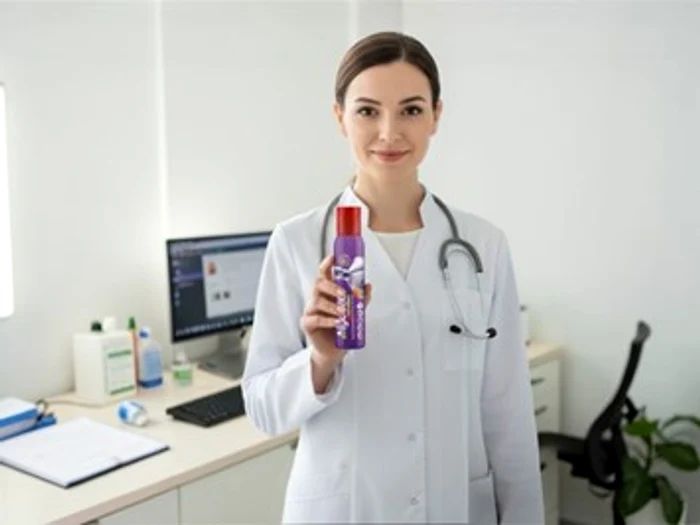
Algoved is a range of Ayurvedic topical products — Rapid Spray 100ml and Rapid Gel 30ml — designed to relieve muscle and joint discomfort through local action with reduced systemic exposure. It is not a medicine and is not a substitute for prescribed medical treatment. It is a natural adjuvant, intended to support the daily comfort of people with musculoskeletal conditions.
What separates it from other topical products is the complexity of the formula: not one ingredient, but over 10 Ayurvedic herbs, oleoresins and essential oils that simultaneously address all four mechanisms of joint discomfort.
Pathway 1 — TRPV1: how the pain signal is turned off
Chili (Capsicum annuum) oleoresin provides capsaicin—the molecule that activates and then desensitizes TRPV1 receptors on nociceptive nerve fibers. Effect: progressive reduction of substance P, the central neuropeptide in the transmission of discomfort.
The mechanism is supported by some of the strongest evidence in the natural topical literature. The 2024 meta-analysis (Tshering et al., Phytotherapy Research, PMID 38761115) synthesized 8 randomized double-blind studies on 498 patients with osteoarthritis and confirmed a significant reduction in the intensity of discomfort compared to placebo (SMD = −0.84, p = 0.01). Separately, a randomized trial of 101 patients showed reductions of 57% in rheumatoid arthritis and 33% in osteoarthritis after 4 weeks.
Pathway 2 — COX-1/COX-2: natural inhibition, no synthetic
Gaultheria fragrantissima (Ayurvedic wintergreen) contains methylsalicylate, which is locally converted to salicylate—a natural COX inhibitor with a mechanism similar to aspirin, but without synthetic ingredients. Randomized double-blind studies have confirmed the efficacy of topical methylsalicylate in muscle injuries and joint discomfort (Higashi et al., Clinical Therapeutics, 2010, PMID 20171409).
Compared to diclofenacsodium, Gaultheria salicylate covers the same type of COX inhibition, through a 100% vegetable ingredient, without any synthetic chemical in the formula.
Pathway 3—NF-κB: broad-spectrum botanical anti-inflammation
Curcuma longa, Vitex negundo, Moringa oleifera and Pluchea lanceolata act convergently to reduce pro-inflammatory cytokines (TNF-α, IL-1β, IL-6) by blocking the NF-κB pathway — one of the main routes of chronic joint inflammation.
Curcumin in turmeric is the subject of nearly 20,000 publications indexed in PubMed (Kunnumakkara et al., ACS Pharmacol Transl Sci, 2023), with clinical data in osteoarthritis, rheumatoid arthritis, and spondylitis. Vitex negundo inhibits PGE2, COX-2 and IL-6, with documented utility in rheumatic pain.
Pathway 4 — Microcirculation and antioxidants: tissue recovery
Galangal (Alpinia galanga), Eucalyptus and Ricinus communis stimulate local circulation through a rubefacient and vasodilatory effect, facilitating the elimination of inflammatory metabolites from the affected areas. Sesame oil (Sesamum indicum) provides antioxidant protection through sesaminol, and Anethum sowa (Indian dill) contributes active flavonoids with effects documented in experimental models of inflammation.
What the study showed
Algoved Gel underwent a study of 60 patients divided into three subgroups: osteoarthritis (OA), rheumatoid arthritis (RA) and spondylitis. Protocol: application 2–3 times daily for 12 weeks, with evaluations at weeks 4, 8, and 12. Monitored parameters: joint pain, tenderness, swelling, mobility, and morning stiffness, on a standardized scale of 0–3.
Results at 12 weeks:
• Osteoarthritis: −25% pain, −26% tenderness, −25.5% mobility limitation, −38% morning stiffness
• Rheumatoid arthritis: −35.7% general pain, −33.2% joint pain, −34% affected joints, −35.2% morning stiffness
• Spondylitis: −36.6% painful joints, −32.6% swelling, −31.8% morning stiffness
Improvements of 25–38% sustained over 12 weeks, with robust statistical significance in all three subgroups, position Algoved Gel among the few natural topical products with its own simultaneously validated clinical evidence on osteoarthritis, rheumatoid arthritis and spondylitis.
Head-to-head comparison: diclofenac gel versus Algoved
Both are topical products with clinical data. The essential difference: the complexity of the mechanism and the origin of the ingredients.
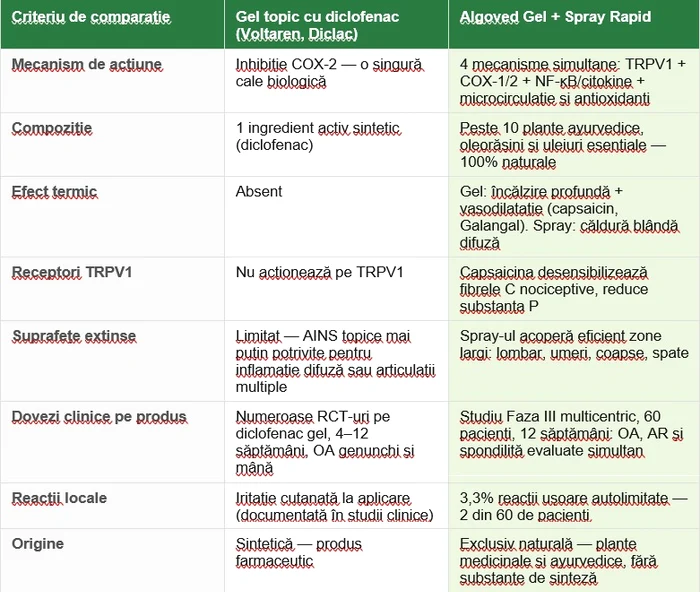
Note: Comparative data is based on public composition information and related peer-reviewed literature. The choice of the product is made according to individual needs; diagnosed conditions require a doctor's opinion.
How to use: Spray, Gel or both?
The Algoved range is designed so that the two products work complementarily, not interchangeably. Each covers a distinct discomfort profile.
Algoved Rapid Spray — discomfort on large surfaces
Recommended when the painful area is wide: back, lumbar area, thighs, shoulders or nape of the neck. Its formula is predominantly anti-inflammatory (Vitex, Turmeric, Moringa, Sida, Galangal), with a mild thermal sensation and no mandatory irritating effect. Ideal in situations where the area is sensitive to direct touch.
Algoved Gel Rapid — localized discomfort, point of maximum tension
Recommended for contractures, muscle knots, specific stiff joints — knee, elbow, ankle, shoulder. The gel brings intense thermal effect through capsaicin (TRPV1 action) and pronounced vasodilatation through Galangal and Gaultheria.
COMBO protocol — for persistent or mixed discomfort
• Step 1: Apply Spray to entire affected area — leave on for 1–2 minutes
• Step 2: apply Point Gel to the area of maximum tension — gentle circular massage until absorbed
• Frequency: repeat 2–3 times a day
User profile: not just diagnostic patients
Algoved addresses a wide spectrum of people, not exclusively those with arthritis or confirmed osteoarthritis:
• Adults with morning joint or muscle stiffness in the knees, shoulders, back or neck
• People with recurrent lumbar or cervical discomfort, including due to sedentary lifestyle or improper posture
• Athletes or active people with muscle fever, overuse or post-exercise contracts
• People looking for a natural topical alternative to the synthetic products available
• Patients for whom the doctor recommends reducing the frequency of use of synthetic topical NSAIDs
Algoved can be used simultaneously with the prescribed medicinal treatment, as a topical adjuvant, with the consent of the attending physician. It is not a substitute for therapy for diagnosed conditions.
Instead of a conclusion: a morning that deserves to start differently
Ayurvedic medicine has used herbal combinations to manage joint discomfort for millennia. Modern research has come to confirm and explain the mechanisms—and now we have clinical trials, safety data, and validated protocols.
Algoved does not make promises without coverage. It offers a formula with 10+ natural active ingredients, four documented biological mechanisms and a Phase III clinical trial with measurable results in three of the most common joint conditions.
For anyone who applies a topical gel daily and feels that the effect has plateaued—or for those who want to understand what the product they're using really does—the Algoved range is an alternative based on data, not marketing.
The morning doesn't have to start with an invisible vise. There are better tools now.