The legacy of Nicușor Dan: the Capital City Hall replaced almost 250 km of the main heating main in the last 5 years

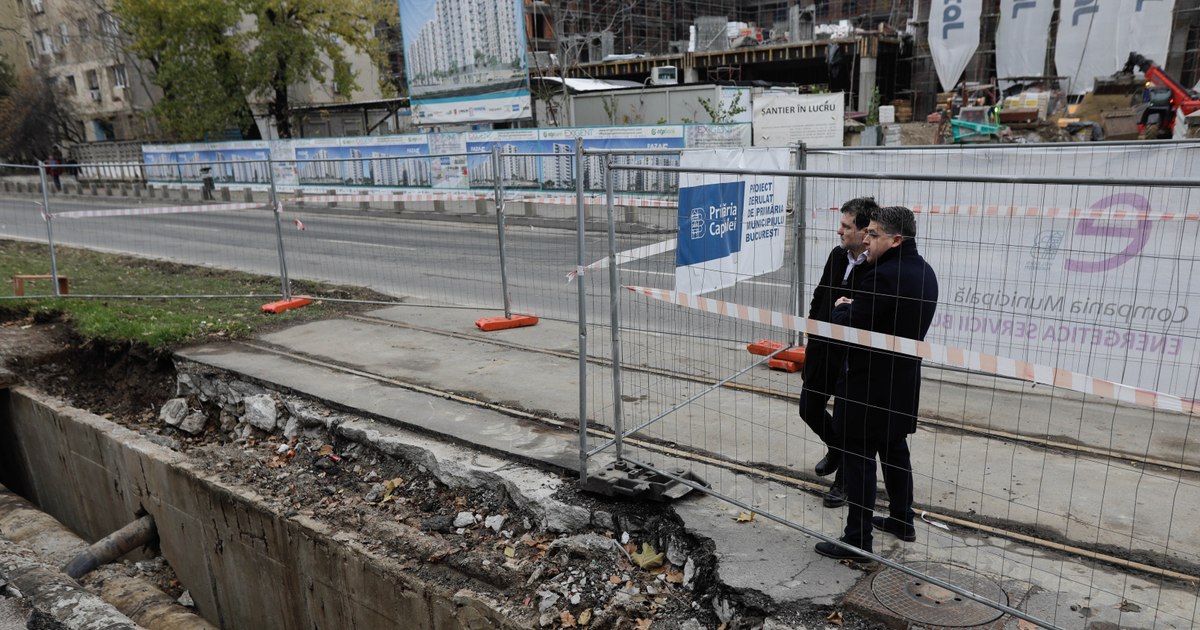
In the period from 2021 to 2025, overlapping for the most part with the term of general mayor of Nicușor Dan, the Capital City Hall managed to replace 247 km of primary heating pipe, more than three times more than during the mandate of Gabriela Firea, according to the data sent by the Capital City Hall at the request of “The Truth”.
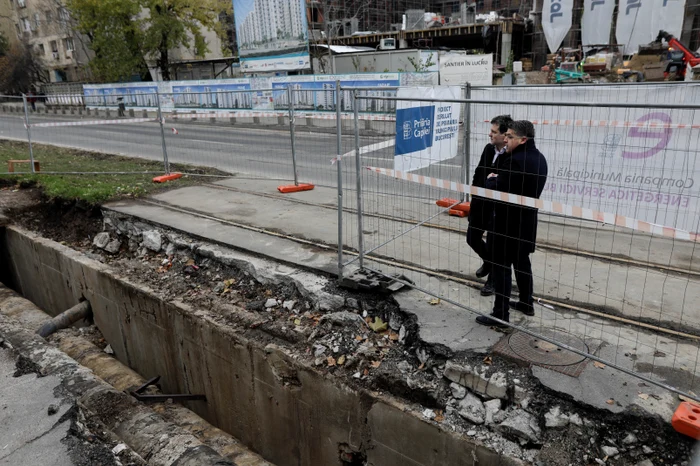
PHOTO: Inquam Photos
In short, the heating system in Bucharest faces major problems on two levels: the production and transport of the heating agent. The production is mainly provided by four electrothermal power plants (CETs), powered by natural gas and managed by the company ELCEN, subordinate to the Ministry of Energy. The oldest of these is CET Sud, commissioned in 1970, while CET Progresu, inaugurated in 1987, is the most recent. Of the four, only CET West benefited from significant modernization works.
The transport infrastructure totals approximately 954 kilometers of pipelines in the primary network and 2,963 kilometers in the secondary network — the latter consisting of smaller pipelines that connect thermal points and real estate. In general, failures occur less often at the secondary network level and have limited impact on the population.
Instead, the main transport network, neglected in the last decades in favor of investments with aesthetic priority, has deteriorated sharply. This deterioration led to an increase in the frequency of breakdowns and, implicitly, to growing dissatisfaction among residents, some of whom opted to disconnect from the central heating system.
The total kilometers of primary pipe rehabilitated annually, aggregating the works contracted by the Investments Department of the Bucharest City Hall and the operative interventions of the Bucharest Municipal Termoenergetica Company (CMTEB), shows a sustained increase: 27.2 km in 2020, 27.1 km in 2021, 28.3 km in 2022, 52.15 km in 2023, 73.53 km in 2024 and 66.23 km in 2025. The steepest jump occurred between 2022 and 2023, with the launch of works at the end of 2022, and remained at a similar level in 2024 and 2025. Nicușor Dan handed over the mandate of mayor general to take over that of president on May 26 2026, but PMB continued its heat pipe replacement program under previous contracts.
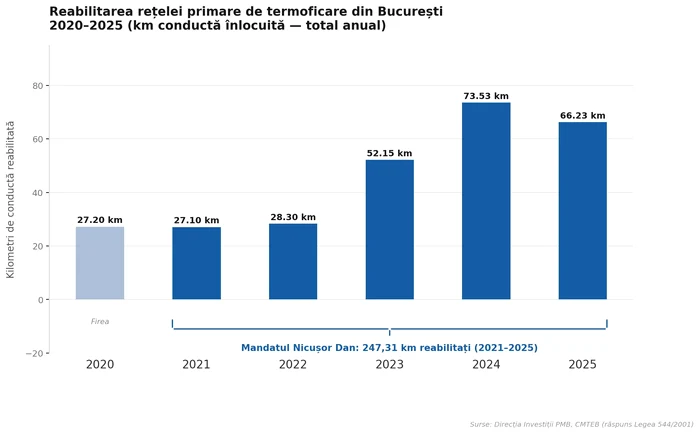
For comparison, according to the data previously communicated by the municipality at the request of Mainnews.ro, in the period 2016-2020, which overlaps with Gabriela Firea's term as mayor, pipeline segments totaling only 70.2 km were replaced in Bucharest. The main reason for this result is related to the fact that, although there was European funding for the replacement of 212 km of main pipeline, the Firea administration was unable to access it. The reason? Radet, the municipal company that managed the network, went bankrupt because the municipality did not pay the subsidy.
Where the pipes have changed in 2025
Last year's largest construction sites were concentrated in the south and center-west of the city. Second South Highway – Lot 1 was the main work front: on Objective 2 (Sector 3, along Camil Ressu, Liviu Rebreanu and Nicolae Grigorescu boulevards, but also on Laborator Street, Aleea Țcolarilor or Drumul Murglui) 8.7 km of pipeline were replaced, and on Objective 6 (Sector 2, Lacul Tei area, with works on Teiul Doamnei, Ghica Tei and Lacul boulevards) Tei, but also on dozens of secondary streets in the neighborhood) – another 8.2 km.
Minister of Energy, solution for heating Bucharest: 24 modular containers will be placed in problem areas
Grozăvești II–III highway – Lot 2 covered the northwest area: Objective 7 (Regie Student Complex, Orhideelor Road, Independence Splai, Calea Plevnei, Știrbei Vodă Street) – 4.48 km pipe, Objective 8 (Cluj Street, Turda, Abrud – Floreasca-Dorobanti area) – 1.2 km, and Objective 11 (connecting braces on Calea Griviței and Calea Giulești) – 1.4 km.
Highway V Grozăvești – Lot 3 brought works to the south-west area and Cotroceni: Botanical Garden, Cotroceni Road, Salt Road, Taberei Road, Calea 13 Septembrie. The Progresu–Berceni highway – Lot 4 targeted Sector 4, on Giurgiului Road and dozens of streets in the Giurgiului and Berceni neighborhoods.
The plan for 2026: new highways and construction sites in the North Station
The Directorate of Investments has identified as a priority for 2026 the continuation and completion of the majority of lots opened in previous years, but also the start of new objectives. The most sensitive from a logistical point of view is Objective 9 from Lot 2 — Magistrala II–III Grozăvești, which involves works on the Nicolae Titulescu Highway, Alexandru Ioan Cuza Boulevard, in the area of Pieța Gării de Nord, on Dinicu Golescu Boulevard and in the vicinity of the Military Hospital – a 4.25 km route that will generate significant traffic disruptions in Sector 1.
Also in 2026, work will begin on Objectives 17, 18 and 22 of the Progresu-Berceni Highway (Lot 4): approximately 15 km of route in Sector 4, covering Berceni Road, Jilavei Road, Metalurgiei Boulevard and the Tineretului Park area. CMTEB aimed to maintain the 2025 pace – 16–20 km primary network and 50–55 km secondary network.
What is new about the PSD Bucharest project regarding hot water and heating bills. The main provision already exists in the contracts
State of the network: 65% of pipelines are over 25 years old
Beyond the accelerating pace of pipeline replacement, the big picture remains worrisome. Compania Municipală Termoenergetica recognizes that approximately 65% of the total length of the pipes of the primary network is over 25 years old, and in the case of the secondary network, the proportion is approximately 50%.
The network was built in stages starting in the 1960s and 1970s and, in the absence of systematic investment for decades, it reached an advanced degree of wear and tear that explains both the high frequency of breakdowns and the massive heat losses.
Data on losses from the primary network show a slight improvement, but also highlight the true scale of the problem. In 2021, the make-up flow (the amount of water needed to compensate for the losses) was 2,038 tons per hour. It dropped to 1,931 t/h in 2022, dropped to 1,802 t/h in 2023, then rose again to 1,998 t/h in 2024, to reach 1,868 t/h in 2025.
Variations from one year to another are not only related to the pace of rehabilitation work, but also to factors such as weather conditions or the number of breakdowns in the cold season. Even so, compared to 2021, the reduction from 2025 is about 8%, a limited progress compared to the scale of the interventions made in this interval. The data suggest that the work to date has not yet decisively targeted the network segments that generate the greatest losses.