How Israel Hunts Iranian Regime Officials in Hideouts Like Tents, Gyms and Public Buildings


From the early days of the war, Israel targeted Iran's leadership and security apparatus; now the effort is systematic and intensive, with officials and commanders being hunted down in their makeshift and unsafe hideouts, the WSJ reports.
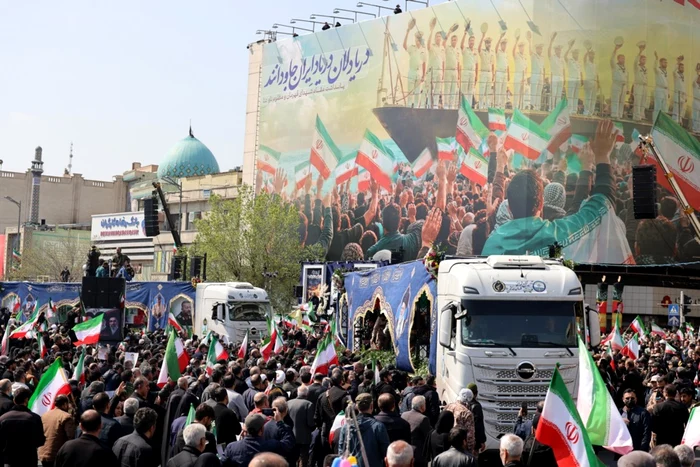
The funerals for the security chief and commander of the Basij militia PHOTO EPA-EFE
Ali Larijani, Iran's top security official, took to the streets in confidence on Friday, joining a pro-regime rally in central Tehran. Dressed in a black coat and sunglasses, Larijani appeared in public for the first time since the outbreak of war, emanating calm even though he was practically a target. “Courageous men. Courageous officials. Courageous leaders. This combination cannot be defeated,” he later wrote on X.
Four days later, Larijani was dead. On Tuesday morning, Israeli intelligence located him in a hideout on the outskirts of Tehran, where he had gathered with other officials, and killed him in a rocket attack.
That same night, the leader of the dreaded Basij militia, Gholamreza Soleimani, was also eliminated. Israeli officials said they received information from Iranian citizens who saw Soleimani and his deputies hiding in a tent in a wooded area of Tehran — an exposed hideout used as needed after Israeli bombing of Basij headquarters and command posts.
Then on Wednesday, Israeli and US officials announced that Iran's intelligence minister, Esmail Khatib, had also been killed – marking a back-to-back series of successful strikes.
This beheading campaign comes as Israel in particular has emphasized that the war is meant to create the conditions for the Iranians to eventually overthrow the regime. Thus, the calculation is that the damage caused by the bombings, in parallel with the collection of information on high-ranking targets, will gradually destabilize the regime.
Thus, with thousands of members of the regime – from top leaders to operatives deployed on the streets – already killed in the war, signs of disorder are multiplying. Security forces are under pressure, seeking cover while simultaneously seeking to intimidate protesters and launch attacks against the United States, Israel and Gulf Arab countries.
Documents seen by The Wall Street Journal show the scale of the effort being mobilized against them: detailed target lists, damage reports and intelligence gathering that reveal how Israel systematically hunted Iran's internal security apparatus.
The campaign, which began in the early days of the war, first targeted command centers and headquarters. Then, as senior officials were forced to move, they were chased from headquarters to assembly points and even into hideouts under bridges, the documents said. The goal is to disrupt their repressive activity, to show the Iranians that their tormentors are being eliminated.
Israel says it has fired more than 10,000 munitions at thousands of targets, including 2,200 linked to the Islamic Revolutionary Guard Corps, Basij and other security forces. Estimates of casualties are several thousand.
However, experts warn that decades of experience show that it is extremely difficult to topple a government through airstrikes alone, and that if it survives it will re-establish itself in a potentially more radical form. “It will be a clear victory for the regime, with predictable and unpredictable consequences,” said Farzin Nadimi, senior Iran fellow at the Washington Institute.
A campaign with a dual purpose: destroying military capacity and eliminating leadership
The first strikes were strategic, aiming directly at the heart of the regime. Israel removed Supreme Leader Ali Khamenei from his residence and, in coordination with the US, destroyed most of Iran's missile launchers and air defenses.
Funerals in Tehran. Thousands of Iranians take to streets to mourn security chief Ali Larijani, threaten Israel with retaliation
Subsequently, responsibilities were divided: the US attacked Iran's military-industrial infrastructure, and Israel focused on internal control structures. By the second day, Israeli planes and drones had already struck headquarters linked to the domestic security wings of the Revolutionary Guards, Basij militias and special police units.
Targets ranged from Tharallah – the Revolutionary Guard unit responsible for protecting the capital – to neighborhood police stations. When intelligence discovered back-up plans to assemble forces at sports complexes, Israel struck these locations.
One of the bloodiest attacks took place at Tehran's Azadi Stadium, where hundreds of members of the security forces were killed. Verified footage showed officers lying on the tarmac outside another stadium and local hospitals were overwhelmed with casualties. A doctor in Tehran said: that security forces were brought to Gandhi Hospital and patients had to make way for the wounded
Iranian state media condemned the strikes as attacks on civilians, an omission that concealed the presence of security forces. An Israeli strike on an Intelligence Ministry command center located in an Iranian Electric Company compound killed several employees and wounded bystanders, according to Iranian reports.
The psychological impact on the security forces was severe. Some members of law enforcement began sleeping in vehicles, mosques or makeshift shelters, according to the Israeli assessment. In other cases, Israeli agents contacted commanders directly, warning them and their families not to intervene or face consequences. A recorded call between a Mossad agent and an Iranian police commander captures the tense atmosphere.
“Can you hear me?” the agent says in Farsi, according to the recording. “We know everything about you. You are on our blacklist and we have all the information about you.”
“Ok,” replied the commander.
“I want to warn you ahead of time that you should stand by your people,” the agent continued. “If you don't do this, you will suffer the same fate as your leader. Do you hear me?”
“Brother, I swear on the Koran, I am not your enemy,” said the commander. “I'm already a dead man. Please come help us.”
The Israeli campaign also targeted police warehouses, computers, vehicles and equipment, as well as biker units that played a central role in suppressing the protests. In Ilam province, on the border with Iraq, at least 34 security forces locations were hit, complicating Tehran's control over Kurdish regions.
Last week, Israeli drones began operating over Tehran, hitting checkpoints and checkpoints of the Basij militia with precision, sometimes guided by information received from citizens. On Thursday alone, at least three checkpoints were hit, including on Imam Reza Road and Shahed Street.
On Sunday evening, Israeli forces carried out a targeted operation on checkpoints, hitting 11 of them, including in Tehran's Enghelab and Azadi markets and along several highways.
The number of civilians killed so far in the conflict in the Middle East has exceeded 2,300
The Iranians confirmed repeated attacks on checkpoints, forcing officers to move under bridges, into schools or residential buildings to avoid being hit. A doctor in Vanak said some members of the security forces “begged us to let them stay overnight in our building. Several were sleeping in a corner near the stairs. He also says he saw some agents setting up tents or taking refuge in buses. Residents reported evacuations as officers moved into apartment buildings, fearing they would be caught in the middle of an attack.
Law enforcement has been affected. Citizens said they were unable to recover their stolen property and businesses had to close early because the police could not guarantee safety.
Many Iranians say it would be pure suicide to revolt now, and fear that Israel and the United States will leave the regime intact and bent on revenge on the population.
Despite these challenges, Iranian security forces still control the streets, maintaining order through threats and the potential for lethal force. However, analysts predict that the combination of targeted strikes, economic pressures and popular discontent will create long-term instability and the regime is in freefall.
“They see a system disintegrating right before their eyes,” concludes Farzin Nadimi, an Iran analyst at the Washington Institute. “But it would take a lot more attacks to turn the tide.”